India-EU FTA redraws trade map, puts autos, chemicals and textiles in fast lane: ICRA
/ 2 min read
Zero-duty access to 99.5% of exports could accelerate India’s manufacturing and export shift towards Europe
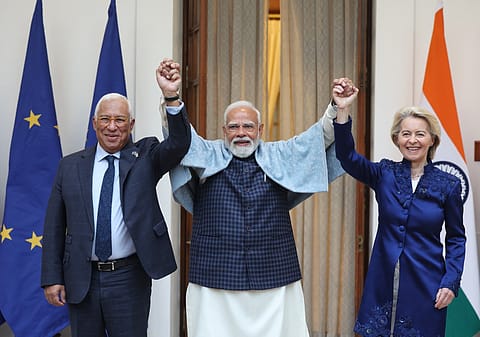
The two sides hailed the conclusion of the India-EU FTA as a historic milestone. | Credits: @narendramodi
India’s Free Trade Agreement (FTA) with the European Union (EU), finalised in January 2026 after nearly 20 years of negotiations, marks one of India’s most consequential trade resets with a developed market. By eliminating tariffs on over 90% of goods traded between the two sides, the pact sharply improves India’s export economics across manufacturing-heavy sectors while keeping key domestic sensitivities ring-fenced.
Under the agreement, India will receive preferential zero-duty access on 97% of EU tariff lines, covering 99.5% of its export value. In return, India will reduce or eliminate duties on 92% of its tariff lines, largely through phased reductions. The structure signals a clear export-first bias for India, particularly in sectors where EU duties earlier ranged between 4% and 26%.
Trade flows already tilt in India’s favour
The agreement lands at a time when India-EU trade dynamics have turned structurally favourable. Merchandise trade between the two sides grew at a 7% CAGR between FY2016 and FY2025, with Indian exports expanding faster than imports. The EU’s share in India’s merchandise exports rose to 17% in FY2025 from 14% a decade ago, resulting in a sustained trade surplus for India since FY2021. Bilateral trade currently stands at about USD 137 billion, with scope to scale further as tariff cuts take effect.
Autos: Premium imports open up, export access improves
In automobiles and components, the FTA is expected to lower duties on select European completely built units under a quota mechanism, easing market access for luxury brands. The impact on India’s mass market remains limited, with small and mid-sized cars largely unaffected and EV tariffs unchanged for the first five years.
More strategically, the deal improves access for Indian auto and component exports into Europe, a market where tariff barriers have historically constrained volumes. Over the medium term, this could strengthen India’s integration into European automotive supply chains.
Chemicals, pharma and textiles emerge as core beneficiaries
Chemicals and pharmaceuticals stand to gain from sharper pricing competitiveness once the FTA is implemented. The EU accounts for nearly a quarter of India’s organic chemical exports and is a major destination for agrochemicals. In pharmaceuticals, tariff elimination is expected to support export growth while reducing input costs domestically through cheaper imports of bulk drugs and medical devices.
Textiles could see one of the clearest structural shifts. Zero-duty access places Indian apparel and home textile exporters on par with competitors such as Bangladesh and Vietnam, correcting a long-standing disadvantage in the EU market.
Constraints remain
Steel exports may face near-term pressure as the EU’s Carbon Border Adjustment Mechanism lies outside the FTA’s scope. However, improved access to European ferrous scrap could partially offset these challenges.
Overall, the India-EU FTA strengthens India’s export competitiveness without exposing sensitive sectors, setting the stage for a deeper manufacturing-led engagement with Europe.
Follow Fortune India
NEXT STORY