India’s $1.4-bn auto component trade gap highlights need to own future technologies: Hyundai Motor India MD & CEO Tarun Garg
/ 3 min read
Garg says exports remain concentrated in mature technologies while imports are increasingly driven by higher-value components such as semiconductors, battery cells and power electronics
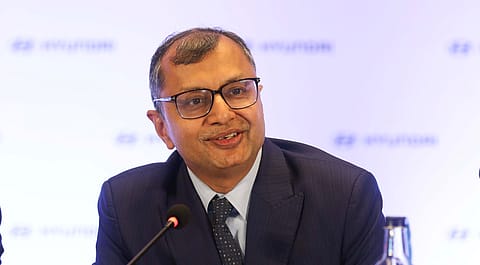
Hyundai Motor India MD & CEO Tarun Garg | Credits: Sanjay Rawat
India’s $1.4 billion auto-component trade deficit highlights the need for the industry to move beyond manufacturing and build domestic capabilities in advanced automotive technologies, Hyundai Motor India MD & CEO Tarun Garg said.
Speaking at the 66th ACMA Annual Session, Garg said India exported around $24 billion worth of auto components in FY2025-26, while imports stood at approximately $25.4 billion. He said the larger concern was not merely the deficit but the nature of India’s trade, with exports still concentrated in relatively mature technologies while imports are increasingly dominated by higher-value technologies that could determine the future of mobility.
“The concern goes beyond the deficit. Our exports remain concentrated in relatively mature technologies, while our imports are led by advanced, higher-value technologies which may well define the future,” Garg said.
He called for faster localisation and the development of domestic capabilities to design, develop and manufacture future technologies, including semiconductor chips, EV battery cells, power electronics and other critical automotive systems.
From manufacturing scale to technology ownership
Garg said India had built considerable manufacturing scale and demonstrated resilience through the Covid-19 pandemic, semiconductor shortages, logistics constraints, wars and geopolitical uncertainty.
India’s passenger vehicle industry has expanded from fewer than 500,000 units in 1996 to more than 4.7 million units, while the country’s GDP has risen from around $393 billion to $4.15 trillion over the same period, he said.
“But resilience is the foundation. Leadership must be our destination,” Garg said.
He noted that vehicles have evolved from predominantly mechanical systems into intelligent, connected and increasingly software-defined mobility solutions. This transformation, he said, requires suppliers to develop capabilities well beyond conventional component manufacturing.
Garg pitches ‘Value Excellence’ as India’s edge
Garg said India should develop a distinctive competitive advantage by combining advanced technology with affordability, quality, safety and scale — a model he termed “Value Excellence”.
“Value Excellence means making advanced technology affordable to the world, while maintaining global standards of quality, performance and safety,” he said.
India’s scale, engineering talent and cost competitiveness provide a strong foundation for this model, while artificial intelligence can help companies optimise product development, manufacturing and costs across the value chain, he added.
{{#most-powerful-women-snapshot-individual.slug}} {{/most-powerful-women-snapshot-individual.slug}} {{^most-powerful-women-snapshot-individual.slug}} {{/most-powerful-women-snapshot-individual.slug}} {{#showRanking}} {{current-rank}} {{/showRanking}} {{#photo.0.url}}
{{name}}
Four priorities for the component industry
Garg outlined four priorities for suppliers — mastering critical technologies, engineering costs from the design stage, continuously compounding learning and building export competitiveness.
He said greater investment in R&D would be critical to developing capabilities in semiconductors, rare-earth magnets, power electronics and battery cells.
Cost competitiveness, meanwhile, needs to be built into product architecture and engineering rather than pursued only during manufacturing, with AI offering opportunities to analyse data, anticipate trends and identify efficiencies.
Garg also called for AI, digitalisation and shared learning to reach Tier-2 and Tier-3 suppliers.
“At the heart of all the above four pillars lies quality, because customer trust is earned through excellence every day,” he said.
‘Make in India’ needs to evolve
Garg said the industry’s next phase should focus increasingly on intellectual property, design and engineering.
“We have built formidable manufacturing capability. However, the greatest intellectual and economic value is created much earlier in the chain, during conceptualisation, project definition, engineering specification and design,” he said.
He called for a progression from “Make in India” to “Design in India, Engineer in India and Create in India”.
Drawing a parallel with UPI, Garg said India had shown that technology, affordability, scale and execution could combine to create globally relevant solutions.
He urged industry leaders to commit to five actions: master one critical technology, localise one imported component, create one Indian patent, enter one global market and integrate AI into every function.
“Let us Design in India. Engineer in India. Create in India. And lead from India,” Garg said.
NEXT STORY