Inside BMW India’s double-barrelled MINI strategy to get to the top
/ 4 min read
With the locally assembled MINI Countryman priced at ₹47 lakh, BMW is taking the fight beyond luxury rivals and into the broader premium SUV market.
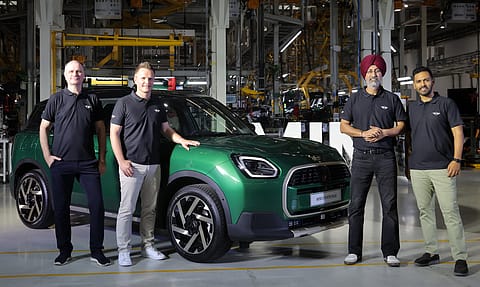
BMW launched the Mini Countryman C on June 16, 2026 | Credits: BMW Group India
It’s a strategy that’s been a few years in the making.
But at the end of it, German automaker BMW is gearing up with a two-pronged attack to win the Indian market, where it had long had to contend with being the runner-up. BMW is now throwing serious money and attention to the MINI brand, the British automobile company that BMW acquired a little over 30 years ago, in its attempt to dethrone Mercedes as India’s largest luxury car maker, and by a mile.
On June 16, BMW launched the Mini Countryman C, an SUV, at a rather attractive price of ₹47 lakh, marking it as the first locally assembled SUV in its lineup. “MINI is a highly aspirational brand for modern, urban Indian luxury carmakers,” Hardeep Singh Brar, the president and CEO of BMW Group India, said at the time of the launch on June 17.
While the price point certainly is aggressive, considering how the luxury car maker’s five-seater SUV will slug it out with the likes of Toyota Fortuner and the Skoda Kodiaq, BMW has also set its sights on a phase where the MINI brand will take on an aggressive expansion plan, to complement the sales of BMW, to jointly give a fight to Mercedes in India’s competitive luxury car market.
Together, BMW and MINI want to sell over 20,000 vehicles a year, up a little over 11 percent from its current sales of around 18,000 units annually. “When you look at the year to date, we have a 42% growth, and we are adding products,” Florian Kuentner, the vice president for MINI for China, Asia Pacific, Eastern Europe, Middle East, and Africa, tells Fortune India. “We're adding two completely new models this year, and I think the MINI family in India has never been bigger than now. So really the goal is that we offer the power of choice in terms of drivetrain, and with the Countryman, we are getting bigger.”
Last year, the automaker's big gamble on electrification helped it close the gap on Mercedes in the country’s automotive pecking order. In early 2025, BMW launched a long-wheelbase version of its entry-level SUV, the X1, namely the iX1. The electric equivalent of the company’s popular SUV was launched at around ₹50 lakh. Now, this vehicle accounts for over 85% of BMW’s electric-vehicle sales in the country. BMW is India’s largest luxury EV maker, with sales of nearly 3,800 units a year. BMW Group India comprises BMW (including Motorrad, the German automaker’s motorcycle division) and the British automobile brand Mini.
For a long time, MINI had been associated with compact cars, often chosen by buyers as a second vehicle in their garages. With the Countryman, though, the luxury carmaker is repositioning itself and is also scaling up local assembly and its dealer network to appeal to younger buyers in a market where the craze for SUVs has been remarkable.
“There was a clear demand from customers and our dealer network to have a car slightly bigger,” adds Kuentner. “We plan to double our sales and are also roughly doubling our dealer network in India. Ultimately, we will then have 21 outlets.” It will also help that MINI can bank on BMW’s service touchpoints, in addition to the new outlets being planned in markets such as Jaipur, Lucknow, Ranchi, Guwahati, Vijayawada and Jodhpur.
Last year, MINI sold 730 units, a fraction of BMW’s total sales of 18,001 units. In all, BMW grew nearly 15%, while Mercedes, the company’s closest rival, saw a 3 percent decline in sales. Despite that, Mercedes outsells BMW by as much as 1,000 units. It’s into this mix that a doubling of MINI's sales could help boost numbers, even though India is still not MINI's fastest-growing market in Asia. “With the launch of the Countryman there's a very good chance that India could emerge as the fastest growing market,” Kuentner says.
Apart from the larger size, the Countryman also boasts localization, which helps keep costs down, and an SUV-like stance and features, with what the company calls “karting”- like capabilities, making it attractive to young, urban buyers in the country. The automaker is also offering its assured buyback program, a key to luxury car sales in India today, with up to 59 percent of the residual value after 4 years and 66 percent after 3 years.
Currently pegged at $1.5 billion, India’s luxury car market is expected to grow to $1.92 billion by 2031, notes market research firm Mordor Intelligence. Rising household wealth is a key factor driving demand for luxury goods. As of 2025, India had nearly 870,000 millionaire households (with a net worth of around ₹8.7 crore), according to the Mercedes-Benz Hurun India Wealth Report 2025 — almost double the number in 2021.
{{#most-powerful-women-snapshot-individual.slug}} {{/most-powerful-women-snapshot-individual.slug}} {{^most-powerful-women-snapshot-individual.slug}} {{/most-powerful-women-snapshot-individual.slug}} {{#showRanking}} {{current-rank}} {{/showRanking}} {{#photo.0.url}}
{{name}}
However, only about 50,000 luxury vehicles are sold in the country, of the total 4.5 million cars sold annually. “You can’t have people at the top growing,” Brar had told Fortune India earlier. “Once they (the buyers) enter, they slowly and gradually upgrade to the bigger cars. And for that, you need your entry-level to be very strong, so people know what luxury is about. The expansion will always happen at the bottom.
That's a marked difference from Mercedes, which has turned its attention away from the entry-level luxury segment toward the core and premium luxury segments. With BMW India on the offensive with a two-pronged attack, it might just be time for Mercedes to relook at its strategy for India.
NEXT STORY