PV retail sales cross 4 lakh units for first time in August; overall auto sales hit record 24.23 lakh units: FADA
/ 3 min read
Passenger vehicle retail sales rise 16.14% to 4,02,398 units, while total vehicle registrations jump 17.51%; two-wheelers and commercial vehicles also post their best-ever August performance
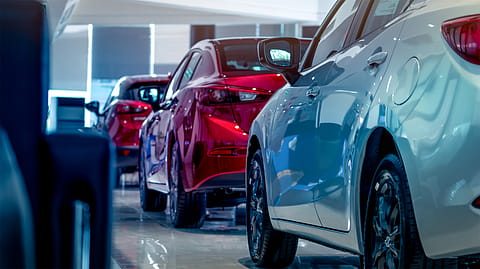
The year-on-year growth also comes against a relatively weak base last year, when buyers deferred purchases ahead of anticipated tax changes. | Credits: Shutterstock
Passenger vehicle (PV) retail sales crossed the 4-lakh mark for the first time in August, rising 16.14% year-on-year to 4,02,398 units, as India’s automobile retail market posted its best-ever August with total sales of 24,23,201 units. Overall vehicle retail sales grew 17.51% from a year earlier, according to data released by the Federation of Automobile Dealers Associations (FADA).
The August performance was broad-based, with two-wheelers, three-wheelers, commercial vehicles and wheeled construction equipment all registering year-on-year growth. However, total retail sales declined 6.48% from July’s record 25,91,138 units, while PV sales fell 3.40% sequentially from 4,16,555 units. FADA President Sai Giridhar attributed the monthly moderation to the seasonal monsoon lull and a shift in the festival calendar, with Ganesh Chaturthi and the spillover of Onam-led buying moving into September.
For passenger vehicles, the record August came alongside a sharp change in the fuel mix. Alternative fuels — CNG, hybrids and EVs — collectively accounted for 41.95% of PV retail sales, overtaking petrol/ethanol at 40.85% for the first time, although petrol remained the largest individual fuel type. CNG accounted for 25.28% of PV sales, hybrids 9.04% and EVs 7.63%. Rural PV sales surged 24.99% year-on-year, compared with 10.93% growth in urban markets. At the same time, PV inventory rose by another five days from July-end to around 38–40 days, well above FADA’s recommended 21-day benchmark, with 56% of PV dealers reporting higher stock month-on-month.
Two-wheelers, CVs drive overall retail growth
Two-wheeler retail sales rose 19.69% year-on-year to 17,14,610 units, making it the segment’s strongest August on record. Commercial vehicle sales increased 14.45% to 90,769 units, also the highest for the month, while three-wheeler retail sales grew 8.64% to 1,22,281 units.
Wheeled construction equipment recorded the fastest growth among the major categories, with sales jumping 31.45% year-on-year to 5,166 units. Tractor sales, meanwhile, were effectively flat, rising 0.84% to 87,977 units. Electric three-wheelers accounted for 65.30% of three-wheeler retail sales, highlighting the segment’s accelerating shift towards electrification.
“August’26 delivered the biggest-ever August in Indian Auto Retail, with the industry registering 24,23,201 units, up 17.51% YoY,” Giridhar said. “Two-Wheelers, Passenger Vehicles, Commercial Vehicles, Tractors and Three-Wheelers each set fresh August records, and overall registrations were the highest ever for the month.”
Rural demand outpaces urban markets
The strength of rural demand was particularly evident in passenger vehicles. Rural PV retail sales grew 24.99% year-on-year, more than twice the 10.93% growth recorded in urban markets.
Giridhar, however, cautioned against reading the headline growth without considering the base effect. “Much of the YoY strength rests on a soft August 2025 base, when buyers had deferred purchases awaiting the GST 2.0 rate cut,” he said.
The FADA President also said the festive-season curtain-raiser had come in below dealers’ expectations, with the “true test of the season” lying in showroom conversion through September to November.
Alternative fuels overtake petrol
The crossover in passenger-vehicle fuel preferences was the most significant structural shift in August. Alternative fuels — CNG, hybrids and EVs — together accounted for 41.95% of PV retail sales, compared with 40.85% for petrol/ethanol.
A little over a year ago, petrol led the alternative-fuel mix by nearly 11 percentage points. That gap has now been erased, although petrol remains the largest individual fuel type. Dealers attribute the shift to running-cost economics and continuing consumer hesitation around the E20 transition.
{{#most-powerful-women-snapshot-individual.slug}} {{/most-powerful-women-snapshot-individual.slug}} {{^most-powerful-women-snapshot-individual.slug}} {{/most-powerful-women-snapshot-individual.slug}} {{#showRanking}} {{current-rank}} {{/showRanking}} {{#photo.0.url}}
{{name}}
EV retail sales across vehicle categories reached a record 2.98 lakh units in August, up 52.9% year-on-year, while electric commercial vehicles also recorded their highest monthly volumes.
Rising PV inventory, however, remains a concern heading into the festive period. Stock levels have climbed to around 38–40 days against FADA’s recommended 21-day benchmark. With festive stocking underway, Giridhar urged PV OEMs to “bill strictly to retail” so that dealer capital is not locked in ageing inventory.
The August numbers offer a strong starting point for the festive season, but FADA’s assessment suggests that the sustainability of the recovery will depend on actual showroom conversions over the September-November period, rather than headline year-on-year growth alone.
Follow Fortune India
NEXT STORY