The FAQs are AI-generated, and Fortune India is not responsible for its content or any associated copyright issues.
Toyota bets on reassurance over range with Urban Cruiser Ebella
/ 3 min read
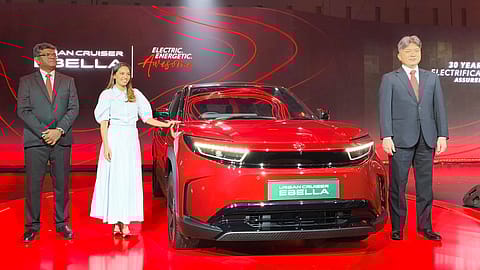
(L-R) Sabari Manohar, Executive Vice President; Manasi N. Tata, Vice Chairperson; Tadashi Asazuma; Deputy Managing Director | Credits: Nishikant Gamre
Toyota bets on reassurance over range with Urban Cruiser Ebella
This summary is AI-generated, and Fortune India is not responsible for its content or any associated copyright issues.
Speaking to Fortune India, Sabari Manohar, Executive Vice President at Toyota Kirloskar Motor, said the company’s approach to EVs has been shaped by years of consumer research rather than competitive benchmarking.
(L-R) Sabari Manohar, Executive Vice President; Manasi N. Tata, Vice Chairperson; Tadashi Asazuma; Deputy Managing Director | Credits: Nishikant Gamre
Toyota Kirloskar Motor’s (TKM) entry into India’s mass-market electric SUV space was expected as Maruti Suzuki unveiled the e-Vitara. With the unveiling of the Urban Cruiser Ebella, the Japanese automaker finally forays into the Indian EV market.
Speaking to Fortune India, Sabari Manohar, Executive Vice President at Toyota Kirloskar Motor, said the company’s approach to EVs has been shaped by years of consumer research rather than competitive benchmarking.
“We have been continuously studying the market; what kind of products and technologies customers are ready for,” Manohar said. “Our hybrid journey has already shown us that when customers trust the technology, they come back and buy again.”
The Urban Cruiser Ebella, which is a rebadged Maruti Suzuki eVitarra, will be manufactured in Gujarat. Though the prices have not been announced, customers can book their vehicle at Rs 25,000 at all showrooms.
Reframing EV anxiety
Contrary to popular belief, Toyota’s research suggests that range anxiety is only part of the problem. According to Manohar, the larger concern is a lack of confidence in the surrounding ecosystem, which includes dealer expertise, service readiness, charging access and long-term ownership risks.
“Range is talked about very loudly, but it is not the only anxiety. Are there EV-trained dealers? Is there assured care? Do customers feel supported after purchase?” said Manohar.
According to their research, Toyota found that nearly 90% of prospective EV buyers prefer home charging over public infrastructure. The ability to plug in overnight and start the next day with a full battery mattered more than fast chargers on highways. “That insight gave us a lot of confidence,” Manohar said. “If you solve home charging, you solve a majority of the pain points.”
Lowering the ownership risk
Toyota is also leaning heavily on reassurance mechanisms to make EV ownership feel less risky. Drawing parallels with its hybrid programme, where it offers an eight-year battery warranty, the company plans to extend similar confidence-building measures to its EV customers.
Battery longevity, resale value and long-term liability remain major concerns in India’s nascent EV market. To address this, Toyota is offering battery-related assurances and an assured buyback programme, guaranteeing around 60% residual value after three years. “People worry that EV resale values won’t match ICE vehicles,” Manohar said. “An assured buyback helps remove that fear.”
Manohar also highlighted that Toyota have been developing manpower and infrastructure at each and every dealership with high-tech tools and equipment for the last 10 years. “We have close to 500-plus trained, 500-plus enabled, EV electrified enabled workshops, and close to 2,500 (and) above technicians who are very well expert in handling electrified technology vehicles, particularly battery and EV motors,” he said when asked about addressing customer satisfaction.
No single-technology bet
Despite entering the EV segment, Toyota continues to back what it calls a “multi-pathway” strategy by offering everything from petrol and diesel to mild hybrids, strong hybrids and full EVs. “We don’t believe in technology-biased growth,” Manohar said. “Customers should decide what works for them.”
RANK
COMPANY NAME
REVENUE
(INR CR)
(INR CR)
{{#current-rank}} {{current-rank}} {{/current-rank}} {{^current-rank}} {{rank}} {{/current-rank}} {{name}} {{#revenue}} {{revenue}} {{/revenue}} {{^revenue}} {{noi}} {{/revenue}}
That philosophy, he added, also eliminates fears of internal cannibalisation. Each powertrain serves a different use case, price point and comfort level with new technology.
Vikram Gulati, Executive Vice President at Toyota Kirloskar Motor, stated that the company has experienced steady growth in sales, having sold approximately 4.5 million vehicles last year. He added that this growth is expected to continue, driven by the expanding size of the economy, low vehicle penetration, and an increasingly affluent, aspirational population.
Currently, the company’s powertrain mix remains overwhelmingly dominated by petrol, diesel, CNG, and other conventional fossil-fuel-based options.
However, Gulati stressed that to make a meaningful impact on carbon emissions, scale and speed are critical. “We have to shift towards greener alternatives that make sense for each market in terms of scale and speed. So, for example, in India, we feel that if you look at the real impact on carbon emissions, which is really going to be on belt and wheel, battery electrics definitely have a role. So do strong hybrids, while shifting towards renewables.”
Tier 2 and Tier 3 ambitions
While EV adoption in India is still concentrated in tier-1 cities, Toyota believes the combination of home charging and closer dealer networks could accelerate acceptance in smaller towns. “Once customers realise, they can charge at home, EVs become far more accessible for tier-2 and tier-3 cities,” Manohar said. “Infrastructure challenges have reduced significantly.”
Frequently Asked Questions
Explore the world of business like never before with the Fortune India app. From breaking news to in-depth features, experience it all in one place. Download Now