West Asia tensions, forex volatility reshaping luxury car demand in India, flags BMW
/ 2 min read
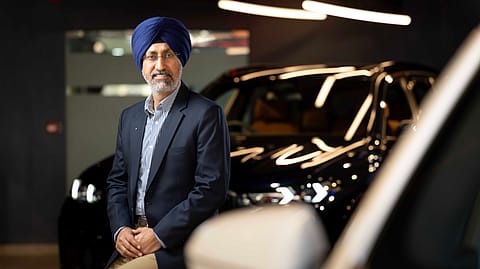
Hardeep Singh Brar, President & CEO, BMW Group India | Credits: Narendra Bisht
West Asia tensions, forex volatility reshaping luxury car demand in India, flags BMW
Geopolitical tensions in West Asia and rising forex volatility are making Indian luxury car buyers more cautious, BMW Group India chief Hardeep Singh Brar said. While mass-market demand stays income-driven and stable, globally exposed luxury customers are conserving cash. BMW sees this as a temporary pause, expecting a faster rebound than the overall auto industry once conditions normalise.
This summary is AI-generated, and Fortune India is not responsible for its content or any associated copyright issues.
Affluent buyers turn cautious amid global uncertainty, as fuel concerns and policy shifts accelerate EV interest
Hardeep Singh Brar, President & CEO, BMW Group India | Credits: Narendra Bisht
Geopolitical tensions in West Asia and rising currency volatility are reshaping demand patterns in India’s luxury car market, prompting a more cautious approach from high-end buyers even as underlying demand drivers remain intact, a senior official at BMW India said.
BMW Group India President and CEO Hardeep Singh Brar says the current macro environment is influencing purchase decisions, especially among business owners and market-linked consumers.
“Business class customers tend to take things a little more cautiously. They are conserving cash flows to ensure they can run their businesses if anything happens,” he told reporters in a round table meeting with reporters.
According to him, this contrasts with the mass market, where demand is largely income-driven and stable. In the luxury segment, global exposure plays a bigger role.
“Customers in this segment are far more dependent on global economics,” Brar noted, explaining the moderation in growth even as the broader passenger vehicle market expands at a healthy pace.
He added that while luxury demand softens early during uncertainty, it also rebounds quickly once sentiment improves. “They tend to come back once the crisis is over—and the turnaround is usually faster.”
Forex pressures, supply risks on the radar
On the supply side, BMW is insulated from immediate disruptions, but risks remain if geopolitical tensions persist. The more immediate concern, Brar said, is currency movement. “It’s not raw material prices right now—the bigger worry is how forex will play out.”
Given its reliance on imports, exchange rate volatility directly impacts pricing. BMW has already raised prices by 1–2% from April to offset currency fluctuations.
While inventory levels remain comfortable in the near term, Brar said a prolonged conflict could begin to strain supply chains. “We are well stocked at the moment, but if this continues longer, there could be an impact,” he maintained.
Fuel concerns, policy shifts nudge EV interest
Even as caution prevails, macro triggers are subtly altering consumer preferences. Rising global crude prices and the possibility of domestic fuel price hikes are prompting buyers to reassess running costs.
“Whenever fuel prices go up, it triggers a thought—what if they go up further—and that can push customers towards EVs,” Brar said, adding that such considerations tend to have a lasting impact on buyer behaviour.
{{#most-powerful-women-snapshot-individual.slug}} {{/most-powerful-women-snapshot-individual.slug}} {{^most-powerful-women-snapshot-individual.slug}} {{/most-powerful-women-snapshot-individual.slug}} {{#showRanking}} {{current-rank}} {{/showRanking}} {{#photo.0.url}}
{{name}}
Policy moves, including higher ethanol blending, could further reinforce this shift. “Any of these moves will definitely bring more customers towards electric vehicles,” he noted. Improvements in EV range—now extending well beyond 500 km in the luxury segment—are also making them more practical.
Outlook: Temporary pause, not structural slowdown
Despite near-term headwinds, BMW remains optimistic about a recovery once geopolitical conditions stabilise. “Once the situation normalises, luxury will grow at a much faster rate than the overall industry,” Brar said.
The company is preparing for that rebound with an aggressive product strategy and network expansion, betting on sustained demand for premium mobility.
Meanwhile, BMW Group India reported a 17% year-on-year rise in car sales to 4,567 units in the January–March quarter, with electric vehicles gaining share—details of which are covered in our earlier report.
Follow Fortune India
NEXT STORY