Adani Ports expands Kaleris partnership to deploy AI across 15 container terminals
/ 2 min read
Under the multi-year agreement, Kaleris will deploy its AI-enabled terminal operating platform across 15 APSEZ container terminals spanning nine domestic and international ports
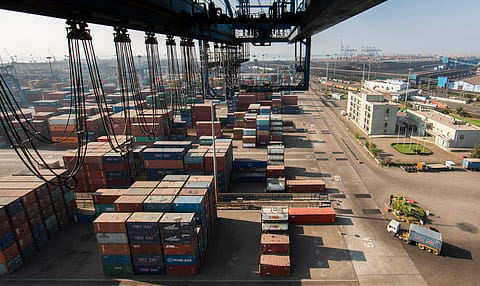
Adani Mundra Port | Credits: Fortune India
Adani Ports and Special Economic Zone (APSEZ) has expanded its strategic partnership with US-based supply chain software company Kaleris to accelerate the use of artificial intelligence and automation across its ports and logistics network.
Under the multi-year agreement, Kaleris will deploy its AI-enabled terminal operating platform across 15 APSEZ container terminals spanning nine domestic and international ports. The move forms part of APSEZ's broader plan to invest $850 million in technology upgrades and decarbonisation initiatives as it works towards handling one billion tonnes of cargo annually by 2030.
As part of the partnership, APSEZ plans to invest up to $100 million in two phases to accelerate automation and operational optimisation. The company expects the technology deployment to help unlock an additional 91 million metric tonnes (MMT) of capacity by 2030, equivalent to nearly 10% of its installed capacity.
The latest expansion builds on the first phase of deployments across six ports. Kaleris will now roll out advanced planning, optimisation and automation capabilities across APSEZ's wider maritime and logistics network, creating a unified digital platform aimed at improving operational efficiency and visibility.
According to APSEZ, Kaleris' advanced optimisation tools are expected to improve Rubber Tyred Gantry (RTG) crane productivity by up to 20% and terminal truck productivity by up to 14%.
"AI-enabled automation will define the next frontier of competitiveness in ports and logistics," said Ashwani Gupta, Whole-time Director and Chief Executive Officer of APSEZ.
"While APSEZ has already deployed an end-to-end digital platform from shore to door, which provides seamless track-and-trace and integrated command and control capabilities, the Kaleris integration will enhance productivity, improve turnaround time, and consistently deliver a superior customer experience," Gupta said.
Kirk Knauff, President and CEO of Kaleris, said the company would expand its N4 Terminal Operating System and optimisation solutions across APSEZ's entire terminal network.
"APSEZ is demonstrating the real impact of an AI-enabled port network at scale. Expanding to all 15 terminals reflects the results already achieved and the trust behind this partnership," Knauff said.
APSEZ said it is increasing investments in artificial intelligence, the Internet of Things (IoT), computer vision and advanced optimisation technologies to improve real-time visibility, resource allocation and decision-making as cargo volumes and supply chain complexity continue to rise. The deployment is expected to improve yard utilisation, vessel turnaround times and cargo movement predictability across its network.
The company currently has a cargo handling capacity of 653 million tonnes per annum and accounts for about 27% of India's total port volumes. It operates 15 ports and terminals in India and four international ports across Australia, Colombo, Israel and Tanzania. APSEZ is targeting throughput of one billion tonnes annually by 2030.
NEXT STORY