Agility is the only way to navigate constant disruptions, says Britannia's Rakshit Hargave
/ 2 min read
Speaking about the challenging operating environment, Hargave said geopolitical tensions, inflationary pressures, and supply chain disruptions are no longer exceptional events but part of the normal course of business.
THIS STORY FEATURES
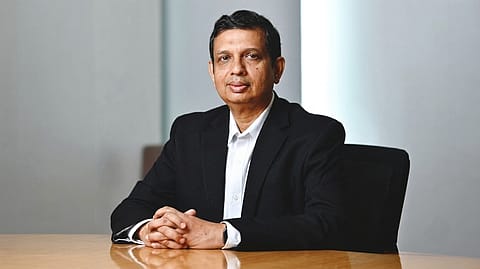
Rakshit Hargave, MD, Britannia Industries. | Credits: LinkedIn @Rakshit Hargave
Disruptions have become a permanent part of the business environment, according to Britannia Industries Ltd, which has prompted the FMCG maker to focus on organisational agility, cost optimisation and innovation rather than waiting for stability to return.
Speaking about the challenging operating environment, Managing Director Rakshit Hargave said geopolitical tensions, inflationary pressures, and supply chain disruptions are no longer exceptional events but part of the normal course of business.
“These kinds of disruptions are a part and parcel of every year. Maybe what has happened is that in the last six months this war has obviously caused more disruption. Before that we also had the GST transition, which was complex,” Hargave told Fortune India.
According to Hargave, the answer lies in building an organisation that can respond quickly to changing conditions rather than expecting periods of stability.
“As an organisation, you have to be flexible, agile,” he said, adding that serving consumers across general trade, modern trade and e-commerce helps Britannia stay relevant regardless of where demand shifts.
The company is relying on multiple levers to protect profitability amid elevated input costs. “You have to cost optimise. Unfortunately, in some cases, you have to pass on to the consumer. And also, sometimes you have to innovate on product formats… Whether it is through optimisation, change in packaging, or introduce a value added product, it’s a constant game,” Hargave said.
Asked about taking charge of Britannia amid a series of global and domestic disruptions, Hargave said unpredictability is something leaders must accept.
“My mindset is very agile. It’s a part of the game. You have to keep tuned to the fact that there will be challenges. You will not get peaceful sleep in any quarter. If things are looking normal, be prepared for the next disruption,” he said.
Britannia reported consolidated revenue from operations of ₹4,432 crore in the quarter ended March 2026, while net profit stood at ₹559 crore, supported by a combination of pricing actions, premiumisation and operational efficiencies.
Quick commerce to grow faster, but general trade will retain its lead
While Hargave expects quick commerce to continue expanding rapidly, he does not see it overtaking general trade across India anytime soon.
“Few years is a very short time frame,” he said, noting that quick commerce is already “nearly equal” to general trade in several large metros and, in some locations, has even surpassed it. However, replicating that model nationwide remains difficult because it requires dense store networks and significant investments, while many quick commerce players are still working towards profitability.
{{#most-powerful-women-snapshot-individual.slug}} {{/most-powerful-women-snapshot-individual.slug}} {{^most-powerful-women-snapshot-individual.slug}} {{/most-powerful-women-snapshot-individual.slug}} {{#showRanking}} {{current-rank}} {{/showRanking}} {{#photo.0.url}}
{{name}}
He expects quick commerce to keep gaining ground across the top 300 to 350 cities over the next three to four years, driven by digitally savvy consumers seeking convenience and by companies using the channel to launch new products. However, he believes general trade will continue to dominate in semi urban India, where the convenience advantage of quick commerce is less pronounced.
For Britannia, the strategy is to stay channel agnostic.
“We have focus on modern trade also, GT also, e-commerce also, because each channel has a specific purpose. You can’t leave one for the other,” Hargave added.

Follow Fortune India
NEXT STORY