Avoid ‘quick fix’ mindset in AI governance, says MeitY Secretary Krishnan at India AI summit
/ 3 min read
Economists and policymakers highlight early evidence from India showing how AI tools are improving farming decisions, road safety, and student learning.
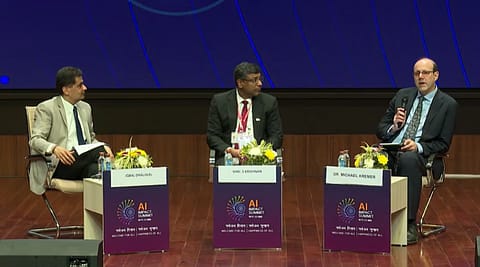
Experts ask governments to focus on evidence, careful evaluation, and real-world outcomes rather than silver-bullet solutions.
Artificial intelligence must move beyond hype and deliver measurable improvements in people’s lives, experts said at the AI Impact Summit 2026, urging governments to focus on evidence, careful evaluation, and real-world outcomes rather than silver-bullet solutions.
Speaking at a session titled “From Algorithms to Outcomes: Building AI that Works for People” at Bharat Mandapam, economists and policymakers highlighted early evidence from India showing how AI tools are improving farming decisions, road safety, and student learning.
S. Krishnan, Secretary at the Ministry of Electronics and Information Technology, warned against getting carried away by technology cycles. Drawing parallels with financial engineering before the 2008 global financial crisis, he said governments often look for quick fixes and must instead focus on consistent impact assessment.
Effective data use remains central to success: Krishnan
“Under the India AI Mission, the government has tried to remain flexible, particularly in providing AI computer access to researchers, startups, and students through a shared platform model. India has chosen a balanced approach, supporting the development of select large language models while also investing in smaller, domain-specific and multimodal models suited to local needs. Effective data use, he added, remains central to success,” he said.
Nobel Laureate Michael Kremer, affiliated with J-PAL and a professor at the University of Chicago, pointed to the use of AI-enabled monsoon forecasts sent by the Indian government to 38 million farmers last year. In an unusual monsoon season when rains arrived early but paused in their northward movement, the AI forecast correctly predicted the pattern.
Beyond accuracy, Kremer said, “The key question is whether such tools change behaviour. Evidence from randomised trials globally and in India suggests that farmers do respond to weather forecasts. Preliminary findings from Odisha indicate that farmers who received warnings about delayed monsoon progression were more likely to adjust transplanting decisions and opt for hybrid seeds.”
Kremer also cited AI-based traffic enforcement and driver testing as examples of public sector innovation. An automated driving test system called HAMS, developed by Microsoft Research India and deployed across 56 RTOs, has been used for over 345,000 driving tests.
“Early analysis using driving data from Ola drivers suggests that those tested under the AI system reported 20 to 30% fewer instances of unsafe driving. While results are preliminary, the findings show strong potential for automated systems to improve safety and reduce discretion-based errors,” he said.
Evaluation of a personalised adaptive learning
In education, Kremer referred to an evaluation of a personalised adaptive learning programme rolled out by the Andhra Pradesh government for grades 6 to 9 in partnership with Central Square Foundation. The programme, implemented in over 1,500 schools, doubled the pace of student learning with just one hour of weekly usage.
However, he cautioned that scaling AI in government services requires incentives, strong procurement systems and a culture of experimentation backed by rigorous evaluation so that states can learn from each other’s successes and failures.
AI as a rare general-purpose technology
Iqbal Dhaliwal, Global Executive Director of J-PAL, described AI as a rare general-purpose technology, comparable to electricity or the internet.
{{#most-powerful-women-snapshot-individual.slug}} {{/most-powerful-women-snapshot-individual.slug}} {{^most-powerful-women-snapshot-individual.slug}} {{/most-powerful-women-snapshot-individual.slug}} {{#showRanking}} {{current-rank}} {{/showRanking}} {{#photo.0.url}}
{{name}}
“Its accessibility, rapid improvement, and multimodal capabilities make it a powerful tool for development,” he said.
He outlined three priority areas where AI can drive impact: improving targeting and prediction for government programmes, providing personalised and timely support such as crop disease diagnosis for farmers, and enhancing the effectiveness of frontline workers like teachers and nurses.
Follow Fortune India
NEXT STORY