Ashwini Vaishnaw unveils New Delhi Frontier AI Impact Commitments at India AI Impact Summit
/ 2 min read
Union Minister for Electronics and Information Technology Ashwini Vaishnaw said India’s AI strategy is anchored in democratisation, scale, and sovereignty
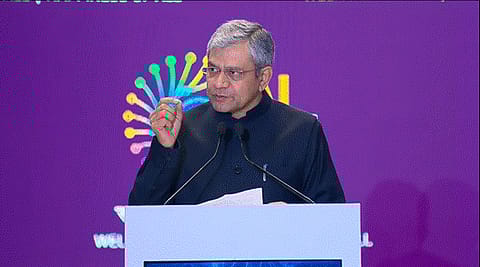
Union Minister for Electronics and Information Technology Ashwini Vaishnaw
At the opening ceremony of the India AI Impact Summit 2026, Union Minister for Electronics and Information Technology Ashwini Vaishnaw announced the New Delhi Frontier AI Impact Commitments, bringing together leading frontier artificial intelligence (AI) companies and domestic innovators to advance inclusive and responsible AI.
Positioned as a key outcome of the summit, the commitments aim to align the development and deployment of AI systems with equity, cultural diversity, and real-world needs, particularly across the Global South.
Addressing the gathering, Vaishnaw said India’s AI strategy is anchored in democratisation, scale, and sovereignty. He outlined a comprehensive approach spanning five layers of the AI stack, applications, models, compute, talent, and energy, with a focus on real-world deployment in healthcare, agriculture, education, and public services.
“AI is a foundational technology. It is already transforming how we work, learn, and make decisions. Our Honourable Prime Minister believes that the true value of technology lies in ensuring that its benefits reach the masses. Our Prime Minister’s vision is to democratise technology, deploy it at scale, and make it accessible to all. That is why in India we are working on all five layers of the AI stack,” said Ashwini Vaishnaw during his address.
Participating organisations include India-based innovators such as Sarvam, BharatGen, Gnani.ai, and Soket, alongside global frontier AI firms.
Advancing real-world AI usage
The first commitment, “Advancing Understanding of Real-World AI Usage”, focuses on generating anonymised, and aggregated insights to support evidence-based policymaking. Participating organisations will work to assess AI’s impact on jobs, skills, productivity, and economic transformation. The initiative seeks to enable data-driven analysis of AI deployment across sectors, helping governments, and institutions frame strategies that maximise benefits while managing technological risks.
“Once we honestly harness the benefits of AI, we must also find collective solutions for mitigating risks. By placing human safety and dignity at the heart of AI, we can move forward with conviction. Let us shape an AI future of the humans, by the humans, and for the humans,” Viashnaw added.
Strengthening multilingual and contextual evaluations
The second commitment, “Strengthening Multilingual and Contextual Evaluations”, aims to improve the effectiveness of AI systems across languages, cultures, and practical use cases.
Organisations will collaborate with governments and local ecosystems to develop datasets, benchmarks and technical expertise in under-represented languages and cultural contexts. The effort is expected to enhance AI performance for diverse populations and broaden access to high-quality AI tools while retaining flexibility in evaluation methods and technology choices.
The minister said coordinated efforts between governments, industry, and research communities will be critical to ensuring AI delivers broad-based gains. He invited participating organisations to advance the commitments as a foundation for responsible AI development globally.
Follow Fortune India
NEXT STORY