Budget 2026: India Inc welcomes Budget’s continuity, seeks patience on consumption recovery
/ 3 min read
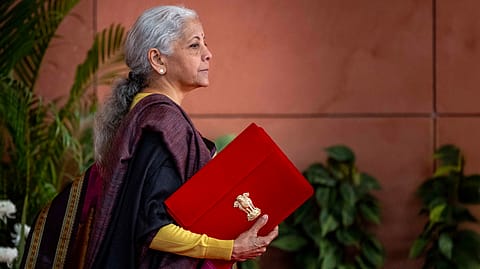
Nirmala Sitharaman | Credits: Narendra Bisht
Budget 2026: India Inc welcomes Budget’s continuity, seeks patience on consumption recovery
India Inc has cautiously welcomed the Union Budget 2026–27, appreciating its focus on infrastructure and institution-building while noting the lack of immediate measures to boost consumption. The budget emphasizes public investment and fiscal discipline, with a 9% increase in capital expenditure aimed at strengthening supply chains and supporting long-term growth, particularly in non-urban areas.
This summary is AI-generated, and Fortune India is not responsible for its content or any associated copyright issues.
Capital expenditure has been raised by nearly 9% to ₹12.2 lakh crore for 2026–27, a move that companies say will gradually support demand by strengthening supply chains, logistics and income resilience beyond urban centres.
Nirmala Sitharaman | Credits: Narendra Bisht
India Inc struck a measured note on the Union Budget 2026–27, welcoming its emphasis on continuity, infrastructure spending and institution-building, even as industry leaders flagged the absence of a strong near-term push to revive consumption.
The Budget, presented against a volatile global backdrop, avoided headline-grabbing giveaways and instead doubled down on public investment, fiscal discipline and manufacturing-led growth. Capital expenditure has been raised by nearly 9% to ₹12.2 lakh crore for 2026–27, a move that companies say will gradually support demand by strengthening supply chains, logistics and income resilience beyond urban centres.
Dabur India CEO Mohit Malhotra described the Budget as being “on expected lines”, underlining that it was not driven by short-term populism. “Instead, it places its faith in continuity, institution-building and resilience,” he said, adding that the focus on farmer incomes, infrastructure and fiscal discipline reinforces confidence in India’s medium-term growth trajectory.
For the FMCG sector, said Rajiv Kumar, vice chairman of DS Group, the Viksit Bharat agenda serves as a vital catalyst by synchronizing demand and supply-side enablers. “Specific interventions in agriculture like push for production of cocoa, fisheries and animal husbandry are poised to boost rural incomes. Simultaneously, the expansion of TReDS and improved credit access will alleviate working capital pressures for distributors and contract manufacturers, fortifying the entire FMCG ecosystem,” he added.
For consumer goods companies, the sharper focus on Tier-2 and Tier-3 cities is emerging as a key takeaway. Malhotra said recognition of Global Capability Centres as a growth driver, along with infrastructure investment, would help companies like Dabur expand the reach of branded products by improving access, logistics efficiency and income stability across Bharat.
Piruz Khambatta, group chairman of Rasna Private Ltd, said he had not expected major tax cuts as this year the Budget was never about immediate gains or losses for taxpayers. “This budget was never about how much goes from my wallet or comes in. The tax bit has been done—GST has been rationalised, personal income tax is already down, corporate tax is down,” he said. Instead, he pointed to tax simplification and certainty as positives. “Decriminalisation has been done to an extent. Till the first appeal, there is no penalty. These are all good, positive rules.”
Beyond taxation, Khambatta highlighted the government’s long-term vision, particularly in agriculture. “They are talking of high-value agri-crops like sandalwood, cashew and nuts, and ensuring their processing,” he said, adding that this aligns with the proposed India–EU free trade agreement, which also covers these products.
The Budget’s push to strengthen the traditional medicine ecosystem also drew praise. Announcements around new All India Institutes of Ayurveda, integrated AYUSH-led medical hubs, and upgraded testing and pharmacy infrastructure signal an effort to mainstream Ayurveda through scale and standards. Dabur said these measures align with its work with more than 13,000 farmers cultivating medicinal plants, linking rural livelihoods with organised consumption.
However, industry voices were clear that consumption revival will be gradual. Kumar Rajagopalan, CEO of the Retailers Association of India, said the Budget “is not designed to stimulate consumption in the short term”. Instead, its impact on retail would come through “improvements in supply chains, workforce readiness, and rural and non-metro demand rather than direct policy support”.
{{#most-powerful-women-snapshot-individual.slug}} {{/most-powerful-women-snapshot-individual.slug}} {{^most-powerful-women-snapshot-individual.slug}} {{/most-powerful-women-snapshot-individual.slug}} {{#showRanking}} {{current-rank}} {{/showRanking}} {{#photo.0.url}}
{{name}}
Others echoed this view, pointing to indirect benefits from infrastructure and manufacturing incentives rather than sector-specific tax relief. Paritosh Ladhani, joint managing director of SLMG Beverages, said the Budget “strongly reinforces a manufacturing-first, ‘Make in India’ approach”. He noted that higher capital expenditure would improve distribution reach and last-mile connectivity, while localisation across bottling and packaging would support cost stability and long-term volume growth, even though there were no direct tax incentives for non-alcoholic beverages.
Textiles and craft-led retail, too, see opportunity in the longer arc of consumption growth. Darshan Dudhoria, CEO of Indian Silk House Agencies, said the Budget reaffirmed textiles as an employment-intensive sector where heritage and growth converge. He highlighted initiatives such as the National Fibre Scheme and National Handloom and Handicraft Programme as enablers for modernisation, market access and artisan-led retail expansion, particularly in emerging consumption centres across smaller cities.
This year's Budget is less about sparking an immediate consumption bounce and more about laying the groundwork for demand to build steadily - through infrastructure, manufacturing depth, rural livelihoods and institutional capacity - over the medium term.
Follow Fortune India
NEXT STORY