Budget 2026–27: Industry seeks execution-led push to Make in India, flags compliance and capital hurdles
/ 2 min read
ASSOCHAM pre-Budget survey flags compliance burden, capital access and muted PLI impact as key manufacturing challenges
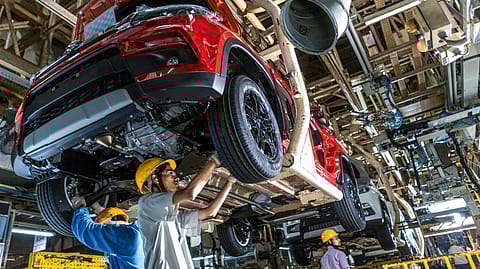
According to a pre-Budget survey conducted by ASSOCHAM, boosting domestic manufacturing emerged as the single most important priority for advancing the vision of Aatmanirbhar and Viksit Bharat | Credits: Narendra Bisht
The domestic industry has urged the government to place a stronger, execution-focused push behind domestic manufacturing and the ‘Make in India’ programme in the Union Budget 2026–27, flagging high compliance burden, logistics and energy costs, and limited access to long-term capital as key impediments to scaling up production in India.
According to a pre-Budget survey conducted by the Associated Chambers of Commerce & Industry of India (ASSOCHAM), boosting domestic manufacturing emerged as the single most important priority for advancing the vision of Aatmanirbhar and Viksit Bharat. Strengthening MSMEs and simplifying tax and compliance systems ranked next on industry’s wish list, followed by infrastructure and logistics development, skills and job creation, and faster digital and AI-led adoption.
Cautious optimism on business outlook, Policy initiatives seen as positive
The survey, which covered respondents across manufacturing, services, infrastructure, IT/ITeS, start-ups and allied sectors, indicated cautious optimism on the business outlook. About 55% of participants expect conditions to improve over the next 12 months, while 32% remain neutral and 13% expressed a pessimistic view.
While government initiatives such as higher infrastructure capital expenditure, GST 2.0 reforms and Production Linked Incentive (PLI) schemes are seen as moving in the right direction, their impact on the ground remains uneven. Around 35% of respondents said these measures have delivered limited benefits so far, while 39% felt the impact has been only moderate, underscoring the need for better scheme design, wider access and stronger last-mile execution.
Compliance, capital access and MSMEs’ pain points
Compliance and regulatory burden were cited as the biggest hurdle to manufacturing expansion, followed by global demand uncertainty, availability of skilled manpower, high logistics and energy costs, and gaps in technology and automation. Quality standards and certification requirements were also flagged as areas needing attention.
To accelerate manufacturing growth, industry participants called for cheaper long-term capital, improved credit availability and targeted tax incentives for technology upgradation, automation and artificial intelligence adoption. Expanding PLI coverage, rationalising customs duties on critical raw materials, and faster approvals in industrial parks, SEZs and clusters were also highlighted.
MSME concerns featured prominently, with over half of respondents belonging to the segment. Delayed payments and working capital constraints were identified as key stress points, reinforcing demands for cash-flow-based lending and faster credit linked to GST and e-invoicing data.
Overall, ASSOCHAM said the findings point to the need for execution-oriented reforms in Budget 2026–27 to unlock private investment, strengthen MSMEs and enable manufacturing scale-up.
Follow Fortune India
NEXT STORY