Davos 2026: India on track for 500 GW non-fossil capacity by 2030, says Pralhad Joshi
/ 3 min read
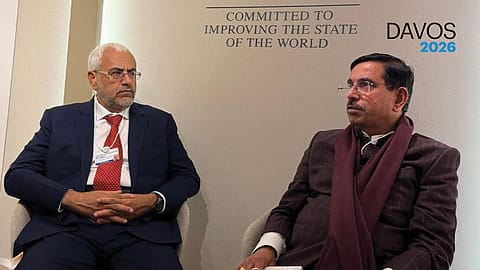
Union Minister Pralhad Joshi and Dr. Said Mohammed Ahmed Al Saqri, Economic Advisor at the Office of the Deputy Prime Minister for Economic Affairs, Oman, at a meeting in WEF, Davos.
Davos 2026: India on track for 500 GW non-fossil capacity by 2030, says Pralhad Joshi
At the World Economic Forum in Davos, Union Minister Pralhad Joshi announced India's progress towards achieving 500 GW of non-fossil fuel capacity by 2030, having already reached 267 GW. He emphasised India's advancements in solar, wind, and green hydrogen, inviting global investors to participate in India's clean energy transition and highlighting partnerships with Canada and Oman.
This summary is AI-generated, and Fortune India is not responsible for its content or any associated copyright issues.
The minister said India stands ready to partner with countries and institutions worldwide, guided by the principle of “Vasudhaiva Kutumbakam”—One Earth, One Family, One Future.
Union Minister Pralhad Joshi and Dr. Said Mohammed Ahmed Al Saqri, Economic Advisor at the Office of the Deputy Prime Minister for Economic Affairs, Oman, at a meeting in WEF, Davos.
Union Minister for New and Renewable Energy Pralhad Joshi on Tuesday made a strong pitch to global investors at the World Economic Forum (WEF) Annual Meeting in Davos, sharing that India has achieved 267 GW of non-fossil fuel-based capacity as of December 2025 and remains firmly on track to reach its target of 500 GW by 2030.
Long-term climate and clean energy investments
Joshi underscored India’s progress across solar, wind, green hydrogen, and energy storage, positioning the country as a reliable and attractive destination for long-term climate and clean energy investments. He held discussions with Charles Emond, President and CEO, and Sarah Bouchard, Chief Operating Officer of Canada-based La Caisse, on strengthening long-term collaboration in climate-focused investments in India.
According to the minister, the talks centred on scaling up solar, wind, and hybrid renewable energy projects, strengthening transmission infrastructure, and exploring opportunities in green hydrogen and energy storage. He encouraged La Caisse to expand its engagement under the “Partner with India” initiative to tap into the group’s committed $400 billion climate action investments by 2030. Joshi said there was strong alignment between India’s clean energy ambitions and La Caisse’s climate investment strategy, with a shared focus on scalable, resilient and impact-driven solutions to support India’s energy transition.
The minister also met Dr Said Mohammed Ahmed Al Saqri, Economic Advisor at the Office of the Deputy Prime Minister for Economic Affairs, Oman, to discuss deepening bilateral cooperation in the renewable energy sector. During the interaction, Joshi highlighted India’s experience in deploying renewable energy solutions even in arid and desert conditions, noting that this creates significant opportunities for global investors and international partnerships.
In another meeting, Joshi held discussions with Juvencio Maeztu, CEO and President of the Ingka Group, which operates IKEA’s global retail business. Maeztu expressed strong confidence in India’s long-term growth and development trajectory and conveyed the group’s interest in expanding its presence in the country’s renewable energy sector. Joshi said the Ingka Group has shown keen interest in investing in solar, wind, and hybrid renewable solutions in India.
He attributed this progress to robust policy support, strong domestic manufacturing, grid modernisation efforts, energy storage deployment and emerging frameworks for technologies such as geothermal and nuclear energy.
Joshi also said the need for patient capital, blended finance and deeper collaboration among governments, the private sector and multilateral development banks to accelerate the global energy transition. He said India stands ready to partner with countries and institutions worldwide, guided by the principle of “Vasudhaiva Kutumbakam”—One Earth, One Family, One Future.
Collaboration, policy continuity key to sustain momentum
Meanwhile, on the global clean energy landscape, Devansh Jain, Executive Director at INOXGFL Group, said, “The World Economic Forum remains an exceptional platform for global leaders to align on shared priorities and collective action. India’s strong presence here reflects how the country has arrived decisively on the global stage, not just as a fast-growing economy, but as a solutions provider. In this context, renewable energy stands at the heart of India’s growth story, combining scale, innovation, and sustainability. By accelerating clean power deployment, strengthening manufacturing, and investing in future technologies, India can drive global energy transition while creating jobs and resilience at home. Collaboration and policy continuity will be key to sustaining this momentum.”
Discussions with the minister also explored joint collaboration in manufacturing and export opportunities for solar modules, electrolysers, and green hydrogen, along with investments in renewable-powered hydrogen hubs, integrated energy projects and port-based export infrastructure.
Follow Fortune India
NEXT STORY