Deepak Parekh bats for higher FDI limits in banks, deeper debt markets to fund India's growth
/ 2 min read
Former HDFC chairman says bank reforms should be undertaken when sector is strongest; calls for corporate bond market to double as share of GDP.
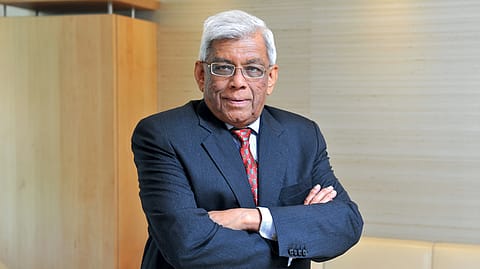
Deepak Parekh, Former Chairman of Housing Development Finance Corporation | Credits: Photograph by Padmini B
Former HDFC chairman Deepak Parekh on Monday called for higher foreign direct investment (FDI) limits in banks, deeper corporate debt markets and fresh banking sector reforms, saying India will need significantly more domestic and foreign capital to fund its next phase of economic growth.
Speaking at the 118th Annual General Meeting of the IMC Chamber of Commerce and Industry, Parekh said India has set an ambitious target of becoming a $30 trillion economy by 2047, requiring the economy to expand seven to eight times over the next two decades.
"The funding needs are immense and India will need to rely on both domestic and more foreign capital to fund its future growth," Parekh said, adding that foreign capital flows are increasingly linked to the evolving geopolitical environment.
Calls for banking reforms
Parekh said the banking sector is currently well-positioned for reforms, with gross non-performing assets at a multi-decade low of below 2% and adequate capital buffers.
"India's banking sector needs new reforms and the time to do this is when the sun is shining or when the banks are at their strongest," he said.
He reiterated the need for a banking system anchored by a few large institutions instead of many smaller ones, noting that while public sector banks have already undergone consolidation, "there merits a case for further consolidation."
Parekh also backed increasing FDI limits in both public and private sector banks, saying it would help bring in much-needed capital to finance India's long-term growth ambitions.
Push for deeper debt markets
Beyond the banking sector, Parekh called for accelerating the development of India's debt markets.
He said India's corporate bond market, currently equivalent to around 18% of GDP, needs to double to support the country's investment requirements.
"We need to be bold like adopting cross-border securitisation transactions, having deeper credit default swap markets, more credit enhancement mechanisms, a thriving municipal bonds market and, of course, the need for a more diversified investor base," he said.
Parekh said India's medium- to long-term macroeconomic fundamentals remain structurally strong, supported by stable political, economic, monetary and fiscal conditions, while GDP growth is estimated at 6.5-7%.
{{#most-powerful-women-snapshot-individual.slug}} {{/most-powerful-women-snapshot-individual.slug}} {{^most-powerful-women-snapshot-individual.slug}} {{/most-powerful-women-snapshot-individual.slug}} {{#showRanking}} {{current-rank}} {{/showRanking}} {{#photo.0.url}}
{{name}}
On capital markets, he described the recent selling by foreign portfolio investors as a temporary phase, noting that domestic institutional investors, particularly monthly systematic investment plan (SIP) inflows of around ₹30,000 crore, have helped keep equity markets resilient.
"We just have to ride out this current phase," he said.
Follow Fortune India
NEXT STORY