Delhi–Dehradun Economic Corridor to boost connectivity, trade, and regional growth: PM Modi
/ 2 min read
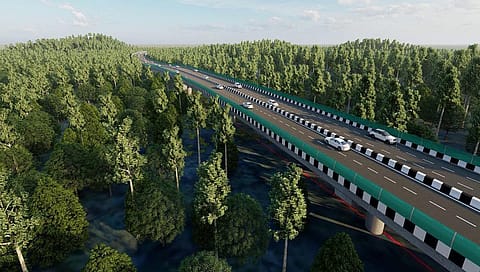
The 213-km, access-controlled high-speed corridor is expected to reduce travel time between Delhi and Dehradun from over six hours to around two-and-a-half hours. | Credits: NHAI's X account
Delhi–Dehradun Economic Corridor to boost connectivity, trade, and regional growth: PM Modi
Prime Minister Narendra Modi inaugurated the 213-km Delhi–Dehradun Economic Corridor, a six-lane, access-controlled highway built at a cost of ₹12,000 crore. The corridor will cut travel time between the national capital and Uttarakhand’s capital from over six hours to about two-and-a-half, boosting tourism, trade, logistics efficiency and regional economic growth across key towns in Uttar Pradesh and Uttarakhand.
This summary is AI-generated, and Fortune India is not responsible for its content or any associated copyright issues.
Highlighting infrastructure as a cornerstone of national growth, PM Modi said roads, highways, railways and airways act as the “fate lines” of the country, shaping its future trajectory.
The 213-km, access-controlled high-speed corridor is expected to reduce travel time between Delhi and Dehradun from over six hours to around two-and-a-half hours. | Credits: NHAI's X account
Prime Minister Narendra Modi on Tuesday inaugurated the much-awaited Delhi–Dehradun Economic Corridor, saying the project will play a key role in accelerating regional economic growth by improving connectivity between major tourism and economic hubs.
The 213-km, access-controlled high-speed corridor is expected to reduce travel time between Delhi and Dehradun from over six hours to around two-and-a-half hours, significantly enhancing mobility and logistics efficiency.
Addressing the gathering, the Prime Minister described economic corridors as “gateways of hope and inspiration” and highlighted their role in driving development. He said the project would open new avenues for trade, tourism and overall economic expansion across the region.
Highlighting infrastructure as a cornerstone of national growth, Modi said roads, highways, railways and airways act as the “fate lines” of the country, shaping its future trajectory. Over the past decade, he noted, India has focused on building such critical infrastructure to support long-term development.
The corridor, developed at a cost of ₹12,000 crore, is a six-lane greenfield highway that begins from the Delhi–Meerut Expressway and passes through key locations including Akshardham, Shastri Park, Khajoori Khas, Baghpat, Shamli, Muzaffarnagar and Saharanpur before reaching Dehradun.
The corridor is equipped with an Advanced Traffic Management System (ATMS) to enable real-time traffic monitoring and improve road safety. It features multiple interchanges, railway overbridges, major bridges, and several wayside amenities for travellers.
With over 100 underpasses and multiple connectivity points, the expressway integrates with key routes such as the Delhi–Mumbai Expressway and the Eastern Peripheral Expressway, facilitating seamless inter-regional connectivity.
The Prime Minister said the project reflects the government’s vision of building next-generation infrastructure that combines high-speed connectivity with environmental sustainability and improved quality of life.
He added that under the “double-engine” government, Uttarakhand is witnessing rapid improvements in connectivity and development, with the new corridor expected to further accelerate progress.
The Union Minister for Road Transport & Highways Nitin Gadkari, who was also present at the event, Monday said Delhi-Dehradun Expressway is not just an economic corridor but it will empower Uttarakhand’s development by creating new employment opportunities.
“With the construction of this expressway, it will open new doors for economic and social growth in Dehradun, Haridwar, Rishikesh, and the entire state,” he said during the inauguration ceremony of the new economic corridor.
{{#most-powerful-women-snapshot-individual.slug}} {{/most-powerful-women-snapshot-individual.slug}} {{^most-powerful-women-snapshot-individual.slug}} {{/most-powerful-women-snapshot-individual.slug}} {{#showRanking}} {{current-rank}} {{/showRanking}} {{#photo.0.url}}
{{name}}
The inauguration ceremony was attended by Uttar Pradesh Chief Minister Yogi Adityanath, Delhi Chief Minister Rekha Gupta, and Uttarakhand Chief Minister Pushkar Singh Dhami.
Follow Fortune India
NEXT STORY