Fiscal discipline, borrowing transparency remain top priority: DEA Secretary
/ 3 min read
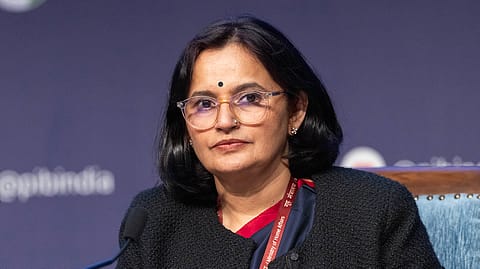
Anuradha Thakur, secretary, DEA | Credits: Narendra Bisht
Fiscal discipline, borrowing transparency remain top priority: DEA Secretary
India's debt-to-GDP ratio is on a downward trend, highlighting the government's commitment to fiscal discipline while maintaining growth and development spending. DEA Secretary Anuradha Thakur emphasized the importance of prudent fiscal management and borrowing transparency, noting that a lower debt burden will create fiscal space for priority sector expenditure and strengthen India's growth trajectory.
This summary is AI-generated, and Fortune India is not responsible for its content or any associated copyright issues.
Anuradha Thakur, secretary, DEA, said that maintaining stability and credibility in macroeconomic policy is critical for enabling long-term investment decisions and strengthening India’s growth trajectory.
Anuradha Thakur, secretary, DEA | Credits: Narendra Bisht
India’s debt-to-GDP ratio has continued on a downward path, reinforcing the government’s commitment to fiscal discipline even as it sustains growth and development spending, Anuradha Thakur, secretary in the Department of Economic Affairs (DEA), said while addressing industry executives at CII's Post-Budget Session.
Thakur said the decline in the debt ratio has become a key fiscal marker for the government, reflecting calibrated and prudent fiscal management amid global volatility. “In line with the accepted standards of fiscal management, the declining debt to GDP ratio, which is our new marker, from 56.1% last year to 55.6% this year, we intend to stay the right path as we have committed to doing,” she said.
She added that maintaining stability and credibility in macroeconomic policy is critical for enabling long-term investment decisions and strengthening India’s growth trajectory.
Borrowing plans and state finances
According to Thakur, a lower debt burden is expected to create fiscal space for priority sector expenditure by containing interest costs and managing the fiscal deficit more effectively. The fiscal deficit for the coming year is estimated at 4.3% of GDP, which she described as a key operational instrument for fiscal targeting.
“This is expected to free up resources of priority sector expenditure by reducing interest account growth,” she said, underlining the link between debt management and developmental spending.
She also addressed market borrowings for the next financial year, pegged at ₹17 lakh crore. Clarifying concerns around the headline number, Thakur noted that a significant portion relates to repayments. “A lot of this ₹5.5 lakh crore is for repayment of the previously issued debt… and the fresh issuances for financing our fiscal deficit would roughly be ₹11.7 lakh crore,” she said, adding that this is broadly in line with borrowing levels seen over the past few years.
She also addressed state finances, noting that states were expected to manage resources responsibly under the Fiscal Responsibility & Budget Management (FRBM) framework. The Centre, she said, was supporting states through initiatives such as the Special Assistance to States for Capital Investment (SASCI) programme, which offers 50-year interest-free loans targeted at capital expenditure to improve productivity and fiscal management.
Credit access and long-term financing under review
Beyond equity, the government is looking to expand and fine-tune credit support for MSMEs. Thakur said the concerned ministry is already working on both ongoing and new schemes to ensure credit availability improves further.
On long-term financing, she said discussions are underway with public financial institutions to assess demand for longer-tenure loans. “We are in talks with public financial institutions to see if there is a demand for long-term, long-tenured term loans,” she said, inviting industry feedback on whether such products are needed and which sectors they should be tailored for.
{{#most-powerful-women-snapshot-individual.slug}} {{/most-powerful-women-snapshot-individual.slug}} {{^most-powerful-women-snapshot-individual.slug}} {{/most-powerful-women-snapshot-individual.slug}} {{#showRanking}} {{current-rank}} {{/showRanking}} {{#photo.0.url}}
{{name}}
Thakur linked the MSME push to the government’s wider manufacturing, services and infrastructure strategy, noting that benefits from sectoral support and public investment do not accrue only to large corporations. “When that becomes a success, not only the big corporates, but also the MSMEs benefit from it,” she said.
“Taking forward the economic growth of a country is actually a partnership,” Thakur concluded.
Follow Fortune India
NEXT STORY