Fortune India Boardroom: India’s beauty market comes of age as ecommerce and D2C brands redraw the landscape
/ 4 min read
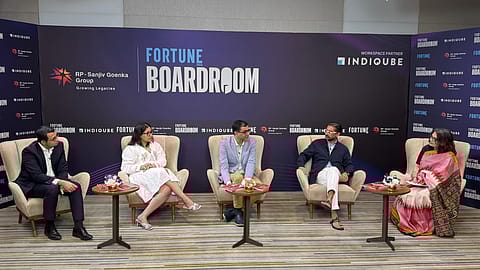
(L-R) Manish Taneja, CEO and Managing Director of Purplle, Romita Mazumdar, Founder and CEO of Foxtale, Shankar Prasad, Founder of Plum, Rohan Vazirali, Country General Manager at The Estée Lauder Companies, and Ajita Shashidhar, National Editor,Fortune India
Fortune India Boardroom: India’s beauty market comes of age as ecommerce and D2C brands redraw the landscape
India's beauty market has evolved from a traditional, offline sector to a dynamic, ecommerce-driven industry. The shift is fueled by digital advancements, changing consumer preferences, and the rise of D2C brands. Industry leaders highlight the importance of innovation, consumer education, and strategic investments as key drivers of this transformation, positioning India as a priority for global beauty companies.
This summary is AI-generated, and Fortune India is not responsible for its content or any associated copyright issues.
Digital-first consumption, science-led products and strategic acquisitions are reshaping how beauty is built, sold and scaled in India.
(L-R) Manish Taneja, CEO and Managing Director of Purplle, Romita Mazumdar, Founder and CEO of Foxtale, Shankar Prasad, Founder of Plum, Rohan Vazirali, Country General Manager at The Estée Lauder Companies, and Ajita Shashidhar, National Editor,Fortune India
Over the last decade, India’s beauty market has transitioned from a largely offline, mass-led category into one of the country’s most dynamic consumer segments. Once characterised by limited choice, traditional retail and narrow beauty definitions, the sector today is shaped by ecommerce-led discovery, science-backed formulations and a growing mix of global and homegrown brands.
That evolution—and the forces driving it—was at the heart of a recent Fortune India Boardroom discussion featuring Romita Mazumdar, Founder and CEO of Foxtale; Shankar Prasad, Founder of Plum; Manish Taneja, CEO and Managing Director of Purplle; and Rohan Vazirali, Country General Manager at The Estée Lauder Companies.
Industry leaders agree that the transformation has been driven as much by changes in infrastructure as by a shift in consumer mindset.
Ecommerce rewired beauty consumption
A decade ago, buying beauty products online was still nascent. Internet penetration was limited, digital payments were evolving, and brands were hesitant to embrace ecommerce as a serious channel. For Taneja, who started Purplle in 2011, the India of that time feels almost unrecognisable today.
“There were no payment aggregators, no Shopify, and brands didn’t want to sell online,” he says. “We started with cash-on-delivery because net banking meant signing agreements with individual banks. People shopped from office desktops because homes didn’t have Wi-Fi.”
Taneja also points to how dramatically the funding and start-up ecosystem has changed. “In 2011, there were barely a handful of early-stage investors in India. Today, there are hundreds of VCs and a very strong angel ecosystem,” he says, adding that access to capital has fundamentally altered how quickly brands can be built and scaled.
That ecosystem has since been transformed by smartphones, affordable data, UPI, and a far deeper venture capital pool. Ecommerce has democratised access to beauty, enabling consumers far beyond metros to browse, experiment, and purchase across categories and price points.
“The online ecosystem didn’t just respond to demand; it created demand,” says Prasad. Increased choice and ease of access encouraged experimentation, fundamentally altering how Indian consumers engage with beauty.
This digital-first environment also enabled the emergence of strong direct-to-consumer (D2C) brands like Foxtale, which scaled without relying on traditional distribution networks. For Mazumdar, ecommerce was not a disruption but the default. “I’ve grown up in this system,” she says. “For me, D2C is not a strategy. It’s how I consume, discover, and trust brands.”
From fairness to function and science
Consumer preferences have evolved sharply alongside distribution. The long-standing dominance of fairness-led narratives has steadily given way to solution-oriented skincare and makeup focused on efficacy, ingredients, and scientific credibility.
Vazirali recalls that when global brands first entered India, education was critical. “We launched with 50 shades of foundation, and consumers would still ask for two shades fairer,” he says. “That obsession has largely broken down. Women today are far more confident and comfortable in their own skin.”
{{#most-powerful-women-snapshot-individual.slug}} {{/most-powerful-women-snapshot-individual.slug}} {{^most-powerful-women-snapshot-individual.slug}} {{/most-powerful-women-snapshot-individual.slug}} {{#showRanking}} {{current-rank}} {{/showRanking}} {{#photo.0.url}}
{{name}}
Prasad points to a broader behavioural shift. “Consumers today are not looking for magical transformations. They’re looking for solutions,” he says. “There’s also a much stronger scientific mindset—people ask why a product works and how it works.”
Mazumdar underlines how quickly this transition has played out. “When we started, everyone was talking about ingredients,” she says. “Very quickly, it moved from ingredient to why the ingredient works. Claims like three or five days don’t work anymore—users know it’s not magic.”
She adds that the power dynamic has shifted decisively. “Today, users are growing faster than brands. In many ways, users are educating brands, not the other way around,” Mazumdar says.
Global brands deepen India focus
India’s growing digital maturity and expanding premium consumer base have made it a strategic priority for global beauty companies. For multinational players, the narrative has shifted from cautious experimentation to long-term commitment.
Vazirali says education—delivered through both digital and physical channels—remains central to growth. “The medium of education has become more hybrid,” he notes. “Digital content has exploded, but physical touch-and-feel is still critical.”
He also highlights the need for India-specific innovation. “Less than 2% of global beauty research is focused on Indian skin tones,” Vazirali says, adding that adapting formulations and undertones has been key to building relevance in the market.
Legacy players turn to acquisitions
As D2C brands gained traction online, legacy FMCG and beauty companies responded by accelerating their own beauty strategies. This has taken two forms: organic portfolio expansion and the acquisition of digital-native start-ups.
Prasad believes acquisitions are largely capability-driven. “Established companies are looking for consumer cohorts and innovation capabilities,” he says. “Distribution is not what they’re looking for—that’s what they already excel at.”
Mazumdar agrees that brand-building, rather than mere scale, is what attracts interest. “There are many companies in beauty today, but very few brands,” she says. “A brand is trust, delivery experience, and consistency—not just a product.”
Why scaling remains a challenge for D2C brands
Despite early momentum, scaling remains a structural challenge for many D2C brands. Online channels enable rapid growth, but sustaining momentum beyond a point often requires heavy investments in offline retail, supply chains, brand marketing, and working capital.
“There is a ceiling that brands hit online,” Prasad reiterates. As investors become more demanding on unit economics and profitability, partnerships or acquisitions are increasingly seen as pragmatic growth paths.
Taneja points out that offline is once again becoming critical. “We opened 150 doors last year and will likely double that,” he says. “India didn’t invest enough in high-quality offline destinations earlier. That’s changing now.”
He also flags a longer-term shift underway. “India will increasingly invest in creating its own IP—whether in ingredients, actives, or formulations,” Taneja says. “That’s where the next phase of value creation will come from.”
A maturing beauty ecosystem
India’s beauty market today is markedly more mature than it was a decade ago. Consumers are more informed, investors more discerning, and competition significantly more intense. Ecommerce has expanded access and choice, D2C brands have reshaped brand-building playbooks, and legacy companies have adapted through innovation and acquisition.
As the sector enters its next phase, the challenge for all players will be endurance—building profitable, differentiated businesses in a market that is no longer just growing rapidly, but growing up.
Follow Fortune India
NEXT STORY