Fortune India Exclusive: BMW looking to assemble its EV portfolio in India as part of wider localisation drive
/ 3 min read
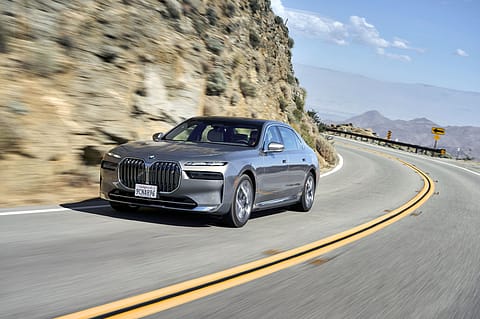
Currently, BMW retails a mix of CKD and CBU electric models, with higher-end offerings imported and attracting customs duties of up to 110%.
Fortune India Exclusive: BMW looking to assemble its EV portfolio in India as part of wider localisation drive
BMW is planning to locally assemble its entire electric vehicle lineup in India, aiming to enhance its manufacturing presence and accelerate electrification in a rapidly growing market. This move is expected to reduce import duties and improve competitiveness against rivals, while also supporting BMW's strategy of offering luxury with sustainable mobility.
This summary is AI-generated, and Fortune India is not responsible for its content or any associated copyright issues.
As EV sales surge and duty pressures persist, the German luxury carmaker weighs full-scale localisation to sharpen its India playbook.
Currently, BMW retails a mix of CKD and CBU electric models, with higher-end offerings imported and attracting customs duties of up to 110%.
BMW Group is contemplating locally assembling all the Battery Electric Vehicles (BEVs) it sells in India, according to sources aware of the development. The move, once firmed up, is part of the German luxury carmaker’s broader strategy to deepen its manufacturing footprint and accelerate electrification in one of its fastest-growing markets.
Currently, BMW retails a mix of Completely Knocked Down (CKD) and Completely Built-Up (CBU) electric models, with higher-end offerings imported and attracting customs duties of up to 110%.
Phased indigenisation, bottom-up approach
According to a source familiar with the company’s plans, BMW is preparing a “phased indigenisation” roadmap for its BEVs in India. “The localisation strategy is expected to follow a bottom-up approach, beginning with the iX1 and going up to the i7,” the source said.
BMW’s BEV portfolio in India comprises the BMW iX1 (starting at around ₹49.9 lakh, ex-showroom), the BMW i4 (₹72.5–77.5 lakh), the BMW i5 (around ₹1.20 crore), the BMW iX (around ₹1.40 crore), and the BMW i7 (₹2.05–2.58 crore).
BMW Group’s electric presence in India also extends to its British marque, MINI, which currently retails the MINI Countryman Electric at around ₹54.9 lakh (ex-showroom). Earlier, the MINI Cooper SE electric hatchback was introduced at around ₹47 lakh (ex-showroom) as a fully imported model catering to niche urban buyers.
From entry-level luxury BEV to manufacturing scale
The localisation journey began with the iX1 LWB, priced at around ₹49 lakh. Positioned at the entry-luxury layer of BMW’s electric portfolio, it offers higher potential volumes and acts as a bridge between mass-market EVs and ultra-premium imports. Early traction appears to have validated the strategy.
“At BMW, we operate at the pinnacle of modern luxury. Local production is our strategic lever to deliver this uncompromising experience to the Indian market. We locally produce 10 car models at Plant Chennai, latest edition being the electric BMW iX1 Long Wheelbase (LWB). It is our first locally produced electric model that brings the BMW hallmark perfection, agility, and performance to an audience that is unequivocally ready for sustainable mobility,” said Hardeep Singh Brar, President and CEO, BMW Group India, in response to queries sent by Fortune India.
BMW’s Chennai plant has an annual production capacity of about 14,000 units in a single shift and can be ramped up to 20,000 units with two shifts. The facility has long assembled internal combustion engine (ICE) models such as the 3 Series, 5 Series, and X models for the domestic market.
“Integrating EV assembly into that line-up allows BMW to sweat existing assets rather than invest in a greenfield electric-only facility,” revealed another source aware of the company’s plans. However, the source noted that scaling EV assembly may eventually require higher localisation levels, particularly for battery systems, high-voltage components, and electronic modules.
When specifically queried on expanding locally assembled EVs in India, Brar stated, “Local production allows immaculate efficiency, cost optimisation, and fast turn-around time, which translates into sales success. Within a year, the locally produced iX1 has become the highest sold luxury EV in the country. BMW Group India is well positioned to lead India’s electric transformation, while staying true to the promise of sheer driving pleasure.”
The rise in EV contribution—from 8% to 21% of total sales within a year—has strengthened the business case for deeper localisation, according to well-informed sources.
{{#most-powerful-women-snapshot-individual.slug}} {{/most-powerful-women-snapshot-individual.slug}} {{^most-powerful-women-snapshot-individual.slug}} {{/most-powerful-women-snapshot-individual.slug}} {{#showRanking}} {{current-rank}} {{/showRanking}} {{#photo.0.url}}
{{name}}
Competitive calculus
Industry experts believe a broader localisation push would help BMW rationalise pricing, reduce exposure to import duties and foreign exchange volatility, and enhance competitiveness against rivals such as Mercedes-Benz and Audi, both of which have sharpened their electric focus in India.
“BMW sells many more EVs in India than the other German luxury brands. Clearly, Indian customers have taken a liking to BMW EVs compared to Merc or Audi EVs. It makes sense for BMW to double down on its efforts and bring some aggressiveness in pricing. Local assembly is a good, logical option,” said Deepesh Rathore, Founder of Insight EV, a global EV research platform.
Follow Fortune India
NEXT STORY