Fortune India MPW 2026: Dhurandhar broke every conventional norm of storytelling, and that's what made it attractive, says Jyoti Deshpande
/ 3 min read
Reliance's media and content business chief says the film was greenlit for its unconventional narrative, with the decision to split it into two parts emerging only after production outgrew the original vision.
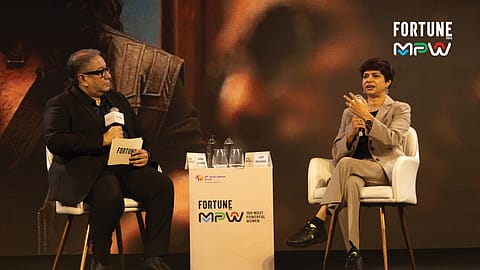
Jyoti Deshpande, President, Jio Studios (Media and Content Business, RIL), during a fireside chat with Fortune India Editor-in-Chief and Group Head – Business Publications, RPSG Group, at the Fortune India MPW 2026 event. | Credits: Fortune India
India's media and entertainment industry needs to back bold, unconventional storytelling rather than rely on established formulae, Jyoti Deshpande, President, Jio Stidios (Media and Content Business, RIL), said at the 16th edition of Fortune India's Most Powerful Women (MPW) 2026.
Speaking during a fireside chat with Sourav Majumdar, Editor-in-Chief, Fortune India, and Group Head–Business Publications, RPSG Group, Deshpande shared the journey behind Dhurandhar, revealing how the film defied conventional industry wisdom from its inception and eventually evolved into a two-part franchise because of its scale.
Breaking conventional storytelling
Deshpande said Dhurandhar stood out because it challenged nearly every established benchmark for evaluating film projects.
"I would say there were a series of unfortunate instances that led to this colossal success and a great deal of divine intervention," she said. "What interested me about the film was that it broke every conventional norm that had been laid out over the last 30 years of storytelling."
Drawing a parallel with business analytics, she said projects that "break the pattern" often present the biggest opportunities. According to her, the film explored the complex idea of the "deep state"—a concept rarely attempted in mainstream Indian cinema—and packaged it as a gangster film to make it accessible to audiences.
"It was more deeply patriotic than many films that pretend to be patriotic. That is why I greenlit it. It was bold, different and clutter-breaking," she said.
Deshpande said the makers also consciously designed the film to appeal to a wider audience despite its intense subject matter. "Looking at the length of the film, the kind of soundscape and realising there is a lot of violence and gore, the challenge was how to make it palatable. It was already going to get an adult rating, but we didn't want it to become a male-testosterone film. We wanted everyone, including female audiences, to enjoy the film," she said.
A bigger vision led to a two-part film
Deshpande disclosed that Dhurandhar was never intended to be released in two instalments. The decision emerged midway through production after the scale of the project expanded significantly.
She recalled that the production team recreated Karachi's Lyari area in Thailand by securing access to a cluster of buildings that were scheduled for demolition within 60 days, allowing them to shoot on location instead of constructing expensive sets.
After completing nearly 40 days of filming, however, the production had exceeded its original budget, while a few scripted pages had translated into hours of footage.
"It was not conceived as two parts. We had already busted through our budget," she said, adding that she ultimately took "a bold bet" by committing additional funding and agreeing with the director to rework the edit into two films rather than compressing the story into an unmanageable five-hour feature.
{{#most-powerful-women-snapshot-individual.slug}} {{/most-powerful-women-snapshot-individual.slug}} {{^most-powerful-women-snapshot-individual.slug}} {{/most-powerful-women-snapshot-individual.slug}} {{#showRanking}} {{current-rank}} {{/showRanking}} {{#photo.0.url}}
{{name}}
Asked whether the success of Dhurandhar would raise expectations for Jio Studios' next project, Deshpande said enduring success cannot be manufactured. "When something becomes a part of popular culture organically, no marketing guru or advertisements can architect that. When audiences make something their own, it becomes a part of popular culture," she said, recalling that after the record-breaking success of Stree in 2024, the studio followed it up with Dhurandhar. "We'll think of something," she added.
She also underscored the importance of staying closely connected to changing audience preferences. "You have to keep your ear to the ground and understand what people are talking about and where the youth is. It is important to tell stories that are relevant," she said. With audiences consuming content constantly across formats, filmmakers must give viewers compelling reasons to spend both time and money in theatres. "Stories are everywhere. It is just important to keep your eyes and ears open and execute them well," she added.
NEXT STORY