Fortune India MPW 2026: Jyotsna Suri, Shraddha Suri Marwah call for inclusive workplaces and gender-neutral leadership
/ 2 min read
The mother-daughter duo share insights on leadership, inclusion, workplace diversity, and navigating traditionally male-dominated industries.
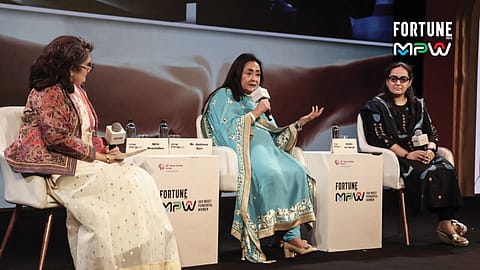
(From left) Fortune India's Ajita Shashidhar with Jyotsna Suri, Chairperson & MD, The Lalit Suri Hospitality Group; and Shradha Suri Marwah, CMD, Subros, at the Fortune India MPW 2026 event.
Inclusion is a strategic business decision rather than a compliance exercise while leadership should be defined by capability and not gender, said Jyotsna Suri, Chairperson and MD of The Lalit Suri Hospitality Group, and Shraddha Suri Marwah, CMD of Subros, during a conversation at the 16th edition of Fortune India's Most Powerful Women (MPW) 2026 event.
The mother-daughter duo shared insights on leadership, inclusion, workplace diversity, and navigating traditionally male-dominated industries.
Jyotsna Suri said inclusion has been embedded into The Lalit's business philosophy and has contributed to both employee loyalty and customer engagement. "For us, inclusion isn't a box to be ticked—it's part of our DNA. Promoting women's inclusion is a deliberate business decision," she said.
Clarifying a common perception, Suri noted that women constitute more than 50% of the leadership team at The Lalit, rather than half of its overall workforce.
She said the group's focus on employing women, persons with disabilities and members of the LGBTQIA+ community has strengthened the organisation by creating a loyal workforce while also making guests from diverse backgrounds feel represented and welcomed.
"It is a win-win situation. We are giving people a life of dignity, while consumers are able to relate to our teams," she said, adding that other hospitality chains have increasingly adopted similar inclusion practices.
Speaking about women in manufacturing, Shraddha Suri Marwah said competence, not gender, should determine professional success. "Skill doesn't have a gender," she said.
Marwah, who has spent 26 years in the automotive components industry, said she joined Subros when there were only three women among nearly 3,500 employees. Rather than focusing on biases, she remained committed to her work. "I walked in as me, not as a male or a female. If somebody has a fractured ego, that's their problem, not mine. I was focused on doing my job," she said.
She noted that the mobility sector has made significant progress in increasing female representation over the past two decades, although senior and middle management continue to lag.
"Please think of work as a skill, not as a gender. Let the best-skilled person lead, regardless of who they are," she added.
Reflecting on her daughter's leadership, Jyotsna Suri described resilience as one of Marwah's defining strengths while highlighting that both share similar values despite leading businesses in very different sectors.
{{#most-powerful-women-snapshot-individual.slug}} {{/most-powerful-women-snapshot-individual.slug}} {{^most-powerful-women-snapshot-individual.slug}} {{/most-powerful-women-snapshot-individual.slug}} {{#showRanking}} {{current-rank}} {{/showRanking}} {{#photo.0.url}}
{{name}}
"Our values, integrity, dedication and commitment, are the same. But our leadership styles differ because hospitality is people-centric, whereas manufacturing is product- and technology-centric," she said.
Suri also addressed the challenge of the "leaky pipeline" that sees many women leave the workforce during marriage and motherhood, affecting their long-term career progression.
"In hospitality, many women join at the entry level but step away after marriage or childbirth. When they return after four or five years, they find themselves behind their male peers," she said.
To address the issue, The Lalit has introduced flexible working arrangements to help women remain connected to their careers during life transitions. "That flexibility ensures they don't lose momentum and can return at the same level as their colleagues. It has helped us build a stronger pipeline of women leaders," she said.
On hiring from marginalised communities, Suri said her experience has been markedly different. "They are among the most dedicated and loyal employees. Their commitment to work is unmatched," she said.
The discussion was part of the 16th edition of Fortune India's Most Powerful Women 2026, which celebrates women leaders who are breaking barriers and shaping the future of Indian business across sectors including finance, manufacturing, healthcare, media, and technology.
Follow Fortune India
NEXT STORY