Fortune India MPW 2026: Financial inclusion has improved, but women must take charge of wealth creation, say industry leaders
/ 3 min read
Ritu Gangrade Arora, Manisha Girotra, and Amisha Vora highlight the gains made through financial inclusion initiatives while stressing the need for greater financial literacy and decision-making among women.
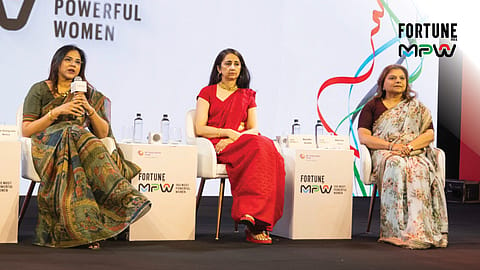
(From left) Ritu Gangrade Arora, Country Head-India, Allianz Services; Manisha Girotra, CEO, Moelis India; and Amisha Vora, Chairperson & MD, PL Capital Group (Prabhudas Lilladher), at the Fortune India MPW 2026 event in Mumbai. | Credits: Sanjay Rawat
India has made significant progress in financial inclusion over the past two decades, but true empowerment will come only when women actively manage their own finances and participate in wealth creation, industry leaders said at the 16th edition of Fortune India's Most Powerful Women (MPW) 2026 event in Mumbai on Friday.
Speaking during a panel discussion on financial inclusion and women's economic empowerment, Ritu Gangrade Arora, Country Head-India, Allianz Services, Manisha Girotra, CEO, Moelis India, and Amisha Vora, Chairperson and Managing Director, PL Capital Group (Prabhudas Lilladher), highlighted the gains made through financial inclusion initiatives while stressing the need for greater financial literacy and decision-making among women.
Manisha Girotra credited India's financial inclusion drive, particularly the Jan Dhan-Aadhaar-Mobile (JAM) trinity, for lifting millions out of poverty and increasing women's participation in the formal financial system. "I think we've come a long way. Direct benefit transfers into women's bank accounts and better access to credit have strengthened women's economic power and given them greater flexibility to manage household finances and start businesses," Girotra said.
However, she noted that many bank accounts and financial assets registered in women's names continue to be effectively managed by men, indicating that financial inclusion has yet to translate into complete financial independence.
"There is still a lot of financial education needed. Even financially independent and highly educated women often leave investment decisions to male family members," she added.
Ritu Gangrade Arora said financial inclusion has improved significantly, with more women participating in financial decision-making but insurance remains an area where gender gaps persist. "Insurance reflects earning participation because one needs an insurable interest. We still need more women earning, buying insurance, distributing insurance products and participating in protection, savings, and wealth creation decisions," she said.
Amisha Vora highlighted the growing participation of women in India's capital markets, noting that women now account for nearly 24% of unique mutual fund investors and hold around 36% of mutual fund assets. Women also represent close to 28% of trading account holders.
While acknowledging that some investment decisions may still be taken by male family members, she said holding assets in women's names remains an important step towards financial security. "Real empowerment comes when family wealth creation and asset protection decisions are discussed jointly. Financial planning should involve daughters, spouses and all members of the family," Vora said.
Girotra argued that financial empowerment requires women to become active participants rather than passive owners of financial assets. "Managing finances is like building a muscle. You learn only by doing. Many women continue to prioritise family responsibilities over managing their own investments, and that mindset needs to change," she said.
The panel also stressed the importance of improving financial literacy rather than introducing additional policy measures.
Arora said regulators and financial institutions must work together to improve financial education, enabling women to understand investment products and make informed financial decisions.
{{#most-powerful-women-snapshot-individual.slug}} {{/most-powerful-women-snapshot-individual.slug}} {{^most-powerful-women-snapshot-individual.slug}} {{/most-powerful-women-snapshot-individual.slug}} {{#showRanking}} {{current-rank}} {{/showRanking}} {{#photo.0.url}}
{{name}}
Vora expressed optimism that artificial intelligence could become a major catalyst for financial inclusion by making personalised financial advice accessible in multiple languages. "AI can act as a financial advisor. Women can ask questions in their own language about investments, insurance or savings and receive guidance instantly. This could significantly improve financial confidence over the next decade," she said.
Calling for greater focus on execution rather than policy formulation, Girotra said India already has a strong financial inclusion framework, but awareness and last-mile implementation need to improve. "The woman has the bank account. Now she must be taught how to use it confidently. Fintech platforms and AI can make financial services far more accessible and easier to adopt," she said.
On personal finance, Vora urged women to start investing early and take ownership of their financial decisions. "The most important thing is to start today. One or two good financial decisions build confidence, and confidence leads to long-term wealth creation," she added.
Follow Fortune India
NEXT STORY