From old gold to smaller sweet boxes: India's new festive spending playbook
/ 6 min read
Indian consumers embrace value-driven festive shopping, balancing aspiration with affordability.
THIS STORY FEATURES
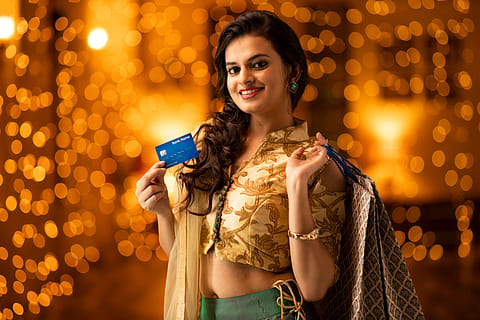
Credits: Getty Images
Indian consumers are not giving up on festive shopping, but they are becoming more careful about how they spend. Record gold prices are prompting jewellery buyers to exchange old ornaments for new designs or opt for lighter pieces, sweet buyers are choosing smaller, packaged gift boxes, and apparel retailers are finding demand stronger at the premium and value ends of the market than in the middle.
Redseer Strategy Consultants estimates that online festive sales exceeded $5 billion in the first four days of the season, from October 8 to 11. Gross merchandise value on the fourth day grew 15% to 20% year on year, while the average order value was 7% to 8% lower. Sales were 4.5 to five times those on a normal day, suggesting that shoppers were buying in greater numbers but spreading their spending across a wider range of categories and price points.
“The short answer: India’s festive sale has opened wider, not deeper,” says Nikhil Dalal, associate partner at Redseer Strategy Consultants. “This is a consumer who is redistributing spend, not pulling back.”
The data points to a market where premiumisation and affordability are operating at the same time. Phones remain the largest online festive category, but their share has edged down as spending moves towards fashion, beauty, home and everyday products. Softlines, which include clothing and other fashion-related products, grew 30% year on year and accounted for around a third of festive sales. Everyday categories grew 50%, home products 30%, and beauty and fashion 25%. Products priced below ₹500 accounted for more than half of orders through value-commerce channels.
Deloitte India’s consumer research offers a possible explanation for this behaviour. The Financial Well-Being Index rose to 111.1 in March 2026 from 109.1 a year earlier. While 79% of consumers said they were confident about meeting upcoming payments and 60% were comfortable with their savings, only 65% expressed willingness to make large purchases. At the same time, 73% expected prices to rise.
The figures suggest that consumers are still willing to spend, but are weighing purchases more carefully. “Consumers are balancing aspiration with affordability, protecting savings while continuing to upgrade in categories where they see meaningful value,” says Anand Ramanathan, partner and consumer industry leader at Deloitte India.
What's the shift?
For businesses, the challenge this festive season is to keep consumers spending without compromising affordability or margins. While festive demand has remained encouraging, companies are seeing consumers adjust the size, price and composition of their purchases rather than simply spend more. Rising input costs are adding to the challenge, forcing brands to balance pricing, promotions and profitability.
In jewellery, higher gold prices have changed the equation between the value of purchases and the quantity bought. Consumers are maintaining their budgets but buying less gold by weight, while paying greater attention to design, versatility and the long term value of a piece.
“We are not seeing any significant postponement of purchases. What has changed is how customers fund them,” says Dr Saurabh Gadgil, chairman and managing director of PNG Jewellers. Nearly 65% to 70% of purchases at the jeweller are now supported by old gold exchange, with customers using existing jewellery to fund new designs, he says. This has helped them maintain their budgets, particularly for larger wedding purchases.
Despite the pressure from gold prices, PNG Jewellers expects around 25% year on year growth over the festive season. Traditional 22 karat gold jewellery continues to sell well, alongside lighter 18 karat options. Younger consumers, particularly Gen Z, are showing interest in 9 karat jewellery, while natural diamond jewellery is also seeing healthy demand.
Average transaction values at PNG Jewellers have increased by approximately 10% to 15%, partly reflecting higher gold prices. The company's overall average transaction value is around ₹1.5 lakh, while casual purchases under its YOOU brand average approximately ₹90,000. Wedding purchases typically range from ₹2.5 lakh to ₹3 lakh.
{{#most-powerful-women-snapshot-individual.slug}} {{/most-powerful-women-snapshot-individual.slug}} {{^most-powerful-women-snapshot-individual.slug}} {{/most-powerful-women-snapshot-individual.slug}} {{#showRanking}} {{current-rank}} {{/showRanking}} {{#photo.0.url}}
{{name}}
Tarang Arora, creative director and CEO of Amrapali Jewels, says consumers are becoming more mindful of how they spend on jewellery. While the value of purchases can remain healthy, the number of pieces bought and the overall weight may not grow at the same pace.
“What is evolving is the nature of the purchase, with greater attention being paid to design, versatility and the value a piece offers over time,” Arora says.
Smaller packs, selective spending and a squeezed middle
The same search for value is playing out in the gifting market, where consumers are changing how they buy rather than abandoning festive purchases.
At Haldiram's, average bill value is rising faster than volume, according to Umesh Kumar Agarwal, director at the company. Customers are choosing gift packs and dry fruit boxes instead of buying loose sweets by weight. Many are also purchasing four or five smaller boxes in a single visit rather than one large box, allowing them to distribute gifts among more people.
“Families are spending more carefully now. They are not cutting down on mithai, but they want it well packed, sensibly priced and from a name they trust,” Agarwal says.
Gift packs containing dry fruits, mithai and namkeen combinations are leading demand, with kaju katli and motichoor laddoo remaining popular choices. At the same time, lower sugar and jaggery based options are attracting a loyal set of buyers, while regional sweets are finding customers beyond their home states.
Demand is growing at both ends of the price spectrum. Smaller packs are doing well as consumers buy for more recipients, while premium gift boxes containing dry fruits and pure ghee mithai are gaining traction among corporate and family buyers. The mid market, however, is stable rather than particularly strong.
Haldiram's is also seeing corporate gifting enquiries arrive earlier than usual, with families buying prasad for Navratri already enquiring about Diwali boxes. Agarwal expects the company to finish the festive period ahead of last year, helped by a longer shopping window before Diwali, which falls in November this year. He also sees the wedding season as a second festive opportunity, with demand for shagun boxes, return gifts and bulk orders for functions growing over the past couple of years.
Apparel retailers are facing a similar divide. Rahul Mehta, chief mentor at the Clothing Manufacturers Association of India (CMAI), says footfalls are encouraging in premium and value segments but showing resistance in the mid segment. While the eastern region is recording fairly good double digit growth over last year, the southern and northern markets have yet to pick up meaningfully, raising hopes that demand will improve closer to their main festivals.
Brands are also placing less emphasis on discounts this year as raw material costs rise and companies attempt to protect margins. That makes it harder to rely on promotions alone to drive sales.
Affordability becomes a business strategy
For appliance makers, the timing of price increases and the availability of financing are becoming important tools in sustaining demand. Godrej Enterprises Group's appliances business says its festive production is already in the dispatch pipeline at existing prices, meaning much of the inventory sold during Diwali should escape the immediate impact of price increases linked to rising commodity costs.
Kamal Nandi, business head of the appliances business, says the company has seen its air conditioners, refrigerators and washing machines grow at two to three times the industry rate in the first half of the year. During Onam, which is often treated as a marker of festive sentiment in Kerala, Godrej recorded a 41% spike despite a weaker industry performance.
The company is also seeing demand for higher end, large capacity washing machines and refrigerators, as well as more energy efficient air conditioners. At the same time, mass market refrigerators and washing machines are picking up, suggesting that consumers are not uniformly moving towards premium products.
Godrej expects more than 50% growth during the festive season, supported by attractive EMIs, cashbacks, a five year comprehensive warranty and expansion of its retail footprint.
Sanjay Chitkara, co-chief sales and marketing officer at LG Electronics India, also points to lifestyle upgrades as a driver of festive demand. Consumers are viewing festivals as an opportunity to move into new homes and upgrade their lifestyles, supporting demand across refrigerators, washing machines, televisions and air conditioners, as well as dishwashers, microwave ovens, audio products and water purifiers.
Improved affordability following GST rationalisation and special festive EMI schemes are providing additional support, he says.
Financing is also playing a role in larger online purchases. Amazon India said more than one third of customers opted for EMI transactions during the early phase of its Great Indian Festival, while Amazon Pay Later EMI transactions doubled and its user base increased 80% year on year.
The wider consumption picture remains supportive, but consumers are becoming more selective. Deloitte India's research found that 79% of consumers were confident about meeting upcoming payments and 60% were comfortable with their savings. However, only 65% expressed willingness to make large purchases, while 73% expected prices to rise.
For retailers, the implication is that festive demand cannot be judged by sales value alone. Higher prices may lift transaction values even when volumes or quantities remain subdued. Consumers are still buying jewellery, sweets, clothes and appliances, but their choices increasingly depend on what they believe offers the best value for money.
As the season moves towards Diwali and the subsequent wedding months, businesses will be watching whether this careful spending translates into sustained demand.

Follow Fortune India
NEXT STORY