GFF 2026: Maha CM Fadnavis flags tokenisation, agentic AI and quantum as next fintech shifts
/ 4 min read
Maharashtra to build pioneering land tokenisation framework as Fadnavis pitches Mumbai as a global testbed for next‑gen fintech
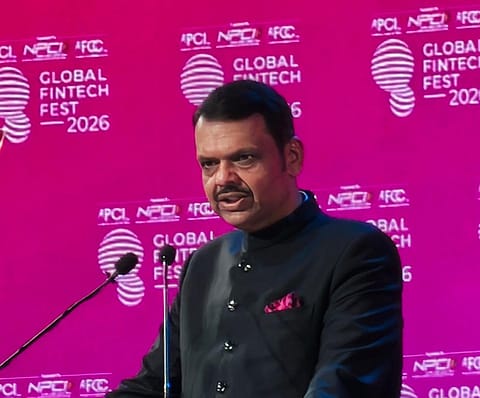
Maharashtra Chief Minister Devendra Fadnavis
Maharashtra Chief Minister Devendra Fadnavis said tokenisation, agentic artificial intelligence and quantum technology could fundamentally reshape finance, as he outlined the state’s plans to build a framework for the tokenisation of land and other assets. Speaking at the Global Fintech Fest 2026 in Mumbai, Fadnavis said India had already shown how technology could democratise finance through UPI, but the next phase would have to go beyond access.
“India has already demonstrated how this can be done. UPI has shown that technology can democratise access and create sophisticated financial infrastructure at massive scale,” he said.
Fadnavis said the next question was whether technology could democratise ownership and access to financial products. “I believe the answer is yes,” he said.
Maharashtra plans land tokenisation framework
Fadnavis said tokenisation could be used to unlock the value of physical assets, including land.
“Last year, right here in October, I had a fascinating conversation with my friend [Kris Gopalakrishnan]. During that conversation, I made a point. I said there are two big opportunities coming in India. One was agentic AI and the other was tokenisation,” he said. “I said, what if we could tokenise land and other physical assets? And that technology has the potential to unlock enormous value,” Fadnavis said.
He said Maharashtra had now moved from discussing the idea to putting a framework in place. “We are now bringing into place a framework for tokenisation of land and other assets,” he said, adding that the state was bringing together expertise from capital markets, industry, technology, law and academia.
He said Maharashtra would become the first state in India to establish such a framework. “The most important thing at this stage is that this has to be accompanied by legal certainty, consumer protection and regulatory frameworks,” Fadnavis said.
Fadnavis elaborated on how tokenisation could help unlock capital from assets that are currently difficult to monetise. “For generations, land has been underutilised in India. A family may own an acre of significant value and yet struggle to access capital against it efficiently,” he said.
“An entrepreneur may have an asset, but may not be able to realise its economic potential fully. Technology gives us the opportunity to change this,” he said.
However, Fadnavis stressed that tokenisation should not become a vehicle for speculation. “Let me make one thing absolutely clear. For us, tokenisation is not about speculation. It is about unlocking productive capital,” he said.
“It is about bringing transparency. It is about improving liquidity. It is about making assets safer, more productive and, ultimately, it is about converting dormant value into economic opportunity,” he said. "That is what I mean when I speak about moving from potential to impact,” Fadnavis added.
{{#most-powerful-women-snapshot-individual.slug}} {{/most-powerful-women-snapshot-individual.slug}} {{^most-powerful-women-snapshot-individual.slug}} {{/most-powerful-women-snapshot-individual.slug}} {{#showRanking}} {{current-rank}} {{/showRanking}} {{#photo.0.url}}
{{name}}
Agentic AI to give people greater financial agency
Fadnavis said the second major transformation would come from agentic AI. “The first generation of digital finance gave people access. The next generation can give people agency,” he said.
At the same time, he stressed that AI in finance would need to retain human oversight. “AI should work for the citizen, but the citizen must remain in control,” he said. “The future of finance must therefore be powered by intelligence, with accountability; innovation with consent; speed with security; and agency with human oversight,” Fadnavis said.
“Because in finance, ultimately, trust is the technology on which every other technology rests,” he added.
Quantum will shape next architecture of trust
Fadnavis also flagged quantum computing as an important part of the future financial security architecture.“Today, real-time financial transactions depend on cryptography. As computing power changes, our security architecture must change,” he said.
“We cannot wait for tomorrow’s threat before building tomorrow’s protection,” Fadnavis said. “If India is going to build one of the world’s largest economies, it must also expect to build one of the world’s most secure and resilient digital infrastructures,” he said.
“Quantum, therefore, is not an isolated technology conversation. It is about the next architecture of trust,” Fadnavis added.
Fadnavis pitches Maharashtra as fintech laboratory
Fadnavis also positioned Mumbai and Maharashtra as a testing ground for new financial technologies. “Mumbai has India’s deepest financial ecosystem. It has extraordinary technology and engineering talent. It is emerging as a new centre of infrastructure, data, information and global connectivity,” he said.
He urged technology companies and startups to look beyond Maharashtra as a market. “Don’t look at Maharashtra only as your market. Look at Maharashtra as your laboratory,” Fadnavis said.
“Bring us your most ambitious ideas. Bring us solutions for agriculture and MSMEs, for urban governments, for mobility, for healthcare, for the financial future and for public finance,” he said. “We are ready to work with innovators, institutions and regulators to test responsible solutions,” he added.
Fadnavis said India’s complexity could itself become an advantage when developing technology for global markets. “I have found that if a solution can work in India and can work in the complexity of India, it can work almost anywhere in the world,” he said.
‘Next great global fintech company can be born in Mumbai’
Fadnavis said Mumbai had the ingredients needed to emerge as a global financial technology centre. “You already possess the ingredients--capital, technology, markets, institutions, regulators, entrepreneurship and, perhaps most importantly, an ability to execute at scale,” he said.
“The next great global fintech company can be born in Mumbai. The next global financial innovation can emerge here. The next innovation in digital public infrastructure can emerge here,” Fadnavis said. “And the next breakthrough in responsible financial AI can be built here,” he added.
Looking at India’s digital-finance journey, Fadnavis said the country had moved from traditional financial infrastructure to an architecture that is now being studied globally. “Ten years ago, many people doubted whether India could leap from traditional financial infrastructure. Today, the world studies India’s digital financial architecture,” he said.
“The question before us is no longer whether India can leapfrog. The question is, what will India innovate next?” Fadnavis said. “UPI democratised transactions. The next billion must be about democratised credit, intelligence, ownership and opportunity,” he said.
“Agentic AI must give people greater agency. Tokenisation must unlock productive capital. Quantum must strengthen trust. And technology must ultimately serve one purpose: expanding human opportunity,” Fadnavis said.
Fadnavis said Maharashtra would work towards becoming a large-scale real-world testbed for the next generation of fintech solutions.
He also reiterated the state’s ambition of making Mumbai a global fintech centre. “Let the best ideas come from India. Let us build them here. Let us take them from Mumbai to the world,” he added.
Follow Fortune India
NEXT STORY