Excise duty scrapped on petrol with 22-30% ethanol blend
/ 2 min read
The exemption applies to higher ethanol-blended fuel variants, including E22, E25, E27 and E30, and represents the first significant fiscal incentive for blends exceeding the E20 threshold
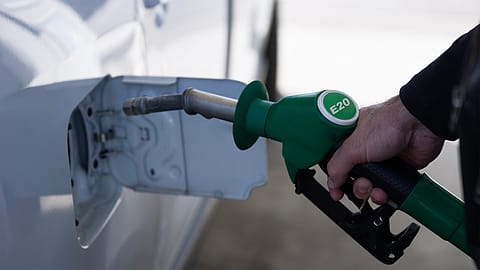
While the tax exemption may appear to be a technical policy adjustment, it signals a broader shift in the government's ethanol strategy | Credits: Shutterstock
The central government late on Wednesday exempted excise duty on petrol with higher ethanol blending, making its consumption cheaper for consumers.
According to the latest official notification, petrol blended with 22-30% ethanol will be free from excise duty, extending tax support beyond the current E20 standard.
The exemption applies to higher ethanol-blended fuel variants, including E22, E25, E27, and E30, and represents the first significant fiscal incentive for blends exceeding the E20 threshold.
Turning to biofuels to reduce dependence on imported oil
The move comes as India continues to scale up its biofuel programme in an effort to cut reliance on imported crude oil and accelerate the transition to cleaner, domestically produced energy sources.
While the tax exemption may appear to be a technical policy adjustment, it signals a broader shift in the government's ethanol strategy. For several years, the focus has been on achieving the E20 blending target, a milestone that is now nearing completion. By extending fiscal support to higher ethanol blends, policymakers appear to be laying the foundation for the next phase of the country's biofuel roadmap.
Paving the way for broader adoption
The policy move follows the Bureau of Indian Standards' (BIS) introduction of quality specifications for E22, E25, E27 and E30 petrol blends under IS 19850:2026. Effective from May 15, 2026, the new standards establish detailed parameters covering ethanol concentration, octane levels, sulphur content, testing protocols, and safety norms.
Taken together, the BIS standards and the excise-duty relief provide the regulatory and fiscal support required to facilitate the gradual rollout of higher ethanol-blended fuels, paving the way for their broader adoption in the coming years.
"Central excise being waived off is ₹11.9/litre. However, how much of this benefit gets passed on to the retail customer remains to be seen. It depends on state VAT, OMC pricing, etc. Ethanol has 1/3rd lower calorific value than Petrol, so E20 has 7% lower fuel efficiency. This is further accentuated to 10% for E30 and 29% for E85. 88% of this central excise cut (i.e. Rs. 10.5/L) has to be passed on to the customer to make E30 comparable to petrol on an energy efficiency basis," said Ayush Patodia, Associate Vice President, Avalon Consulting.
"The government has also mentioned a ₹20/L discount for E85. But the energy adjusted economics demand a ₹29.9/L discount today, else the retail customer stands to lose a massive 13.6% in fuel efficiency. This can only be offset by optimised FFV (flex fuel vehicles) with higher thermal efficiencies, but even that is expected to be 10%," he added.
Why is the govt pushing ethanol blending?
With India relying heavily on overseas suppliers to meet its crude oil needs, petroleum imports remain a significant burden on the country's import bill. Policymakers see ethanol blending as a key strategy to reduce this dependence while strengthening domestic energy security.
Union Road Transport and Highways Minister Nitin Gadkari recently outlined the economic and environmental benefits of expanding ethanol use.
{{#most-powerful-women-snapshot-individual.slug}} {{/most-powerful-women-snapshot-individual.slug}} {{^most-powerful-women-snapshot-individual.slug}} {{/most-powerful-women-snapshot-individual.slug}} {{#showRanking}} {{current-rank}} {{/showRanking}} {{#photo.0.url}}
{{name}}
“The biggest thing is that pollution will be less because this is a green fuel. The money that goes abroad for fuel imports will remain in the country and benefit farmers, rural youth, labourers, tribal communities, and the agriculture sector,” he had said.
NEXT STORY