HDFC Bank taps ex-finance secretary, former CEC Rajiv Kumar as part-time chairman
/ 3 min read
Ex-IAS officer who spearheaded India's banking sector clean-up to serve as independent director from June 30; chairman appointment awaits RBI nod.
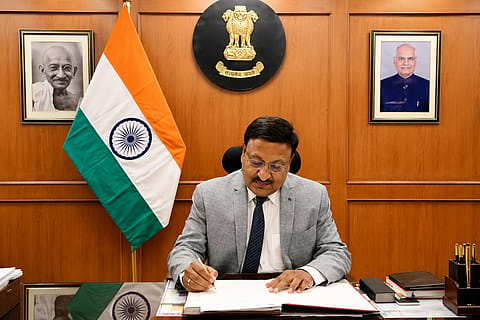
Rajiv Kumar | Credits: PIB
India's largest private lender HDFC Bank on Monday appointed former finance secretary and former chief election commissioner (CEC) Rajiv Kumar as its part-time chairman, subject to approval from the Reserve Bank of India (RBI), ending a three-month search for a permanent chairman following the resignation of Atanu Chakraborty.
The bank's board approved Kumar's appointment as an additional director (independent director) for a four-year term effective June 30, subject to shareholder approval. It also approved his appointment as part-time chairman for a period of three years from a date to be approved by the RBI.
Architect of India's banking reforms
Kumar is widely regarded for his transformative role in revitalising India's banking and financial sector during a period of significant systemic stress from 2017-2020.
A 1984-batch IAS officer, Kumar retired as Finance Secretary in February 2020 after serving as Secretary, Department of Financial Services, where he spearheaded several structural reforms in the banking sector. The bank said he led the "4R strategy" of Recognition, Resolution, Recapitalisation and Reforms, which helped clean up public sector bank balance sheets through transparent recognition and provisioning of bad loans, enforcement of the Insolvency and Bankruptcy Code (IBC) framework and restoration of credit discipline.
During his tenure, Kumar oversaw the government's bank recapitalisation programme involving capital infusion of more than ₹3 lakh crore, aimed at strengthening bank balance sheets and reviving credit growth. He also played a key role in improving governance standards and financial discipline following the non-performing asset (NPA) crisis.
The filing credits him with leading the consolidation of public sector banks, merging multiple lenders into stronger institutions to improve operational efficiency, scale and competitiveness. It also highlights his role in strengthening governance and risk management through technology-driven monitoring of large loan exposures, tighter fraud surveillance and enhanced regulatory oversight.
Beyond banking reforms, Kumar supported financial inclusion by strengthening the Jan Dhan ecosystem and expanding access to banking services, digital payments, insurance and pension schemes for underserved sections of society. He also advanced reforms in the pension sector, including improvements to the National Pension System (NPS), while helping strengthen coordination between the government, RBI and other financial regulators on key policy initiatives.
The bank further noted that Kumar enhanced deposit insurance coverage from ₹1 lakh to ₹5 lakh during his tenure and served on several key financial sector bodies, including the RBI's Central Board, the Financial Stability and Development Council, the Bank Board Bureau, and the boards of State Bank of India and NABARD.
Kumar later served as India's 25th Chief Election Commissioner, overseeing the 2024 Lok Sabha elections that saw participation of around 642 million voters, including 312 million women electors, according to the filing.
Appointment follows governance episode
Kumar's appointment comes after former chairman Atanu Chakraborty resigned in March, citing certain practices at the bank that were "not in congruence" with his personal values and ethics. Following his exit, independent director Keki Mistry was appointed interim part-time chairman, a role he is expected to hold until September 18. Kumar's appointment, subject to RBI approval, is expected to ensure a seamless transition in the bank's board leadership.
Chakraborty's exit triggered an independent legal review by international law firms Wilson Sonsini Goodrich & Rosati and Wadia Ghandy & Co.
{{#most-powerful-women-snapshot-individual.slug}} {{/most-powerful-women-snapshot-individual.slug}} {{^most-powerful-women-snapshot-individual.slug}} {{/most-powerful-women-snapshot-individual.slug}} {{#showRanking}} {{current-rank}} {{/showRanking}} {{#photo.0.url}}
{{name}}
Last week, HDFC Bank said the review found no evidence to substantiate Chakraborty's concerns after examining board records, documents and interviews. Separately, Chakraborty said his resignation was intended as a "call of conscience" rather than an allegation requiring legal scrutiny.
However, in an earlier interaction with Fortune India, Chakraborty maintained that his resignation was intended as a "call of conscience" rather than an allegation requiring legal scrutiny.
“I am glad that the legal compliance exercise found no governance issues of concern… My resignation was more for the bank’s board and the highest echelons within the bank to introspect upon practices taking place,” Chakraborty had said.
The appointment also comes as HDFC Bank prepares to seek regulatory approval for a third term for managing director and chief executive officer Sashidhar Jagdishan after the board decided to proceed with his reappointment following the completion of the governance review.
Follow Fortune India
NEXT STORY