How the Adani airport play is taking shape
/ 4 min read
Adani Airports manages eight airports, including Mumbai and Ahmedabad, and handles roughly 95 million passengers annually.
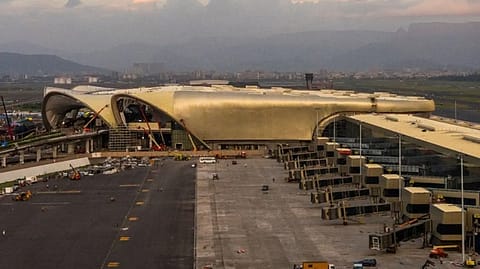
Adani Airport operates eight airports in Mumbai, Ahmedabad, Lucknow, Mangaluru, Jaipur, Guwahati, Thiruvananthapuram, and Navi Mumbai. | Credits: NMIA's X account
India now has the world’s third most valuable airport operator. And that has come about in seven years.
Although privately held, Adani Airports is now worth a staggering $18 billion after raising $1 billion from investors such as Alpha Wave Global, Premji Invest, Temasek Holdings Pte and BlackRock Inc, as it sets its sights on international ambitions alongside domestic expansion.
This week's fundraising is also the first foreign investment in the conglomerate's airport unit, after it cemented itself as India’s largest private airport player by the number of airports. Adani Airports manages eight airports, including Mumbai and Ahmedabad, and handles roughly 95 million passengers annually.
Set up in 2019, shortly after the Centre decided to privatise some government-controlled airports, Adani has been on an ambitious trajectory, including a ₹20,000 crore investment into an airport-led urban development program, spread over 655 acres in the country.
Crucially, the fundraise comes at a time when rumours have been rife about the airport operator's plan to set up its own airline, or possibly acquire one, as it looks to expand its aviation play under Jeet Adani, Gautam Adani’s son.
Adani Airport operates eight airports in Mumbai (CSIA), Ahmedabad, Lucknow, Mangaluru, Jaipur, Guwahati, Thiruvananthapuram, and Navi Mumbai. “The portfolio is built on long-period concessions with a hybrid-till tariff framework, providing long-dated, visible cash flows underpinned by India's structurally underpenetrated aviation market,” brokerage firm Jefferies said in a note. “AAHL sits within AEL's incubation model — the same playbook that previously housed other group Companies like Adani Ports, Adani Power, Adani Energy Solutions (among others) — before their eventual demerger and independent listing.”
The Adani group’s foray and its rise to become India’s largest airport operator have been rather swift. In February 2019, when the Indian government decided to invite private players to take over, upgrade and operate the airports of Lucknow, Jaipur, Thiruvananthapuram, Mangaluru, Guwahati, and Ahmedabad, the group offered the highest per-passenger fees to AAI in its bids.
Then, in 2020, the company acquired Mumbai airport from Hyderabad-based GVK Group, helping it emerge as India’s largest airport operator. Today, the group also runs Mumbai’s second airport, the Navi Mumbai International Airport, a ₹16,700 crore greenfield airport co-developed by the group and CIDCO. The airport began domestic operations in December 2025 and launched international passenger flights to destinations like Abu Dhabi shortly after.
Big play
Over the last few years, the group has also expanded its aviation business to newer frontiers, signing an agreement with Brazilian aircraft maker Embraer. Under the strategic partnership, the two companies are to develop a regional transport aircraft (RTA) ecosystem in India, in addition to collaborating on aircraft manufacturing, supply chain development, maintenance, repair and overhaul (MRO) services, and pilot training.
Days later, the Adani group also announced a strategic partnership with Italy’s Leonardo to develop a helicopter manufacturing ecosystem in the country. Today, the airport business handles 23% of India’s passenger traffic, 21% of air traffic movements, and 29% of air cargo.
“AAHL handled around 95mn passengers in FY26, and we expect traffic to increase to around 150mn by FY31, implying a 9% CAGR,” Jefferies notes. “The key driver is the phased ramp-up of Navi Mumbai International Airport, supported by capacity additions and growth across its other airports. Mumbai Airport is currently capacity constrained, limiting near-term traffic growth, with incremental demand from the Mumbai Metropolitan Region expected to be largely captured by Navi Mumbai Airport.”
{{#most-powerful-women-snapshot-individual.slug}} {{/most-powerful-women-snapshot-individual.slug}} {{^most-powerful-women-snapshot-individual.slug}} {{/most-powerful-women-snapshot-individual.slug}} {{#showRanking}} {{current-rank}} {{/showRanking}} {{#photo.0.url}}
{{name}}
Mumbai Airport, India’s second-largest airport by passengers, is currently undertaking phased terminal refurbishment over the next 3-5 years, which will help it increase capacity from around 55 million to around 60 million passengers. Navi Mumbai airport, meanwhile, offers an even longer runway for traffic growth, scaling from 20 million to 90 million over time.
The company has also outlined a ₹1 lalkh crore capex plan over five years across air-side infrastructure, terminal expansion and city-side development initiatives. Airports are among the most attractive infra assets because of their long concession lives, regulated aero cash flows, and diverse non-aero revenue streams.
“Unlike traditional transport utilities, airports can monetize the same pax base across retail, duty-free, lounges, F&B, cargo, ground handling, fuel farms, hospitality & cityside real estate,” says Jefferies. “This creates a diversified earnings model where sustained pax growth drives both regulated revenues and scalable, high-margin ancillary income.”
Into this mix, the Indian government is now looking to open more airports, which could attract the group's interest. It has already given in-principle approval for 11 AAI airports across five 50-year PPP bundles: Amritsar–Kangra, Raipur–Aurangabad, Bhubaneswar–Hubballi, Tiruchirappalli–Tirupati and Varanasi–Gaya–Kushinagar.
An airline play too
As it goes aggressive on the airport side, all eyes are also on the airport’s airline play. While the company has denied any such move, a proposal by the group is still reportedly pending before the government to ease rules for airport operators to run airlines.
Demand for new airlines in the domestic sector was also fueled by the IndiGo crisis last year, when the airline, which controls around 66% of the domestic market, plunged into crisis after canceling thousands of flights due to inadequate regulatory preparedness, stranding thousands of passengers at airports.
The IndiGo cancellation fiasco became a nationwide catastrophe, with as many as 1,600 of its 2,200 daily flights halted as IndiGo grappled with a new rest-norm implementation imposed by the Indian government for flying crew. The turmoil forced the government to step in and cut IndiGo’s schedule by 10%.
Meanwhile, Air India, the second-largest airline by market share, has faced its own crisis and has been heavily criticised for its slow turnaround since the Tata Group's 2021 acquisition. The airline has also been fighting a perception crisis following the crash of a Boeing 787 Dreamliner that proved fatal to as many as 260 people.
Into this mix came speculation about the Adani group. “The only positive is to avoid a duopoly,” Alok Anand, the chairman of Acumen Aviation, an aircraft asset management and leasing company, had told Fortune India earlier. “The negatives are many, such as the conflict of interest, where the airport operator controls all key resources like slots, stands, maintenance areas, allocation, and commercial facilities. This could lead to discrimination against other airlines, which is difficult to prove but commercially significant. Even Dubai, which has government-owned airlines, is not spared from such allegations.”
So, what does the play look like now, especially with the company flush with funds? “AAHL controls a strategically important airport portfolio with long concession tenures, giving visibility on cash flows and capacity expansion,” Jefferies notes. “India’s air travel market remains structurally underpenetrated, and rising incomes, urbanization and airline fleet additions should support long-term traffic growth.”
Follow Fortune India
NEXT STORY