India Inc backs Budget 2026, cites capex push, manufacturing focus, and policy certainty
/ 3 min read
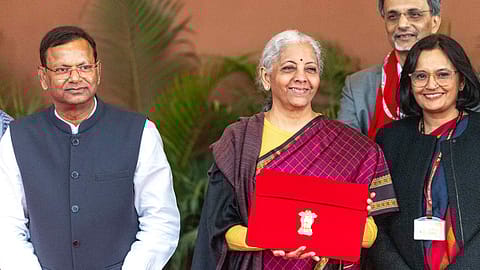
Finance Minister Nirmala Sitharaman. | Credits: Narendra Bisht
India Inc backs Budget 2026, cites capex push, manufacturing focus, and policy certainty
India Inc has praised the Union Budget 2026 for its focus on long-term growth, policy continuity, and fiscal discipline. The budget emphasises manufacturing, infrastructure, and sustainable growth, reinforcing India's position as a competitive investment destination. Industry leaders highlight the benefits of increased capital expenditure, tax incentives, and strategic initiatives in sectors like defense, technology, and energy transition.
This summary is AI-generated, and Fortune India is not responsible for its content or any associated copyright issues.
Industry leaders said the Union Budget signals continuity in policy direction, a firm commitment to sustainable, and inclusive growth, and a clear intent to strengthen India’s position as a globally competitive investment destination.
THIS STORY FEATURES
Finance Minister Nirmala Sitharaman. | Credits: Narendra Bisht
India Inc and market participants have welcomed the Union Budget 2026, describing it as pro-investment, fiscally credible, and focused on long-term structural growth rather than short-term incentives.
Industry leaders said the Budget signals continuity in policy direction, a firm commitment to sustainable, and inclusive growth, and a clear intent to strengthen India’s position as a globally competitive investment destination.
Haigreve Khaitan, Senior Partner at Khaitan & Co, said the Budget sends “a clear signal that India is pursuing growth without sacrificing fiscal credibility,” a factor he said is crucial in a volatile global environment. By sustaining high public capital expenditure while tightening deficit and debt metrics, the government has reinforced confidence in India’s macroeconomic framework and long-term policy direction, he said. Khaitan pointed to a shift from headline incentives to structural enablers, with a focus on manufacturing depth, logistics efficiency, urban growth corridors and capital-market liquidity. The expansion of safe-harbour regimes and clearer treatment for global services, cloud infrastructure and bonded-zone operations, he added, signal greater predictability and lower dispute risk for investors.
Baba Kalyani, Chairman and Managing Director of Bharat Forge Ltd, said the Union Budget reflects Prime Minister Narendra Modi’s “stable, strong and visionary leadership,” anchored in policy continuity and fiscal discipline. Congratulating Finance Minister Nirmala Sitharaman on presenting her ninth successive Budget, Kalyani said it strikes a balance between macroeconomic stability and investment-led growth. He highlighted the renewed thrust on manufacturing, modern infrastructure, high-speed rail, healthcare and urban development, along with the progression of the semiconductor programme to ISM 2.0 and the announcement of rare-earth corridors. Kalyani also welcomed allocations for carbon capture and decarbonisation and said defence, with the second-highest allocation and a sharp rise in the modernisation budget, has emerged as a key pillar. He lauded the tax holiday for data centres and cloud services and said the focus on university-industry clusters and AI-led productivity would help India leverage its demographic dividend.
ReNew Founder, Chairman and CEO Sumant Sinha said Budget 2026 “delivers clarity and confidence” while balancing youth employment generation with disciplined fiscal consolidation. He said lower import duties on essential inputs and machinery would make it easier to build domestic manufacturing for strategic and export-oriented products, while the emphasis on critical minerals, carbon capture and next-generation nuclear technologies marks a decisive push towards the energy-transition future.
Mahindra Group CEO and Managing Director Anish Shah said the Budget enhances India’s global competitiveness and takes meaningful steps towards atmanirbharta. He welcomed the emphasis on frontier and strategic manufacturing, including schemes such as Biopharma Shakti and ISM 2.0, and the increase in capital expenditure to ₹12.2 lakh crore for FY27. Shah said the proposed ₹10,000 crore SME growth fund and incentives for industry clusters would support job creation, enterprise scaling and competitiveness, while initiatives around critical minerals and rare-earth corridors would strengthen industrial resilience.
Sanjay Kaul, Managing Director and Group CEO of GIFT City, said the Budget provides strong long-term tax certainty for entities operating from India’s first International Financial Services Centre. The extension of the tax deduction window and clarity on tax rates, he said, would enhance India’s offshore financial competitiveness and strengthen GIFT City’s position as a global financial hub.
Market experts offered a more nuanced view. Axis Mutual Fund CIO Ashish Gupta said the Budget is fairly conservative, with measured assumptions on nominal GDP and tax growth. While maintaining a stable tax regime, he said higher STTs and the borrowing programme could disappoint capital markets. Shreyash Devalkar, Head–Equity at Axis Mutual Fund, said capex growth of around 11%, particularly in defence and power, stood out positively, while Devang Shah, Head–Fixed Income, flagged higher-than-expected gross borrowing that could put some upward pressure on bond yields.
Vivek Sen, India Director at Climate Policy Initiative, said Budget 2026 links climate resilience with economic growth and lays out a pathway for India’s long-term global leadership. He pointed to allocations for municipal bodies, MSMEs, manufacturing and skills, and measures to deepen corporate bond markets as key enablers of a low-carbon transition.
Rajiv Sabharwal, MD and CEO of Tata Capital, said the Budget adopts a forward-looking approach, positioning capital expenditure as a long-term productivity driver while maintaining fiscal prudence with a projected deficit of 4.3% of GDP.
Motilal Oswal Financial Services Chairman and Co-founder Raamdeo Agrawal called the Budget a “masterstroke for India’s digital future,” highlighting the tax holiday for data centres and greater clarity for IT services and GCCs. While cautioning about near-term market headwinds from higher STT, he said the long-term earnings story remains intact, supported by fiscal discipline and a strong capex push.

Follow Fortune India
NEXT STORY