India's headline inflation rises to 0.71% in November after hitting a record low in October
/ 3 min read
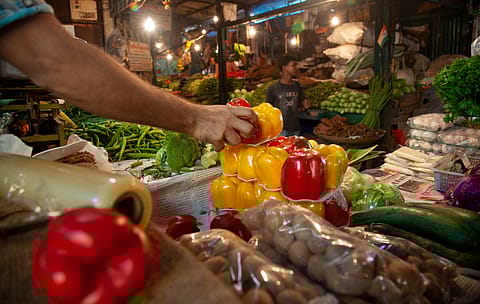
In the F&B segment, as many as 8 of the 12 sub-segments witnessed a hardening in their YoY prints in November 2025, as compared to October 2025. | Credits: Fortune India
India's headline inflation rises to 0.71% in November after hitting a record low in October
After hitting a record low in October, India's inflation climbed to 0.71% in November, influenced by rising food and fuel prices. The Consumer Price Index data indicate a significant increase, with rural inflation at 0.10% and urban inflation at 1.40%. The Reserve Bank of India projects a softer inflation outlook for the coming fiscal year.
This summary is AI-generated, and Fortune India is not responsible for its content or any associated copyright issues.
The Consumer Price Index data revealed rural inflation at 0.10% and urban inflation at 1.40%. The Reserve Bank of India forecasts a more moderate inflation rate for the next fiscal year, with expectations of a 2% rate.
In the F&B segment, as many as 8 of the 12 sub-segments witnessed a hardening in their YoY prints in November 2025, as compared to October 2025. | Credits: Fortune India
After declining to an all-time low in October 2025, India’s headline inflation, measured by the Consumer Price Index (CPI), rose to 0.71% in November from 0.25% in October, according to the latest data released by the Ministry of Statistics and Programme Implementation (MoSPI). The rise in headline inflation in November was mainly due to higher prices of certain food items, including vegetables, eggs, meat and fish, and spices. Fuel and light also contributed to the increase in inflation.
The retail inflation rose 46 basis points compared to October. “Year-on-year inflation rate based on All India Consumer Price Index (CPI) for November, 2025 over November, 2024 is 0.71% (Provisional). There is an increase of 46 basis points in headline inflation of November 2025 in comparison to October 2025.”
Food inflation, based on the All India Consumer Food Price Index (CFPI), stood at -3.91% November 2025, an increase of 111 basis points in comparison to October 2025. Corresponding inflation rates for rural and urban are –4.05% and -3.60%, respectively.
The headline inflation came in at 1.44 in September, marking a drop from 2.07% recorded in August. The faster-than-anticipated decline in October inflation was led by a correction in food prices, contrary to the usual trend witnessed during September and October.
Commenting on the retail inflation data, Aditi Nayar, Chief Economist, Head - Research & Outreach, ICRA said the YoY prints for most food items have hardened during December 1-11, 2025 vis-à-vis November 2025, even as a fairly large number of these remained in the deflationary zone. "A continued base-normalisation and the hardening in prices of some vegetables could make the headline CPI inflation cross 1.5% in the next print, which will be the last before the next MPC. In our view, the evolving inflation-growth outlook, as well as the fiscal policy measures unveiled by the next Union Budget, will guide the MPC's next decision. Our base case suggests a pause in the MPC's February 2026 policy review."
Key Highlights of November Inflation data:
Rural inflation: Headline inflation rose to 0.10% in November 2025 from -0.25% in October 2025. CFPI-based food inflation increased to -4.05% from -4.85% in October.
Urban Inflation: Headline inflation increased to 1.40% in November 2025 from 0.88% in October. Food inflation rose to -3.60% from -5.18% in October.
Housing Inflation: Year-on-year housing inflation for November 2025 is 2.95%, marginally lower than 2.96% in October. The housing index covers only the urban sector.
Education Inflation: Year-on-year education inflation for November 2025 is 3.38%, down from 3.54% in October. This reflects combined rural and urban data.
Health Inflation: Year-on-year health inflation for November 2025 is 3.60%, compared with 3.81% in October. Figures are combined for rural and urban sectors.
Transport & Communication: Inflation stood at 0.88% in November 2025, slightly lower than 0.94% in October. Data is combined for rural and urban areas.
{{#most-powerful-women-snapshot-individual.slug}} {{/most-powerful-women-snapshot-individual.slug}} {{^most-powerful-women-snapshot-individual.slug}} {{/most-powerful-women-snapshot-individual.slug}} {{#showRanking}} {{current-rank}} {{/showRanking}} {{#photo.0.url}}
{{name}}
Fuel & Light: Inflation rose to 2.32% in November 2025 from 1.98% in October. Data is combined for rural and urban sectors.
In its inflation outlook, RBI Governor Sanjay Malhotra, in his statement, said food supply prospects have improved on the back of higher kharif production, healthy rabi sowing, adequate reservoir levels and conducive soil moisture. He projected the FY26 inflation to fall to 2%.
“Barring some metals, international commodity prices are likely to moderate going forward. Overall, inflation is likely to be softer than what was projected in October, mainly on account of the fall in food prices. Considering all these factors, CPI inflation for 2025-26 is now projected at 2% with Q3 at 0.6%, and Q4 at 2.9%. CPI inflation for Q1:2026-27 and Q2 is projected at 3.9% and 4%, respectively. The underlying inflation pressures are even lower as the impact of the increase in the price of precious metals is about 50 bps. The risks are evenly balanced,” said the RBI Governor.
Follow Fortune India
NEXT STORY