India’s office market hits record high in 9M 2026 as GCCs, BFSI power leasing
/ 2 min read
In the July-September quarter, office absorption stood at around 21 million sq. ft, up 6% from a year earlier, CBRE report says.
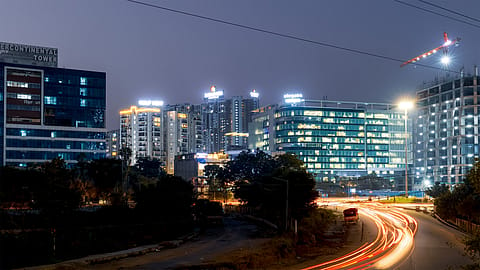
GCCs continued to drive office demand, accounting for around 41% of total office take-up in Q3 and 42% during 9M 2026. | Credits: Shutterstock
India’s office sector recorded a record 66.4 million sq. ft of absorption in the first nine months of 2026, marking the highest leasing volume for any nine-month period, according to CBRE Research. Absorption rose 8% year-on-year, reflecting sustained demand from global and domestic occupiers.
In the July-September quarter, office absorption stood at around 21 million sq. ft, up 6% from a year earlier. Despite geopolitical uncertainty in the Middle East, occupier decision-making and deal closures remained broadly resilient, supported by strong market fundamentals.
GCCs retain top spot in office leasing
Global capability centres (GCCs) continued to drive office demand, accounting for around 41% of total office take-up in Q3 and 42% during 9M 2026.
GCC leasing reached 8.7 million sq. ft. in Q3, taking 9M absorption to a record 28 million sq. ft. Leasing volumes and the number of GCC deals increased 16% and 13%, respectively, year-on-year.
GCCs accounted for 59% of large-format transactions involving more than 100,000 sq. ft during the quarter. Bengaluru and Hyderabad remained the preferred markets for large deals, together accounting for 64% of such transactions. BFSI companies and flexible workspace operators were the other key drivers of large-format demand.
New office supply hits record
New development completions reached a record 51 million sq. ft during 9M 2026, up 18% year-on-year, led by Bengaluru, Hyderabad, and Pune.
In Q3, supply additions rose 26% year-on-year to around 19 million sq. ft, although they moderated sequentially following a particularly strong previous quarter.
More than half of the new supply comprised Grade A+ assets, highlighting occupiers’ growing preference for high-quality workplaces. Green-certified buildings accounted for around 80% of quarterly additions, while integrated technology parks made up nearly 89% of new supply.
77% of occupiers plan office expansion
The outlook for office demand remains firm. CBRE’s 2026 India Office Occupier Survey found that nearly 77% of occupiers expect to expand their India office portfolios over the next two years.
Bengaluru, Hyderabad, Delhi-NCR, and Mumbai are expected to remain key demand centres, supported by established business ecosystems and deep talent pools. Chennai and Pune are also likely to see increased interest, while tier-II cities could gain a more selective role in expansion plans.
Nearly half of the occupiers surveyed plan to operate across two or more cities, pointing to greater portfolio diversification.
{{#most-powerful-women-snapshot-individual.slug}} {{/most-powerful-women-snapshot-individual.slug}} {{^most-powerful-women-snapshot-individual.slug}} {{/most-powerful-women-snapshot-individual.slug}} {{#showRanking}} {{current-rank}} {{/showRanking}} {{#photo.0.url}}
{{name}}
BFSI, E&M widen demand base
Office demand is broadening beyond technology. BFSI, engineering and manufacturing (E&M), and technology companies are expected to remain key demand drivers as businesses invest in digital capabilities and specialised talent.
More than 80% of BFSI and E&M firms surveyed plan to expand their office footprint over the next two years, compared with 77% of technology companies. Life sciences, semiconductors and automotive are also expected to contribute to future demand.
Flexible workspaces are gaining traction, with 67% of occupiers planning to include flex space in their portfolios over the next two years.
AI to reshape workplace requirements
AI adoption is widespread, with around 93% of occupiers reporting some level of adoption. However, 57% expect no significant near-term impact on office space requirements.
Instead, AI is expected to influence workplace design and building technology. Occupiers are increasingly looking for smart building systems, predictive maintenance, AI-enabled security, adaptive layouts and collaborative spaces.
Follow Fortune India
NEXT STORY