
The FAQs are AI-generated, and Fortune India is not responsible for its content or any associated copyright issues.
Infosys CEO Salil Parekh’s FY26 pay rises to ₹82.6 crore; company crosses $20 billion in annual revenue for the first time
/ 4 min read
The IT services major reported revenue of ₹1.78 lakh crore and net profit of ₹29,440 crore in FY26.
THIS STORY FEATURES
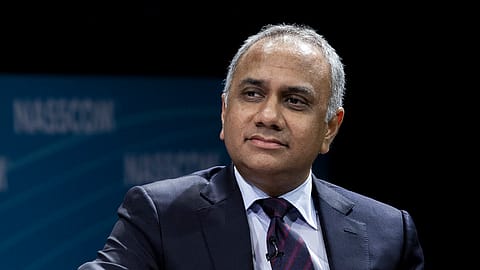
Salil Parekh, CEO, Infosys | Credits: Sanjay Rawat
Infosys chief executive officer and managing director Salil Parekh earned ₹82.6 crore in total compensation in FY26, 742 times the median salary of an Infosys employee, according to the company’s latest integrated annual report, as India’s second-largest IT services exporter sharpened its pitch as an “AI-first” company.
The compensation — up 2.5% from the previous year — comprised a fixed salary of ₹8.5 crore, variable pay of ₹23.35 crore and perquisites from exercised restricted stock units (RSUs) worth ₹50.75 crore. The bulk of Parekh’s remuneration came from stock-linked incentives tied to long-term performance.
The disclosure comes at a time when India’s $300-billion IT industry is navigating slowing discretionary spending, AI-led productivity disruptions and growing investor scrutiny around executive compensation and workforce costs.
Infosys crossed the $20-billion annual revenue milestone for the first time in FY26, reporting revenue of ₹1.78 lakh crore and net profit of ₹29,440 crore. The company also reported $14.9 billion in large deal total contract value (TCV), stressing continued demand for long-term digital transformation programs despite macroeconomic uncertainty.
In his letter to shareholders, Parekh positioned Infosys squarely at the centre of the global AI transformation wave.
“Last year marked an inflection point as AI began evolving from experimentation to enterprise-scale adoption,” Parekh said in the annual report.
“At Infosys, we acted early and decisively to lead this transition – shifting our portfolio, investing in talent, and scaling partnerships to help clients unlock value from AI at speed and scale,” he added.
The company said AI-led programs are now deployed across 90% of its top 200 clients. Infosys also disclosed that more than 4,600 AI projects are currently underway globally.
Parekh said the company’s AI strategy is built around six focus areas — “strategy & engineering, data, process, legacy modernization, physical AI, and trust” — which together represent a “US$300 billion opportunity”.
The annual report repeatedly stressed that AI is moving beyond experimentation into large-scale deployment.
“Across boardrooms and operating reviews, the conversation has turned from possibilities to outcomes,” the company said in its opening note. “Enterprises that began with curiosity and pilots are asking sharper questions.”
RANK
COMPANY NAME
REVENUE
(INR CR)
(INR CR)
{{#current-rank}} {{current-rank}} {{/current-rank}} {{^current-rank}} {{rank}} {{/current-rank}} {{name}} {{#revenue}} {{revenue}} {{/revenue}} {{^revenue}} {{noi}} {{/revenue}}
Infosys chairman Nandan Nilekani directly addressed fears that generative AI could eventually reduce the need for software engineers and IT services firms.
“More than 3 years after the launch of Generative AI, we can unequivocally say that Infosys is more relevant than ever, and we have a bright future in front of us,” Nilekani wrote.
“The existential question asked of us: If coding becomes automated, then why are we needed at all?” he said, before arguing that testing, cybersecurity, architecture modernization and governance would continue creating large opportunities for IT services firms.
Nilekani also warned that “technical debt is no longer a background cost” but has become “a strategic liability”.
The report strongly positions Infosys as a large-scale enterprise AI orchestrator rather than merely a software vendor. It cites AI-led client engagements with companies including Liberty Global, Microsoft, Hertz, Mondelēz International and Dutch bank ABN AMRO.
Among the highlighted projects, Infosys said it helped Hertz modernize nearly three million lines of COBOL code using multimodal large language models and AI-powered reverse engineering. The company claimed the transformation enabled “60% faster modernization timelines”.
In another engagement, Infosys said its AI-led support systems helped Microsoft reduce root-cause analysis turnaround times by 40% and improve critical incident response times by 33%.
Infosys also disclosed that 84% of its workforce is now “AI-enabled”, while more than 20,000 college graduates were recruited during FY26.
The company maintained that AI productivity gains would not necessarily translate into job losses. Both Nilekani and Parekh stressed reskilling and redeployment rather than workforce reduction.
“We will completely prepare our talent for this new age and redistribute those released by productivity to grow new accounts and offerings,” Nilekani said.
Infosys ended FY26 with 3.28 lakh employees and 1,965 active clients across 59 countries.
The annual report also shed light on the company’s leadership structure and governance changes. Nilekani continues as chairman and promoter-director, while Parekh’s current term as CEO runs until March 2027. Former Hindustan Unilever chairman Nitin Paranjpe was appointed vice chairman effective April 30, 2026.
Infosys said it remained carbon neutral for the seventh consecutive year and reiterated its ambition to move from “carbon neutrality to climate positivity”.
The company’s adjusted operating margin stood at 21 per cent in FY26, though Infosys disclosed that implementation of India’s labour codes led to an additional gratuity-related liability of ₹1,289 crore during the year.
IT CEO pay race intensifies
Parekh remains among the highest-paid executives in Indian IT, although HCLTech CEO C Vijayakumar continues to top the compensation charts.
Vijayakumar earned about ₹94.6 crore in FY25, according to HCLTech’s annual report, and the company has approved a revised compensation structure that could take his FY26 pay to roughly ₹154 crore.
By comparison, TCS CEO K Krithivasan earned around ₹26.5 crore in FY25, while Wipro CEO Srinivas Pallia drew roughly ₹53.6 crore, according to company disclosures and industry reports.
Persistent Systems CEO Sandeep Kalra has also emerged as one of the industry’s better-compensated executives amid the company’s rapid AI-led growth, though its FY26 remuneration disclosures are yet to be fully detailed publicly.
The widening gap between top executive compensation and median employee pay is increasingly becoming a global governance issue, particularly as companies aggressively deploy AI-driven productivity tools while keeping overall headcount growth restrained.
Still, Infosys has framed the AI transition as a long-term opportunity rather than a threat.
“The future enterprise will be enabled by those firms that have built long and trusted client relationships, have a successful track record of execution, and can blend the old with the new,” Nilekani wrote.
“This is what Infosys will do best.”
Frequently Asked Questions
NEXT STORY