How Araku Coffee is trying to get Indians to pay a premium for home-grown specialty coffee
/ 4 min read
The speciality coffee producer claims to pay 60% more to its farmers than its competitors, making Araku coffee farmers among the highest paid coffee producers in the world.
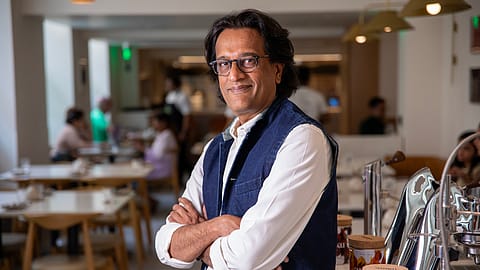
Manoj Kumar, co-founder, Araku Coffee | Credits: Fortune India
Araku Coffee founder Manoj Kumar (CEO, Naandi Foundation), is staring at an interesting problem—the quality of coffee that he sources from close to 100,000 farmers in Araku Valley of Andhra Pradesh is getting better by the day. So, how is that a problem? “It’s a good problem to have,” he says.
Kumar claims that while 4,000 estates produce 85-86 score (out of 100) coffee (anything above 80 points is considered high-quality specialty coffee, according to the Speciality Coffee Association’s grading scale), around 30,000 farms produce a quality of 80-82, and the remaining 60,000 are steadily upping the game. “My point is, if I keep getting this quality coffee, it will be a crime not to pay the farmers for the quality that they are producing. So, we have started paying higher prices.”
The speciality coffee producer, claims Kumar, pays 60% more to its farmers than its competitors, making Araku coffee farmers among the highest paid coffee producers in the world. “Last year, our prices went up as high as ₹1,000-1,200 a kg, and the lowest we paid was ₹850 per kg. Just to give you a perspective, the average coffee export market buys at ₹550 for this quality. I am talking about the cherry price,” Kumar further explains.
He has also decided to sell only roasted coffee, so that he is able get a better premium. “When I opened my first café in Paris in 2019, I was a 100% green coffee exporter. This year, roasted coffee was as high as 80%. The plan is to move to 100% roasted coffee.” Here comes the dilemma—global coffee buyers are now wanting to buy lesser coffee, because of the premium. If they were earlier buying 100 tonnes, today they are buying only 10 tonnes. “They are telling me they will mix my coffee with a few others, and give a blended coffee. According to them, the moment our coffee comes into the blend, it increases the average quality. I respect their decision.”
Spreading the net wider
So, how is Kumar trying to bridge the gap?
Selling less coffee (even though at a higher value) has impacted revenue. Is upping the price of the coffee at his cafés an option? “This has been an interesting challenge where my retail sales and marketing team has to compete with the base of farmers' upgradation of their quality and estates. Or else, they will give up on this great India story.” The specialty coffee brand, has therefore, started investing heavily on ecommerce and has been finding ways to reach out to Indian specialty coffee lovers. Kumar believes that Indian coffee enthusiasts are ready to pay a premium. “Some of our nano-lots were sold within 24 hours, and they were largely B2C consumers.”
Araku has also widened its net in the B2B segment by selling its coffee to institutions as well as premium coffee chains, which only offer organic coffee. “So, for instance, the likes of Facebook and Google, or any company that is conscious about the ecological advantages of our coffee, are willing to buy. We have the likes of Pret-A-Manger, which use our organic coffee. We have a few others too. More and more are wanting to buy Araku coffee.”
But B2B is a low-margin business. The margins in a consumer-facing business is way higher, says Kumar. Therefore, the specialty coffee-maker has chosen to open more cafés. Araku has three cafés in Paris. In India, it has two cafés in Bengaluru and two in Mumbai.
Cafés, says Kumar, can be turned into interesting education spaces and societal places for community exchange. “If you have a certain ethical positioning, the way you grow coffee, the way you treat your farmers, the way you brew, you have a chance to build a narrative. The café customers would also end up being my online customer for buying coffee for their home.”
A cup of coffee for ₹1,000?
If Araku is paying its farmers ₹1,000-1,200 for a kg of coffee, what stops it from pricing its coffee at a premium at its café? A cup of speciality coffee in most cafés in India is priced between ₹300-400. Why can’t Araku have a ₹1,000 cup? “If I tell my team to put a ₹1,000 coffee, they will have fever for two days,” jokes Kumar. “We don't have a culture to pay for quality. We have a value mindset. We only pay for a brand that is famous abroad,” he cribs.
Kumar had gone café hopping in New York recently. “We are starting our New York operations. My colleague took me to New York's best cafés. In one of them, the coffee was priced at $35 (coffee in most cafes in New York is priced in the $7-8 range). My immediate question was, 'do consumers pay that kind of price?', and I was told it does extremely well. My colleague told me the score of that coffee at best would be 75. And, the Araku farmers are close to a score of 90.”
{{#most-powerful-women-snapshot-individual.slug}} {{/most-powerful-women-snapshot-individual.slug}} {{^most-powerful-women-snapshot-individual.slug}} {{/most-powerful-women-snapshot-individual.slug}} {{#showRanking}} {{current-rank}} {{/showRanking}} {{#photo.0.url}}
{{name}}
Kumar circles back to his obsession of offering a premium to his farmers who are producing the best quality coffee. He talks about Araku nanolot (high-quality coffee sourced from individual farms), which he claims were sold out within a week of launch.
“We had 15 nanolots last season, I had kept one or two (around 120 to 900 packs) to sell in India, and we were able to sell everything. When I look at the buyers, they were not only from South Mumbai or New Delhi, many of them were from places like Surat too,” he says. If there is anything that his café hopping escapade in New York has taught him, it is not just to pay his farmers the premium they deserve, but also price it at a substantial premium at his cafés. Interestingly, Kumar has chosen to sell all the nanolots this year within India and not in the export market.
Is a ₹1,000 Araku coffee on the cards? Kumar says his team is brainstorming to see if a few offerings on the menu could be priced at a premium. “We don’t want to premiumise to make money; we want to give our farmers the due they deserve.”
Follow Fortune India
NEXT STORY