JSW Steel plans massive expansion to achieve 50 MT capacity in India in five years
/ 3 min read
The company has lined up two big projects—at Dolvi in Maharashtra and Utkal in Odisha—to bolster its ambition of reaching 50 MT.
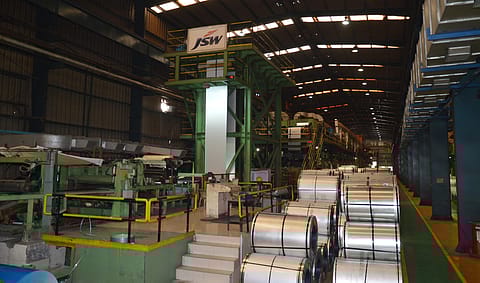
JSW Steel, the largest steel producer in the country, is targeting a massive expansion of its India production capacity to 50 million tonne (MT) per year by FY31. The company currently has 29.7 MT of steelmaking capacity in the country, excluding the recently acquired bankrupt steelmaker Bhushan Power and Steel Ltd (BPSL), which has a capacity of 4.5 MT. Including BPSL and overseas projects, the overall capacity is expected to touch 56 MT by FY31.
The company has lined up two big projects—at Dolvi in Maharashtra and Utkal in Odisha—to bolster its ambition of reaching 50 MT. The Dolvi Phase III expansion will increase the plant’s capacity to 15 MT from 10 MT. The project is scheduled for completion by September 2027. Long lead-time items have already been ordered and letters of credit established, company officials said.
The board has approved a 5 MT steel plant at a new site in Jagatsinghpur, Odisha. The project will be housed under its subsidiary, JSW Utkal Steel Ltd, and will entail a capital expenditure of ₹31,600 crore, with commissioning targeted by FY30. This project represents the first phase of development at the site, with expansion potential to 13.2 MT.
“We have already commenced the setting up of two 8 MT pellet plants at Jagatsinghpur, along with a 30 MT slurry pipeline to transfer iron ore from captive mines to this plant. The two pellet plants are expected to be commissioned by FY28,” the company said in its updates. The construction of the slurry pipeline, being set up by JSW Infrastructure Ltd, is progressing well and is expected to be commissioned in FY27, it added.
The company also cited brownfield expansion potential of about 5 MT at its Vijayanagar steel complex, along with a 4 MT brownfield green steel project. In addition, the management said it will selectively explore value-accretive acquisitions.
At the Kadapa 1 MT electric arc furnace (EAF) and structural mill project, technical and commercial discussions for equipment procurement are currently underway. The project is expected to be commissioned by FY29.
In line with its strategy to enhance downstream capabilities, the board has approved a 0.2 MT tinplate line and a 0.36 MT continuous galvanising line at the existing downstream plant in Rajpura, Punjab.
JSW Steel Q3 FY2026 results
The company’s consolidated capital expenditure stood at ₹3,482 crore during Q3 FY26 and ₹10,018 crore during the nine months of FY26. An additional spending of ₹5,000–6,000 crore is expected during the January–March period, company officials said.
Consolidated revenue from operations increased 11% to ₹45,991 crore, while net profit jumped 235% to ₹2,410 crore. The surge in profit was aided by net deferred tax assets of ₹1,439 crore relating to brought-forward unabsorbed depreciation in its subsidiary, Bhushan Power and Steel Ltd. The company’s net debt stood at ₹80,347 crore, with net debt-to-equity at 0.92 times and net debt-to-EBITDA at 2.91 times.
The Indian operations registered revenue from operations of ₹43,422 crore. Reported operating EBITDA was ₹6,400 crore, while profit after tax stood at ₹2,668 crore for the quarter.
The company announced a strategic joint venture for BPSL in December 2025 with Japan’s JFE Steel. Under the transaction, JFE will acquire a 50% stake in the BPSL steel business by investing ₹15,750 crore. This deal will enable a cash inflow of ₹32,000 crore and lead to substantial deleveraging of ₹37,000 crore for JSW Steel, the company said.
{{#most-powerful-women-snapshot-individual.slug}} {{/most-powerful-women-snapshot-individual.slug}} {{^most-powerful-women-snapshot-individual.slug}} {{/most-powerful-women-snapshot-individual.slug}} {{#showRanking}} {{current-rank}} {{/showRanking}} {{#photo.0.url}}
{{name}}
Management pinned its hopes on India’s economic growth, supported by GST rationalisation, a supportive monetary policy environment, benign inflation, and robust government capital expenditure. “Domestic demand remains healthy, with double-digit auto sales growth in Q3 FY26 and improving discretionary consumption. Rural indicators are also firm, supported by strong tractor and two-wheeler sales, higher kharif output, robust rabi sowing, and lower MNREGA demand. Central government capex remains on track, rising 28% in April–November 2025 despite some easing in October–November,” the company said. It added that commercial real estate trends remain robust, although residential sales have been modest. Conditions for private capital expenditure are improving, aided by better capacity utilisation and stronger balance sheets.
Follow Fortune India
NEXT STORY