Kotak Mahindra Bank CEO Vaswani explains why he is stepping down
/ 3 min read
Vaswani says with family commitments and having already rebuilt the bank franchise, the time seemed right to move on. KMB, meanwhile, will continue to look for more acquisitions after recent Deutsche Bank, Standard Chartered Bank deals, he says.
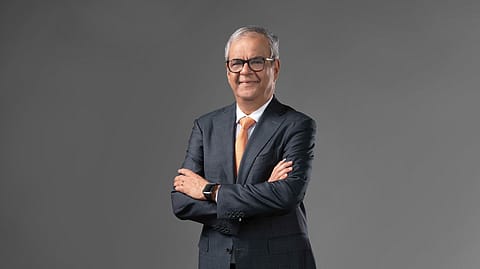
Ashok Vaswani, MD & CEO, Kotak Mahindra Bank | Credits: Kotak Mahindra Bank
Kotak Mahindra Bank’s (KMB) managing director and CEO Ashok Vaswani has broken the ice on his decision to not seek reappointment when his term ends on December 31, 2026. Personal family developments and having rebuilt the bank franchise towards a stronger growth path were the reasons for Vaswani to decide that the time had come to not extend his term.
Vaswani is the second non-promoter chief executive to be stepping down, after Dipak Gupta—a KMB veteran and part of founder Uday Kotak’s core management team—completed his term from September 2023 to December 2023, as interim managing director and CEO.
“There is never a good time to call it a day. My decision was well thought through. We have been doing hard, heavy lifting at the bank in recent years—to rebuilding the management team, cleaning up the personal banking, credit card and the microfinance book. All of this indicates that the bank is well set to accelerate its journey,” Vaswani told the media after announcing the bank’s Q1FY27 earnings.
“I have also become a grandfather, so my attention has shifted towards San Francisco,” Vaswani said, referring to the city where his daughter stays. “The Nomination and Remuneration Committee (NRC) will do what is right for the Kotak Group. I believe internally we have a strong bench and they will also look broader [for an outside candidate].”
Vaswani took charge of the bank from Gupta on January 1, 2024. Uday Kotak had stepped down from his role as MD & CEO on September 1, 2023.
Vaswani’s biggest challenge has been not just to build a new team—out of the shadow of Uday Kotak—but also build scale which would take Kotak Mahindra Bank closer to its nearest rival Axis Bank.
In the KMB annual report and message to shareholders on July 6, Vaswani said: “While our primary focus remains on organic growth, we will continue to pursue inorganic opportunities that enhance scale, capabilities, or customer reach, as evidenced by our recent acquisition of Deutsche Bank’s retail portfolio.”
In late June 2026, Kotak Mahindra Bank had announced that it had acquired Deutsche Bank’s retail banking, affluent private banking, and wealth management businesses in India.
The deal, valued at ₹281.7 crore, was executed on a slump sale basis. Approximately 1,000 Deutsche Bank employees in India are expected to join Kotak Mahindra Bank as part of the transaction. The Deutsche Bank business comprises approximately ₹29,000 crore in loans, ₹16,000 crore in deposits, and ₹10,500 crore in assets under management.
Earlier in October 2024, KMB announced that it had acquired the personal loan book of Standard Chartered Bank’s India business, further strengthening its position in the retail credit market.
“We will look at every opportunity: does a deal make strategic sense? Is it going to be financially accretive and attractive and will it create distraction for the management or create more boardroom talk. If the answer to the first two questions is ‘yes’ and ‘no’ for the last one, it is all fine.”
{{#most-powerful-women-snapshot-individual.slug}} {{/most-powerful-women-snapshot-individual.slug}} {{^most-powerful-women-snapshot-individual.slug}} {{/most-powerful-women-snapshot-individual.slug}} {{#showRanking}} {{current-rank}} {{/showRanking}} {{#photo.0.url}}
{{name}}
On Saturday, July 18, profit for KMB rose 26% year-on-year to ₹4,123 crore in Q1FY27 from ₹4,027 crore in the quarter-ended March 2026. Net interest margin for the bank fell to 4.53% from 4.46% for the corresponding period.
Net interest income for the bank edged up 9% to ₹7,928 crore in Q1FY27 from ₹7,876 crore for the corresponding period a year earlier.
Advances outstripped deposit growth for the bank in this quarter. Advances rose 15% year-on-year to ₹512, 249 crore for Q1FY27, led by strong home loan growth and institutional banking. Deposits grew 12% year-on-year to ₹5,72,820 crore from ₹5,12,838 crore level a year earlier. The CASA ratio for the bank, however, weakened to 40.3% in Q1FY27 from 43.3% a year earlier.
On the demand from FCNR(B) offerings to NRIs, Vaswani said: “This is an interesting opportunity. We will give it our best. It is important for the country,”. He said KMB will partner with banks in Asia and the Middle-East to enhance the proposition. “We are in advanced talks, it is work-in-progress.”
NEXT STORY