The FAQs are AI-generated, and Fortune India is not responsible for its content or any associated copyright issues.
MakeMyTrip sees conversational AI as the next paradigm shift in travel commerce
/ 2 min read
With its AI-powered assistant Myra, MakeMyTrip aims to simplify trip planning through natural conversations, voice interfaces and multilingual support, while unlocking the next wave of digital travel adoption beyond metros
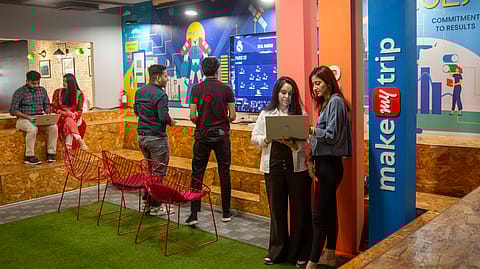
Representational Image | Credits: Sanjay Rawat
MakeMyTrip is positioning conversational AI as the next major shift in travel commerce, stating that the technology is taking the industry back to its roots of human-like conversations.
Speaking at Mumbai Tech Week, Group CEO Rajesh Magow said the travel industry has come “full circle” in the way consumers interact with booking platforms. Before the internet, travellers relied on conversations with travel agents to plan and book trips.
The rise of online travel platforms transformed the process into a self-service experience, with customers navigating websites and apps, using filters, rankings and recommendations to make decisions on their own.
Now, Magow believes AI is changing that dynamic again. “What do you think we are going back to with AI? It’s like full circle. We are going to conversation again. The only difference is the human agent is getting replaced by a digital agent,” he said.
According to Magow, traditional online journeys were designed around predefined flows, often requiring users to adapt their needs to the structure of a platform. Conversational AI, by contrast, allows travellers to start from any point, change their plans midway and express complex requirements naturally.
“AI is not necessarily an incremental feature and is clearly not going to be just one more additional thing that we do. AI is bringing the power to fundamentally do a paradigm shift,” he said.
MMT's Myra bot
MakeMyTrip’s AI-powered travel assistant, Myra, is central to this strategy. The tool enables users to plan and book trips through voice or text conversations, in English and other languages, instead of navigating multiple search pages and filters.
Magow also sees the technology helping bridge a major gap in India’s digital economy. While internet and smartphone penetration have grown rapidly, online commerce adoption still lags. He argued that language remains one of the biggest barriers for the next wave of internet users.
He sees potential in the more than 200 million users who are not used to the old way of travel booking and UI. He also states that with 22 official languages, the scope of conversational AI lies in the tier-two cities and voice features will not be an exception but a default.
“The barrier remains language. The moment you add voice features and bring in non-English languages, you break that barrier,” he said.
{{#most-powerful-women-snapshot-individual.slug}} {{/most-powerful-women-snapshot-individual.slug}} {{^most-powerful-women-snapshot-individual.slug}} {{/most-powerful-women-snapshot-individual.slug}} {{#showRanking}} {{current-rank}} {{/showRanking}} {{#photo.0.url}}
{{name}}
For MakeMyTrip, conversational AI is not just about improving booking flows. It is about expanding participation in online travel by making planning, discovery and transactions more intuitive and accessible for a broader set of consumers. As customers usually come with incomplete intent, the Myra bot is capable of providing information as per context.
"Consumers will be able to come with any need, any context, any change of plans, multi-generational travel requirements, and much more. Behind the scenes, knowledge graphs and AI systems will understand these needs and provide answers exactly the way consumers want," Magow explained.
Follow Fortune India
Frequently Asked Questions
NEXT STORY