The FAQs are AI-generated, and Fortune India is not responsible for its content or any associated copyright issues.
Middle East tensions weigh on housing sales; Q1 sees 7% sequential dip across top cities
/ 2 min read
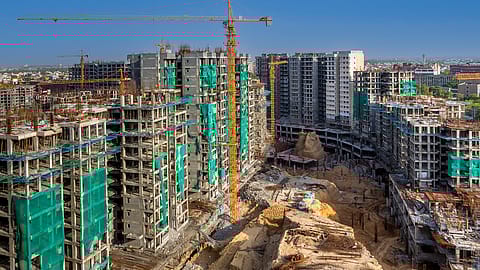
The Mumbai Metropolitan Region and Bengaluru together accounted for 48% of total housing sales during the quarter. | Credits: Narendra Bisht
Middle East tensions weigh on housing sales; Q1 sees 7% sequential dip across top cities
India's residential real estate market experienced a 7% sequential dip in Q1 2026 due to Middle East tensions affecting buyer sentiment and input costs. Despite a 7% YoY sales increase, new launches outpaced sales, leading to a rise in unsold inventory. MMR and Bengaluru drove demand, while Chennai saw the steepest decline.
This summary is AI-generated, and Fortune India is not responsible for its content or any associated copyright issues.
According to ANAROCK data, housing sales across the top seven cities declined 7% QoQ to approximately 1,01,675 units worth ₹1.51 lakh crore in Q1 2026, compared with around 1,08,970 units valued at ₹1.60 lakh crore in Q4 2025.
The Mumbai Metropolitan Region and Bengaluru together accounted for 48% of total housing sales during the quarter. | Credits: Narendra Bisht
India’s residential real estate market saw a sequential slowdown in the first quarter of 2026, as geopolitical tensions in the Middle East weighed on buyer sentiment and input costs.
According to data from ANAROCK Group, housing sales across the top seven cities declined 7% quarter-on-quarter (QoQ) to approximately 1,01,675 units worth ₹1.51 lakh crore in Q1 2026, compared with around 1,08,970 units valued at ₹1.60 lakh crore in Q4 2025.
However, on a year-on-year (YoY) basis, sales rose 7%, supported by a lower base. In Q1 2025, about 93,280 units worth ₹1.42 lakh crore were sold. While sales value declined 5% sequentially, it registered a 6% annual increase.
MMR, Bengaluru drive demand
The Mumbai Metropolitan Region (MMR) and Bengaluru together accounted for 48% of total housing sales during the quarter. Chennai recorded the steepest sequential decline at 18% but also posted the highest annual growth at 31%.
Supply momentum continues
New launches remained resilient despite softer demand. The top seven cities saw approximately 1,26,265 units launched in Q1 2026, marking a 2% QoQ rise and a sharp 26% YoY increase.
MMR and Bengaluru led supply additions, contributing 51% of total new launches. While MMR saw a 6% sequential rise in supply, Bengaluru recorded a 7% increase. In contrast, Chennai, NCR, Kolkata, and Pune saw declines of 28%, 17%, 10%, and 9%, respectively. Hyderabad stood out with a 46% surge in new supply.
Inventory levels rise
With new launches outpacing sales, unsold inventory increased 4% QoQ and 7% YoY, rising from about 5.77 lakh units at the end of Q4 2025 to over 6.01 lakh units by the end of Q1 2026.
Among major cities, Bengaluru saw the highest quarterly increase in unsold stock at 12%, followed by Hyderabad at 7%.
War impact visible on sentiment
Commenting on the trends, Anuj Puri said the short-term impact of the Middle East conflict was evident in the housing market. “While the long-term fundamentals of India’s residential segment remain strong, the 7% dip in sales reflects war-induced uncertainty. Rising oil prices and construction costs, particularly in March, impacted sentiment and buying activity,” he said.
Puri noted that demand from Middle Eastern investors, who form a significant buyer segment in Indian real estate, slowed amid geopolitical uncertainty.
A notable shift this quarter was the reversal of the post-pandemic trend, where housing sales had consistently outpaced new launches. “New launches have begun to exceed sales, leading to a build-up in unsold inventory, which has risen both sequentially and annually,” Puri added.
RANK
COMPANY NAME
REVENUE
(INR CR)
(INR CR)
{{#current-rank}} {{current-rank}} {{/current-rank}} {{^current-rank}} {{rank}} {{/current-rank}} {{name}} {{#revenue}} {{revenue}} {{/revenue}} {{^revenue}} {{noi}} {{/revenue}}
Key markets dominate launches
MMR, Hyderabad, Bengaluru, Pune, and NCR together accounted for nearly 92% of total new supply in Q1 2026, underscoring their dominance in India’s residential real estate landscape.
Frequently Asked Questions
Explore the world of business like never before with the Fortune India app. From breaking news to in-depth features, experience it all in one place. Download Now