Mitigata raises $15 million in Series B, banks on cyber resilience moving from IT concern to boardroom priority
/ 2 min read
Bengaluru startup’s unified cyber resilience and insurance platform draws fresh backing from Bessemer as enterprises treat digital risk as a board-level financial issue
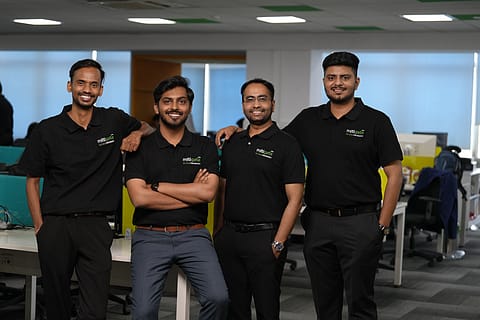
(L-R) Mayank Morya, Mohit Anand, Sarthak Dubey, and Akshit Kaushik, Co-founders of Mitigata
Bengaluru-based cyber resilience startup Mitigata has raised $15 million in a Series B funding round led by Bessemer Venture Partners, less than a year after its previous fundraise, as enterprises increasingly look beyond traditional cybersecurity tools and towards broader risk management and cyber insurance solutions. The round also saw participation from existing investors Nexus Venture Partners, Titan Capital and WEH Ventures.
Founded in 2023 by Mohit Anand, Sarthak Dubey, Mayank Morya and Akshit Kaushik, Mitigata combines cybersecurity, compliance and cyber insurance into a single platform. The company says it now supports over 800 organisations, has triaged more than one million security incidents over the past 12 months, and recorded 12x year-on-year growth. The company has also grown revenue from around ₹3 crore to nearly ₹40 crore over the past two years, according to Anand.
For Anand, the idea behind the company came from a problem the founders faced while scaling their previous startup overseas. “When we tried to take it outside India, customers started asking for cyber insurance, GDPR compliance and security controls. We went to every vendor in India, and even the big firms could not deliver everything that we needed,” Anand told Fortune India.
That experience led the founders to rethink cybersecurity not as a collection of products but as a broader business problem. “We just needed to be cyber resilient as a company. I don’t care about cybersecurity products whether it’s one or that one. It’s just about having cyber resilience as a company,” he said.
“We are not selling our products. We are not selling services. We are selling cyber resilience.”
Cyber insurance gains traction
Mitigata’s approach comes at a time when cyber insurance adoption remains relatively low in India despite rising cyber threats and the growing use of artificial intelligence.
According to Anand, India’s cyber insurance market has expanded from around ₹600 crore in premiums two years ago to nearly ₹1,500 crore today, growing at roughly 30% annually.
Yet awareness remains limited. “There are publicly listed entities with more than ₹50,000 crore market cap that don’t have cyber insurance,” he said. Anand believes enterprises are beginning to treat cyber risk as a financial issue rather than just a technology problem. He cited the example of a listed hospital chain that increased spending on cybersecurity, compliance and insurance from less than ₹50 lakh annually to nearly ₹9 crore over three years.
“The problem with India right now is that we are in our awareness phase. Boards cannot take a decision because they don’t understand the attached financial risk,” he said.
As India’s cybersecurity startup ecosystem becomes increasingly crowded, Anand argues Mitigata’s advantage lies in the data it collects across the entire cyber risk lifecycle—from risk assessment and underwriting to incident response and insurance claims. The company says that feedback loop allows it to continuously refine how cyber risk is measured and managed.
The fresh capital will be used to scale Mitigata’s AI-powered security operations business, invest in product development and research, and support expansion into international markets, including the Middle East and North Africa region.
{{#most-powerful-women-snapshot-individual.slug}} {{/most-powerful-women-snapshot-individual.slug}} {{^most-powerful-women-snapshot-individual.slug}} {{/most-powerful-women-snapshot-individual.slug}} {{#showRanking}} {{current-rank}} {{/showRanking}} {{#photo.0.url}}
{{name}}
For Bessemer Venture Partners, the bet is on a category that extends beyond traditional cybersecurity tools. “The accelerating number of AI-driven malicious attacks, combined with a severe shortage of cybersecurity talent, has resulted in a perfect storm for Indian enterprises,” said Pankaj Mitra, Partner at Bessemer Venture Partners.
Follow Fortune India
NEXT STORY