Not all that Mukesh Ambani touched turned gold
/ 3 min read
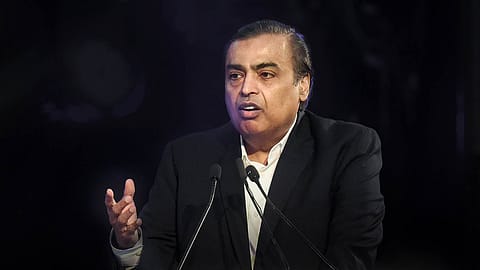
RIL Chairman Mukesh Ambani | Credits: Fortune India
Not all that Mukesh Ambani touched turned gold
Mukesh Ambani's investment ventures reveal a mixed track record. While successes like Jio and Asian Paints highlight his strategic acumen, other acquisitions such as Just Dial and Alok Industries have struggled to meet market expectations. Despite significant investments, some companies continue to face challenges, underscoring that not all of Ambani's ventures have turned to gold.
This summary is AI-generated, and Fortune India is not responsible for its content or any associated copyright issues.
From Just Dial to Asian Paints, Reliance Industries’ acquisition playbook reveals that the Ambani premium does not always translate into market gains—though a few bets have delivered outsized returns
RIL Chairman Mukesh Ambani | Credits: Fortune India
Billionaire Mukesh Ambani is often credited with a midas touch when it comes to begin large businesses—he proved it with Jio, built Reliance Retail into a formidable force, and is now investing heavily in renewable giga factories. In his 22 years at the helm of Reliance Industries (RIL), he has entirely acquired or picked up partial stakes in several companies, either to strengthen core operations or to seed new ventures. Yet, it is less talked about that the stock market has not always rewarded the Ambani connection.
Take Just Dial. Reliance Retail Ventures (RRVL) made an open offer at ₹1,022.25 per share in October 2021. Today, the stock trades at around ₹642. Investors remain sceptical about the company’s growth prospects in its core local search and SME advertising businesses. While Just Dial reported a profit of ₹584.2 crore in FY25, a significant portion—about ₹342 crore—came from treasury operations, aided by its substantial cash and investment reserves of ₹5,700 crore as of December. Interestingly, RRVL had spent roughly ₹5,700 crore to acquire about a 64% stake in the company.
In another case, RIL, along with JM Financial ARC, spent ₹5,050 crore in 2020 to acquire a majority stake in bankrupt textile manufacturer Alok Industries through insolvency proceedings. RIL currently holds a 40% stake. Despite Alok’s large capacities and vertical integration from yarn to garments, the strategic backing has not translated into a turnaround. Even after capital infusion, debt reduction and operational restructuring, losses have mounted, and the share price continues to hover near its lows.
Investment spread
The acquisitions of Den Networks and Hathway Cable & Datacom were aimed at strengthening Jio’s position in broadband and cable distribution. The ₹5,230 crore twin takeover in early 2019 was later folded into the group’s media business. In 2020, RIL consolidated TV18 Broadcast, Den Networks and Hathway Cable & Datacom with Network18 Media & Investments. Yet, Den and Hathway have continued to languish at subdued market valuations. The flagship media business has also struggled to find favour with investors, with the stock falling over 20% in the past year.
In 2017, RIL acquired nearly a 25% stake in Balaji Telefilms, led by Ekta Kapoor, for around ₹413 crore. The investment was intended to bolster content creation, particularly for the OTT platform ALTBalaji, and strengthen Jio’s content offerings. RIL’s holding has since reduced to about 21%. The stock, which had peaked above ₹180 in July 2017, now trades near ₹90. The group also holds about a 5% stake in HFCL, another laggard. The company has reported negative revenue and profit CAGR over the past three years. Although recent reports point to financial improvement, the stock is still down 19% over the last year.
The story of EIH, however, stands apart. The late PRS Oberoi’s hotel chain has nearly tripled in value since the Ambanis entered in 2010. Oberoi had brought in RIL as a white knight to ward off a hostile takeover threat from ITC, then led by YC Deveshwar. The Oberoi family sold a 14.12% stake to a Reliance investment arm for ₹1,021 crore. Today, Nita Ambani and Manoj Modi sit on the board of EIH, and the investment has bettered the value.
Asian Paints investment is another success saga. RIL acquired a 4.9% stake in January 2008 for around ₹500 crore. After holding it for about 17 years, the company exited in June 2025 for over ₹7,700 crore, booking a massive profit.
So RIL's takeover track record, therefore, is not a uniform tale of alchemy. While some bets turned into blockbusters, others test the investor patience.
Follow Fortune India
NEXT STORY