Ola Electric’s shifting narratives
/ 10 min read
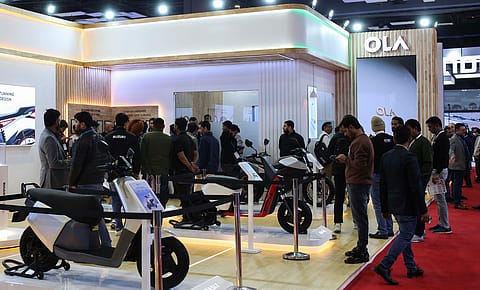
Ola Electric was cutting its EBITDA break-even target—the monthly sales volume at which the business would stop bleeding money—from 50,000 scooters to 25,000. | Credits: Sanjay Rawat
Ola Electric’s shifting narratives
Ola Electric has been shifting its break-even targets, reducing them from 50,000 to 15,000 units in just three quarters, reflecting a pattern of changing narratives to suit declining numbers. Despite initial promises, the company has faced significant revenue and market share losses, raising concerns about its long-term viability and management strategies.
This summary is AI-generated, and Fortune India is not responsible for its content or any associated copyright issues.
When the story keeps changing, ask what the numbers are saying.
THIS STORY FEATURES
Ola Electric was cutting its EBITDA break-even target—the monthly sales volume at which the business would stop bleeding money—from 50,000 scooters to 25,000. | Credits: Sanjay Rawat
It was a summer afternoon, and I was in the back of a car, laptop open, one earbud in, listening to Ola Electric’s Q4FY25 earnings call. My six-year-old was in the seat next to me, reviewing his tables. We were on the way back from his therapy session. I was listening to the post-earnings analyst call while typing my story for the next day’s edition when I heard this number.
Ola Electric was cutting its EBITDA break-even target—the monthly sales volume at which the business would stop bleeding money—from 50,000 scooters to 25,000. I stopped typing, waiting to see if I misheard the company’s management in the rush to finish the story. (EBITDA is earnings before interest, taxes, depreciation, and amortisation, a key metric for evaluating a company’s core operating performance and cash flow profitability.) As it turned out, I had heard right.
“As a result of cost savings, as well as our network project Vistaar, the break-even point of our auto business segment, EBITDA, has now come down to almost 25,000 units from earlier what we had communicated,” Ola Electric founder, chairman and MD Bhavish Aggarwal told investors, adding that the company was on track to hit 25,000 unit sales in either June or July 2025.
The language was fluent and confident. By the end of the call, several analysts seemed satisfied. Journalists filed stories. Everyone moved on. But the number stuck with me.
Then recently, this happened again. In the earnings call after releasing the Q3FY26 numbers, the company said its break-even target had fallen to 15,000 units a month. That’s a reduction of 70% in three quarters. The company now calls this a “structural reset”.
Reading between the numbers
This is not the first time the company has tried to change the narrative to suit the numbers. There is a pattern to this kind of decline. It has grammar. The pivot to margins when volume falters, because a ratio can improve even as the absolute numbers deteriorate. The reframing of retreat as a strategy. The moving goalpost shifted just often enough to remain perpetually within reach. Strip away the management commentary from Ola Electric’s seven earnings calls since the company listed in August 2024, and you can watch this grammar at work, quarter by quarter.
A detailed questionnaire shared with Ola Electric did not elicit a response. The story will be updated in case the company responds.
Building narratives
Revenue has fallen from ₹1,644 crore in Q1FY25—Ola Electric’s first earnings since its listing—to ₹470 crore in Q3FY26, a decline of more than 70% over seven quarters. Deliveries of its two-wheelers have fallen sharply from more than 125,000 units to less than 33,000 units during the respective quarters. As a result, the company’s market share has fallen from around 49% of India’s electric two-wheeler market in June 2024 to around 6% in January 2026, pushing it to fifth place behind TVS Motor, Bajaj Auto, Ather Energy, and Hero MotoCorp, according to VAHAN data.
The net loss in the nine months of FY26 is ₹1,333 crore. The company has been burning through the ₹5,275 crore it raised at IPO in August 2024 at a pace that has prompted its auditors to draw attention to the going concern assumption embedded in the accounts.
“We draw attention to Note 4 to the unaudited consolidated financial results of the Group, which explains the management’s assessment of its going concern assumption and its assertion that, based on the estimated cash flow projections made by it, the Group will continue as a going concern and will be able to discharge its liabilities and realise its assets, for the foreseeable future. Our conclusion is not modified in respect of this matter,” the auditor mentioned in the Q3FY26 earnings report. Similar notes were made in Q4FY25 and then Q1FY26 earnings reports.
The language is careful and technical, as auditor language always is. But the implication is not. Essentially, the auditors have felt it necessary to tell investors that the company’s ability to survive rests on projections the company has made about itself—and that they, the auditors, are neither endorsing nor disputing those projections. In the grammar of financial disclosure, it is one step short of pulling the alarm outright.
{{#most-powerful-women-snapshot-individual.slug}} {{/most-powerful-women-snapshot-individual.slug}} {{^most-powerful-women-snapshot-individual.slug}} {{/most-powerful-women-snapshot-individual.slug}} {{#showRanking}} {{current-rank}} {{/showRanking}} {{#photo.0.url}}
{{name}}
It got worse. Emkay Global on February 16 downgraded the company to “sell” from “buy” and cut its target price, highlighting that the company has swung from a net cash position of ₹160 crore in H1FY26 to net debt of ₹670 crore as of 9MFY26.
Needless to say, the markets have been spooked, and the share price has taken a toll. It breached the psychological barrier of ₹30 and closed trading on Monday, February 16, at ₹28.83. The slide continued through the week to hit historic lows and closed on Friday at ₹26.58. The stock has fallen 65% from its listing price of ₹76 and a staggering 83% from its post-listing peak of ₹157 in August 2024.
None of this appears, in quite this form, in the management’s presentation of events. What appears instead is a story, which keeps changing. Over seven earnings calls, certain themes recur, evolve, and then quietly disappear, replaced by new ones better suited to the latest set of numbers.
Take market share, for example. The original story, told at IPO, was a growth story. “Almost one in two electric two-wheelers sold in India was an Ola vehicle,” Aggarwal told analysts in August 2024. By Q2FY25, the share had fallen by 15 percentage points to around 33%. When a Bank of America analyst pointed out that volumes were down quarter-on-quarter, Aggarwal told her to look at a “broader time horizon” and said the company would aim to grow volumes “around 50%” year-on-year. That growth never arrived. By Q4, the framing had changed: the top three players were now “equal, give or take”. By Q2FY26, Aggarwal told analysts the company didn’t “mind a little bit of market share loss to other guys who are actually buying market share”. By Q3, the number was no longer disclosed. “We don’t worry about short-term market share,” Aggarwal said. From “one in two” to “we don't worry about it” in seven quarters.
The same arc played out across every metric Ola Electric has touted. Volumes, distribution, the gigafactory—each followed the same trajectory of ambitious promise, quiet revision, and eventual retreat reframed as strategy.
Big promises, slowing sales
In Q1FY25, Ola delivered 125,000 scooters, the highest ever. By Q2, Aggarwal was telling analysts to expect 50% annual volume growth. By Q3, volumes had started falling. In Q1FY26, Aggarwal offered a full-year volume outlook of 325,000 to 375,000 vehicles, but hedged it as “more an outlook than a hard guidance”. In the nine months of FY26, the company has delivered 153,538 vehicles, less than 50% of the lower end of the sales outlook.
In the latest quarter, Ola Electric produced 72,500 units but delivered only 32,670. That’s a production-to-delivery ratio of roughly 2.2:1—meaning for every scooter delivered, another 1.2 were manufactured and sitting somewhere. Management frames this as a gigafactory ramp-up producing cells for future deployment.
It also didn’t give any volume guidance. The word “growth” had been replaced in the company’s vocabulary by “operating leverage”—the idea that fixed costs would stay flat while any uptick in volumes would flow straight to the bottom line. It is a fine theory. All it requires now is the uptick. January sales stood at around 7,500 vehicles—down 69% from 24,413 units in January 2025—almost half of the fourth-placed Hero MotoCorp, one-fifth of TVS Motors at the top of the list. In the first two weeks of February, it has slipped to sixth, behind Ampere, according to VAHAN data.
Then there is distribution. In Q2FY25, Aggarwal announced a push from 780 company-owned stores to 3,000 outlets, including the ones owned by network partners. Within a year, the network was pared to roughly 700—fewer than when the expansion began. The cost, at least ₹120 crore in capital expenditure by the company’s own estimate, had been sunk into a retail footprint that no longer exists. On the Q2FY26 call, Aggarwal said “the number of stores is less important”. It had been very important two quarters earlier.
The gigafactory
The gigafactory, though, is the most revealing example. At IPO, it was the centrepiece of Ola Electric’s pitch. Phase 1A—1.4 GWh of cell manufacturing capacity—was built. The roadmap was 5 GWh, then 6.4, then 10 and beyond. Of the ₹5,275 crore raised at IPO, ₹1,228 crore was earmarked specifically for the expansion from 5 to 6.4 GWh. Each quarter brought a revision. Yields that were at 70% in Q3FY25 had regressed to “60-odd per cent” by Q4. Cell integration was delayed. The PLI timeline fell roughly five quarters behind the government's schedule. By Q1FY26, Aggarwal said the company didn’t “foresee the need to expand beyond 5 GWh over the next three years, at least”.
The redeployment of the IPO funds is now disclosed in the filings. The Q3FY26 earnings report shows the ₹1,228 crore originally allocated for the 5-to-6.4 GWh expansion has been reduced to zero. A new line item—repayment of subsidiary debt—has appeared at ₹395 crore. The money raised to build a gigafactory is being used, in part, to pay down debt and fund operating expenses. This is legal, disclosed, and approved by the board. It is also not what investors were told their money was for.
And then, the service crisis. In Q2FY25, when media reports suggested 80,000 to 90,000 service complaints a month, Aggarwal pushed back: “More than two-thirds were minor,” he said. Routine check-ins, customers confused by the software. In the fourth quarter, the company took a one-time provision of ₹250 crore to clean up accumulated warranty liabilities. In the latest call, Aggarwal said that “Brand trust will take its time to recover,” acknowledging what two years of earnings calls had been constructed to avoid saying: that the service failures had damaged the brand itself.
“There is no stakeholder—employees, customers, shareholders—who are happy with the company. The employees face a toxic work environment, leading to a high employee turnover. Customers have been unhappy with the product quality and servicing right from the product launch,” says Shriram Subramanian, founder and managing director of InGovern Research Services.
“Traditional two-wheeler manufacturers were slow off the blocks but have now developed good EV scooters and given their manufacturing, distribution, and servicing reach, have been able to catch up and overtake Ola Electric. There is no longer any first-mover advantage,” he says.
As for the shareholders, he says they only have themselves to blame. “Shareholders, be it institutional or retail, in the company have only themselves to blame for loss of their investment values,” says Subramanian. “Simple channel checks and readings would indicate that all is not well with the company.”
By Q3FY26, the story had its final, most polished form. The new CFO Deepak Rastogi, who replaced Harish Abichandani, opened the call with language that deserves to be read carefully: “This quarter marks a structural reset for Ola Electric as EV penetration growth slows down and we identified gaps in service execution. We made a deliberate choice to realign our retail footprint, cost structure, and operating model to a sustainable steady state. We chose to fix the fundamentals rather than optimise for short-term volume.”
The grammar of decline
Ola Electric is not the first company to tell this particular story. It will not be the last.
Unacademy is the closest recent parallel. As the edtech company’s revenue shrank after the pandemic, its founders spoke repeatedly of improving margins, a leaner organisation, and the best financial performance in the company’s history. The framing was accurate—margins were improving. But they were improving because the company had cut the costs attached to revenue it was no longer generating. Today, Unacademy has cash in the bank, but its core business has stalled, and the company has been forced to consider all options, including looking for a buyer.
None of this is unique to India, or to startups, or to this decade. But it is more visible in founder-led companies that went public on the strength of a vision—ambitious, forward-looking, slightly untethered from the present. The language that keeps remodelling even after the underlying facts have changed.
Ola Electric’s vision, at listing, was expansive: end the age of the internal combustion engine in Indian two-wheelers, build a vertically integrated technology company, scale a gigafactory to 10 GWh and beyond. Eighteen months later, the company’s ambition has contracted to surviving long enough to sell 15,000 scooters a month. The management calls this strategic repositioning.
In manufacturing, break-even normally falls when scale rises—fixed costs spread across more units. At Ola Electric, break-even has fallen because volumes have fallen. That is not scale economics. It is resizing.
And every quarter, the resize gets smaller, reflecting in its operating metrics getting worse, except for margins. But here is the thing, 100% of X is still smaller than 20% of 20X.
The latest narrative is energy storage. Aggarwal told analysts earlier this month that he “personally believes the energy storage business globally and in India will be a much bigger business than automotive”. The company has launched a home battery product called Ola Shakti and guided for ₹1,000–1,200 crore in energy storage revenue in FY27.
But the numbers require context. The company produced around 72,418 cells in Q3—roughly 7.2 MWh of output against an installed quarterly capacity of 625 MWh, a utilisation rate of just over 1%. The Indian inverter battery market is worth roughly $1 billion, dominated by lead-acid batteries that cost a fraction of what Ola Electric produces, made by companies with 100 times more dealerships and decades of track record. How Ola Electric will carve out 10% of this market is a question no one has answered yet.
Alongside a core business that is shrinking fast, it doesn’t bode well for the company.
“India does not have activist investors the way the US does. Here, promoters can get away with almost anything. All major shareholders have already exited. It is retail investors who are left holding the bag,” says an industry veteran, who asked not to be named.
He suggests there might be a strategic investment in the future.
“At a valuation of around $1.1 billion, the assets are attractive—a large assembly plant, a cell manufacturing facility,” he says. “Two-wheeler can be the foundation; from that, you can build a three-wheeler or a four-wheeler. A Suzuki, a Honda, even a large Indian conglomerate that wants to enter the EV space could acquire them.” But for any of this to happen, he is clear that the management has to change at the top.
Subramanian of InGovern agrees: “At some point soon, when the enterprise valuation becomes attractive, Ola Electric will become an acquisition target,” he says. “That would likely be a good outcome for investors as the company can be revived under new ownership and management.”
He also believes that for the company to arrest the decline, Aggarwal has to step down. “Any revival plan has to start with new Board members and new CEO and management team.”
Both converge on a version of the same future: professional management, brick by brick, possibly new ownership. Because if Ola Electric continues on its current trajectory—losing market share, burning cash, and redefining success every quarter to match a shrinking business—the next earnings call may not be about break-even at all. It may be about who owns the company.
(Pradip K. Saha is the author of 'The Learning Trap: How Byju's took Indian edtech for a ride'.)

Follow Fortune India
NEXT STORY