The FAQs are AI-generated, and Fortune India is not responsible for its content or any associated copyright issues.
India must reduce dependence on imported fuels, accelerate shift to domestic energy sources: PMO Advisor Tarun Kapoor
/ 2 min read
PMO advisor says energy security concerns and geopolitical uncertainties underscore the need for faster adoption of EVs, biofuels, hydrogen and other indigenous fuel pathways.
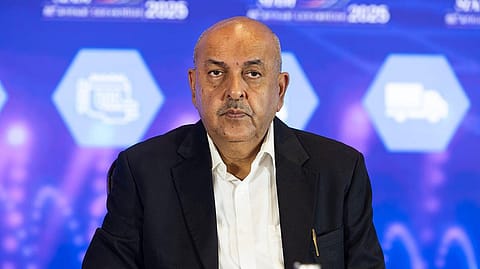
Tarun Kapoor, Advisor to PM | Credits: Sanjay Rawat
India can no longer afford to remain heavily reliant on imported fuels and must accelerate the transition towards domestically produced energy sources to strengthen long-term energy security, Prime Minister's Office (PMO) Advisor Tarun Kapoor said on Friday.
Speaking at the Society of Indian Automobile Manufacturers' (SIAM) sixth International Conference on "Climate Action: Accelerating India's Transition to a Low-Carbon Future", Kapoor said the transport sector would play a pivotal role in reducing India's vulnerability to external energy shocks.
His remarks come at a time when geopolitical tensions in West Asia have once again exposed the risks associated with heavy dependence on imported crude oil, prompting policymakers and industry stakeholders to push for greater diversification of the country's energy mix.
"The transport sector must play a central role in strengthening India's energy security. We cannot continue to depend on large-scale fuel imports and, over time, must move towards fuels that can be produced within the country," noted Kapoor.
Multiple pathways for cleaner mobility
Kapoor stressed that India's mobility transition would not be driven by a single technology. Instead, the country is pursuing a broad range of alternative fuel and clean-energy options, including biofuels, ethanol and isobutanol blends, flex-fuel technologies, compressed biogas, green hydrogen, LNG/CNG, electric mobility and synthetic fuels.
He added that coal gasification-based fuel pathways are also being explored as part of efforts to diversify domestic energy sources while advancing decarbonisation goals.
According to Kapoor, the three-wheeler segment is already well-positioned for rapid electrification, but adoption in the passenger vehicle segment needs to gather pace if India is to meaningfully reduce emissions and fuel-import dependence.
Industry seeks balance between growth and sustainability
The conference, organised on World Environment Day, brought together policymakers, automobile manufacturers, researchers and sustainability experts to deliberate on climate action, low-carbon mobility and the future of sustainable transportation.
Discussions focused on decarbonisation across the automotive value chain, including alternative fuels, circular economy practices, recycling, resource efficiency and green manufacturing.
SIAM Executive Director Prashant K. Banerjee said the industry is navigating a period marked by climate concerns, air pollution and energy security challenges, but also sees significant opportunities in sustainable mobility.
"As the world's largest market for two-wheelers and three-wheelers, India has already demonstrated remarkable progress in sustainable mobility," Banerjee said.
{{#most-powerful-women-snapshot-individual.slug}} {{/most-powerful-women-snapshot-individual.slug}} {{^most-powerful-women-snapshot-individual.slug}} {{/most-powerful-women-snapshot-individual.slug}} {{#showRanking}} {{current-rank}} {{/showRanking}} {{#photo.0.url}}
{{name}}
At the same conclave, industry leaders highlighted the need for coordinated progress in policy, infrastructure, innovation and investment to support electrification, alternative fuels and sustainable manufacturing
Frequently Asked Questions
NEXT STORY