Pvt investment picking up, capital formation at 3-year high: DEA Secy
/ 3 min read
Revival in investment is taking place against the backdrop of a challenging global environment, Thakur said
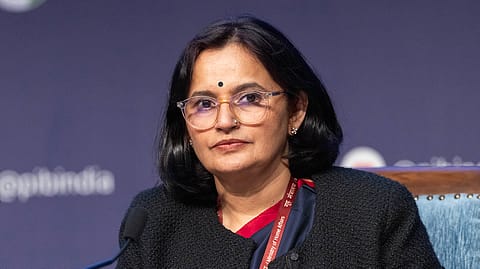
Anuradha Thakur, secretary, DEA | Credits: Narendra Bisht
Private investment in India is showing signs of a strong revival, with capital formation in the first quarter of the current financial year growing at its fastest pace in more than three years, Economic Affairs Secretary Anuradha Thakur said on Sunday.
Speaking at the Kautilya Economic Conclave here, she said private companies are committing to new projects, particularly in sectors such as power, data centres and metals, while bank credit to industry, large and medium enterprises, and micro and small businesses is also gaining momentum.
"We have seen with dismay that private investment is not picking up but now, the results are beginning to show. Investment is once again leading growth," Thakur said.
She said the revival in investment is taking place against the backdrop of a challenging global environment, where capital remains constrained.
Stressing that India attracted a record gross FDI inflow of USD 97 billion in FY26, Thakur said the momentum has continued in the current financial year as well and the first quarter gross FDI inflows were about USD 30 billion.
She expressed confidence in India's ability to attract investment, saying credibility built through sustained fiscal discipline, reforms and deregulation would remain an important strength.
"Measures can be announced, but credibility that our country has earned is one that is gained through sustained efforts," she said, stressing the importance of a consistent and prudent fiscal path.
Thakur also highlighted the durability of India's international economic partnerships, pointing to the signing of several free trade agreements (FTAs) in the last few years.
"We have followed this path through steady reform, prudent macroeconomic management," she said, adding, "The Centre's fiscal deficit has come down from a high of 9.2 per cent of GDP just five-six years back to a budgeted 4.3 per cent this year, and the fiscal anchor is moving in tune with global trends towards a declining debt-to-GDP ratio."
Besides, she said inflation targeting, NPAs at multi-decadal lows, strong forex reserves and rating upgrades in the last few months are indications of robust fundamentals.
These are the foundations for any country that hopes to borrow at a reasonable price when capital is scarce and expensive, she said.
{{#most-powerful-women-snapshot-individual.slug}} {{/most-powerful-women-snapshot-individual.slug}} {{^most-powerful-women-snapshot-individual.slug}} {{/most-powerful-women-snapshot-individual.slug}} {{#showRanking}} {{current-rank}} {{/showRanking}} {{#photo.0.url}}
{{name}}
Thakur expressed hope that the rules of the game will still play out and countries will recognise that the durability of partnerships with fair rules around the globe will help everyone move forward and boost global growth.
Her comments come against the backdrop of renewed uncertainty in global trade, amid US tariff measures and the growing use of trade policy to advance economic and strategic objectives.
Thakur also flagged the changing nature of the global capital landscape, saying growing geostrategic considerations in trade could affect the efficiency of global flows of goods and capital.
"When trade is organised around security and geostrategic concerns over comparative advantages, goods and capital move less efficiently," she said, adding that trade surpluses and deficits could increasingly become sources of friction and push up the cost of capital globally.
She said the investment cycle linked to artificial intelligence (AI) is also emerging as an important factor influencing the global demand for capital.
"The AI investment cycle is not limited to software or computing. It requires data centres, semiconductors, reliable electricity and transmission capacity," she said.
Thakur noted that investments in these areas are creating significant additional demand for capital and are increasingly being financed through debt.
"More investments would mean greater demand for savings, while higher borrowing means that financial markets have to absorb a large supply of debt," she said.
Thakur said global bond yields could therefore no longer be understood solely through the lens of monetary policy and fiscal deficits, as the changing composition of investment and rising capital requirements are also becoming important factors shaping financial markets.
Her remarks come amid a significant rise in bond yields across the globe in the last seven to 10 days, driven in part by heightened geopolitical uncertainties.
Speaking at a session at the conclave, former Finance Commission chairman N K Singh said society has the right to require of every public agent an account of his administration.
"All citizens have the right to ascertain by themselves through representatives the need for a public tax to consent to it freely to follow up on its use and to determine its proportion, basis, collection and duration," he said
Follow Fortune India
NEXT STORY