Rising fuel costs may trigger broader inflationary pressure across sectors, says Crisil
/ 2 min read
Freight transport accounts for nearly 54% of India’s total logistics costs while road or land transport represents 71% of total freight movement, making the sector especially sensitive to fluctuations in fuel prices.
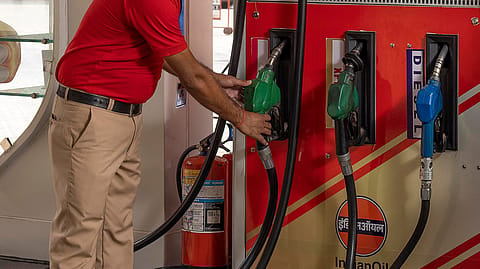
The report highlights the consequences of energy inflation extend beyond traditionally energy-intensive sectors. | Credits: Narendra Bisht
Higher fuel prices are beginning to ripple across India’s economy through transportation costs, with land transport emerging as the most vulnerable among key core input sectors due to its extensive linkages across industries, according to a latest report by Crisil.
The report highlights that transport acts as one of the primary transmission channels through which fuel inflation spreads across the economy, amplifying cost pressures well beyond energy-intensive industries.
Freight transport accounts for nearly 54% of India’s total logistics costs while road or land transport represents 71% of total freight movement, making the sector especially sensitive to fluctuations in fuel prices. Fuel alone contributes 42% of road transport costs, according to a study by the National Council of Applied Economic Research (NCAER).
As fuel prices rise, transportation costs have already started increasing. For producers, however, the larger concern is the secondary impact—higher input costs resulting from elevated freight and logistics expenses.
Crisil noted that transportation costs are captured in the Supply and Use Tables (SUT) through trade margins, which ultimately become part of product pricing. Several critical sectors are particularly exposed to this cost escalation, including mined inputs such as coal and iron ore, agricultural commodities, chemical products, and construction materials, including cement and ceramics.
The report identifies multiple industries that are not only directly exposed to energy shocks but also function as essential suppliers to other sectors of the economy. Core input sectors such as land transport, mining (especially iron and metal ores), agriculture, chemicals, rubber, and plastic products are among those most vulnerable to rising energy costs.
Higher energy prices are expected to push up the cost of these inputs, creating second-order inflationary effects across the production chain.
As a result, producers face a dual challenge: direct cost pressures from crude oil, petroleum and gas, and indirect pressures arising from higher prices of transport, chemicals and other intermediate goods. Crisil said understanding these downstream linkages is critical to assessing the broader economic impact of energy shocks.
The report highlights the consequences of energy inflation extend beyond traditionally energy-intensive sectors. Costlier transport and chemical inputs are likely to spill over into a wider range of industries.
At one end of the spectrum is oil refining, where more than 80% of inputs are exposed to energy-related cost pressures, although the sector contributes only around 1% to India’s gross value added (GVA).
At the other end are sectors such as financial services, real estate and professional services, which together account for nearly one-fourth of GVA but remain relatively insulated from energy-related input costs.
{{#most-powerful-women-snapshot-individual.slug}} {{/most-powerful-women-snapshot-individual.slug}} {{^most-powerful-women-snapshot-individual.slug}} {{/most-powerful-women-snapshot-individual.slug}} {{#showRanking}} {{current-rank}} {{/showRanking}} {{#photo.0.url}}
{{name}}
Overall, sectors facing elevated cost pressures account for 17% of India’s GVA, Crisil said. Companies operating in these sectors may attempt to pass on higher costs to consumers where demand conditions allow; otherwise, profit margins are likely to come under pressure.
The report also noted that although dependence on natural gas has risen over time, petroleum continues to remain the dominant energy input due to its broad linkages across sectors.
According to the SUT framework, crude oil and petroleum products account for 8.4% of intermediate consumption across the economy, compared with 1% for natural gas. This suggests that a prolonged increase in crude oil prices would have a significantly larger and more widespread impact on production costs and inflation than a similar shock in natural gas prices.
NEXT STORY