SMRs and private participation in nuclear energy have more hurdles to cross: experts
/ 4 min read
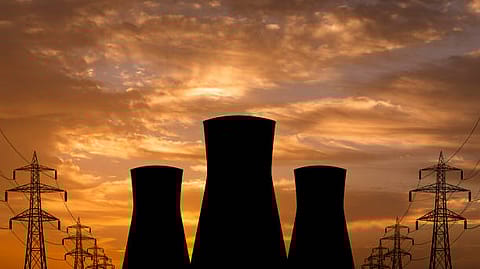
Small Modular Reactors (SMRs) are fission reactors with a capacity of up to 300 MW or less | Credits: Getty Images
SMRs and private participation in nuclear energy have more hurdles to cross: experts
India's SHANTI Bill, 2025, aims to modernize the nuclear legal framework, allowing limited private participation. Despite this, experts predict private nuclear projects will face delays due to technology, cost, and land challenges. The government targets 100 GW nuclear capacity by 2047, with SMRs playing a key role, but private sector involvement remains uncertain.
This summary is AI-generated, and Fortune India is not responsible for its content or any associated copyright issues.
India’s nuclear programme was originally governed by rules framed in 1948 and later by the Atomic Energy Act, 1962
Small Modular Reactors (SMRs) are fission reactors with a capacity of up to 300 MW or less | Credits: Getty Images
With Parliament passing the Sustainable Harnessing and Advancement of Nuclear Energy for Transforming India (SHANTI) Bill, 2025, India has begun consolidating and modernising its nuclear legal framework to enable limited private participation under regulatory oversight. However, industry experts caution that private nuclear projects are unlikely to materialise for at least the next two to three years due to factors like technology adoption, viability and cost concerns, land acquisition challenges, and long gestation periods.
The SHANTI Bill, 2025
India’s nuclear programme was originally governed by rules framed in 1948 and later by the Atomic Energy Act, 1962, which vested exclusive control of atomic energy with the Central Government, ensuring strict regulation over research, development, and use of nuclear materials. Amendments introduced in 1986, 1987 and 2015 gradually expanded participation to government companies and joint ventures in nuclear power generation.
The Civil Liability for Nuclear Damage Act, 2010 established a no-fault liability regime to ensure compensation in the event of nuclear incidents. That legislation aimed to clarify responsibility while building public trust by prioritising safety and accountability.
With India’s nuclear energy programme maturing and the need to increase the share of nuclear power in clean energy goals, the Government has now introduced the SHANTI Bill to allow a greater role for private players. The new Bill consolidates various aspects of nuclear development into a single, comprehensive framework and seeks to create a more streamlined and future-ready system. It adopts a forward-looking approach to shaping India’s long-term energy pathway.
Currently, nuclear power contributes only about 3% of India’s total electricity generation. In 2024–25, its share stood at 3.1%, with an installed capacity of 8.78 gigawatts (GW). With indigenous 700 MW and 1,000 MW reactors and international cooperation, capacity is projected to rise to 22.38 GW by 2031–32. The Government’s long-term target is 100 GW of installed nuclear capacity by 2047.
“Nuclear power will now be open to participants beyond the Central Government and its entities through the introduction of a transparent licensing framework, supported by an appropriate and independent regulatory architecture to enable efficient governance and competitive determination of tariffs,” said Anujesh Dwivedi, Partner, Deloitte India.
SMRs: a new nuclear energy concept
Small Modular Reactors (SMRs) are fission reactors with a capacity of up to 300 MW or less. They can be manufactured centrally in factories and transported to sites for installation. Compared to conventional nuclear plants—which typically take 5–10 years to construct—SMRs can be deployed and commissioned much faster.
SMRs are seen as a promising technology for industrial decarbonisation, particularly where a reliable and continuous power supply is required. They can be located at brownfield sites, including repurposed fossil-fuel plants, in off-grid areas, or as captive power sources for energy-intensive industries where large nuclear plants are not feasible. Modular construction also helps reduce construction time, industry sources said.
Globally, there are more than 80 SMR designs and concepts at various stages of development, some of which are considered near-term deployable. According to the International Atomic Energy Agency (IAEA), four SMRs are currently in advanced stages of construction in Argentina, China and Russia, while several countries are undertaking SMR research and development.
{{#most-powerful-women-snapshot-individual.slug}} {{/most-powerful-women-snapshot-individual.slug}} {{^most-powerful-women-snapshot-individual.slug}} {{/most-powerful-women-snapshot-individual.slug}} {{#showRanking}} {{current-rank}} {{/showRanking}} {{#photo.0.url}}
{{name}}
India’s SMR plans
As part of its 100 GW nuclear energy target for 2047, the Union Budget 2025–26 allocated ₹20,000 crore for the design, development and deployment of SMRs. The Government aims to have at least five indigenously designed SMRs operational by 2033.
The Bhabha Atomic Research Centre (BARC) has been entrusted with designing and developing the 200 MWe Bharat Small Modular Reactor (BSMR-200). The reactor is based on proven pressurised water reactor technology and uses Slightly Enriched Uranium (SEU) as fuel. The lead unit is proposed at the Tarapur Atomic Power Station site in Maharashtra.
In addition, BARC is developing a 55 MWe SMR-55, with its lead unit also proposed at Tarapur, as well as high-temperature gas-cooled reactors of up to 5 MW thermal capacity for hydrogen generation.
Responding to a recent Parliament question, the Department of Atomic Energy (DAE) said that funds have been allocated under the Nuclear Energy Mission for R&D of the BSMR-200, which is at an advanced stage of obtaining administrative and financial sanction.
The Government has also announced plans to partner with private players for deploying 220 MW Bharat Small Reactors (BSRs). Accordingly, the Nuclear Power Corporation of India Limited (NPCIL) has issued a Request for Proposal (RFP) under the existing legal framework, inviting Indian industries to participate in setting up BSRs for captive power generation. The aim is to provide industries with a sustainable, low-carbon energy solution to support decarbonisation.
Interest from private players
Companies such as Tata Power, Adani Power, Reliance Industries, Larsen & Toubro (L&T), JSW Energy, Hindalco and Jindal Steel have expressed interest in participating in the SMR programme. However, many believe it will take at least two to three more years for the sector to evolve before private SMR projects take off.
Industry executives cite unresolved concerns, including project feasibility, technology risks, land acquisition challenges and resistance from local communities to nuclear facilities. Nuclear power also remains one of the most capital-intensive energy sources, with costs estimated at ₹16–20 crore per megawatt, compared with ₹3–5 crore per MW for solar and wind power.
“The sector faces inherent challenges, including extremely high capital cost (₹16–20 crore per MW), long gestation periods and plant stabilisation-related issues. Private firms lack an operational track record in this domain, raising concerns over execution risks and tariff competitiveness,” said Ankit Jain, Vice President and Co-Group Head, Corporate Ratings, ICRA Limited.
That said, several Indian private companies already have experience working with NPCIL, the sole operator of India’s nuclear power plants. These include Larsen & Toubro, which manufactures key components such as steam generators and end shields and undertakes largescale EPC work; Hindustan Construction Company (HCC), which has expertise in building nuclear plants and related infrastructure; and component manufacturers such as Walchandnagar Industries, MTAR Technologies and Patels Airtemp.
Follow Fortune India
NEXT STORY