The FAQs are AI-generated, and Fortune India is not responsible for its content or any associated copyright issues.
T-Hub launches third cohort of ORBIT SpaceTech Accelerator, onboards 13 startups
/ 2 min read
T-Hub noted that the emergence of Skyroot Aerospace as India's first SpaceTech unicorn underscores Hyderabad's growing importance in the country's space innovation ecosystem.
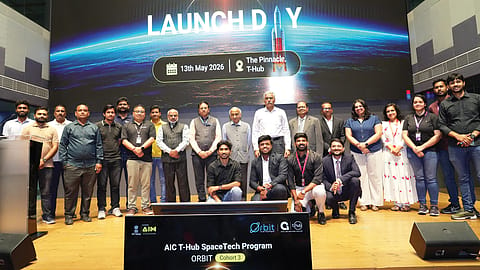
The new cohort comprises Sanyark Space Technologies, Trishul Space, Kessler Dynamics, Velotrax, Zoove Space, Space OS, Humanity Space, Landlens, STAR Labs, Red Balloon Aerospace, Astro Voltaics, Orbit Grid and Nibiaa Devices.
T-Hub, which describes itself as the world's largest home for startups, has launched the third cohort of ORBIT, its AIC T-Hub SpaceTech accelerator programme, inducting 13 startups developing technologies across key segments of the space sector.
The new cohort comprises Sanyark Space Technologies, Trishul Space, Kessler Dynamics, Velotrax, Zoove Space, Space OS, Humanity Space, Landlens, STAR Labs, Red Balloon Aerospace, Astro Voltaics, Orbit Grid and Nibiaa Devices.
The startups are working on a range of critical technologies, including propulsion systems, orbital servicing, sovereign compute, satellite intelligence, space-based energy systems, satellite connectivity, and downstream geospatial solutions.
According to T-Hub, the cohort includes founders with experience across the Indian Space Research Organisation (ISRO) and the country's growing private space ecosystem, including former ISRO scientists and professionals from leading SpaceTech companies.
As part of the accelerator programme, participating startups will receive access to industry experts, investors, former ISRO leaders and veterans from India's space sector through specialised masterclasses, mentorship programmes and industry engagement opportunities.
The launch comes at a time when India's SpaceTech sector is witnessing strong growth, driven by increasing private sector participation, rising investor interest, and growing global attention. Hyderabad has emerged as a key hub for the sector, with a growing number of startups operating across the space value chain.
T-Hub noted that the emergence of Skyroot Aerospace as India's first SpaceTech unicorn underscores Hyderabad's growing importance in the country's space innovation ecosystem.
Speaking at the launch, A. S. Kiran Kumar, former chairman of ISRO, said the pace at which startups are building capabilities in India's space sector is encouraging. “Platforms like ORBIT are playing a critical role in enabling founders and strengthening India’s SpaceTech capabilities for the future,” he said.
Kavikrut, Chief Executive Officer of T-Hub, said India's SpaceTech ecosystem is entering an important growth phase. “Through ORBIT, we aim to provide startups with access to the expertise, networks and opportunities they need to scale and contribute to India’s expanding space economy,” he said.
With the induction of the third cohort, ORBIT has now supported 36 SpaceTech startups since its inception. T-Hub said its broader SpaceTech initiatives have engaged with more than 100 startups operating across the sector.
The accelerator's impact is already becoming visible, with startups from previous cohorts collectively raising around ₹30 crore in funding and generating 18 published intellectual property assets.
{{#most-powerful-women-snapshot-individual.slug}} {{/most-powerful-women-snapshot-individual.slug}} {{^most-powerful-women-snapshot-individual.slug}} {{/most-powerful-women-snapshot-individual.slug}} {{#showRanking}} {{current-rank}} {{/showRanking}} {{#photo.0.url}}
{{name}}
Among the notable successes, Cosmoserve secured $3.17 million in pre-seed funding, Spantrik completed the test flight of its vertical take-off and vertical landing (VTVL) demonstrator "Hopstone", Research Sat confirmed a payload mission to the International Space Station (ISS) scheduled for November 2026, and Nalwa Aero became the first Indian company to receive Directorate General of Civil Aviation (DGCA) Design Organisation Approval for a five-seater eVTOL aircraft.
Follow Fortune India
Frequently Asked Questions
NEXT STORY