Simone Tata: The Lady Who Saw Tomorrow
/ 3 min read
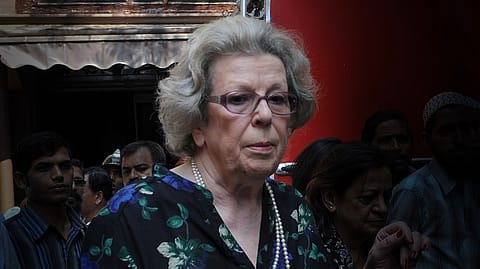
Simone Tata: 1930-2025 | Credits: Getty Images
Simone Tata: The Lady Who Saw Tomorrow
Simone Tata, a visionary in India's beauty and retail sectors, transformed Lakmé into a household name and pioneered the retail brand Westside. Her leadership and business acumen not only empowered women but also reshaped India's retail landscape. Her legacy is a testament to the power of entrepreneurship and understanding opportunity cost.
This summary is AI-generated, and Fortune India is not responsible for its content or any associated copyright issues.
Simone Tata’s true legacy lies not in the creation of Lakme and Westside but in demonstrating what true entrepreneurship is all about
Simone Tata: 1930-2025 | Credits: Getty Images
“An interesting point: beauty is the best incentive to self-respect. You may have great inner resources, but they don’t show up as confidence when you don’t feel pretty. People are more apt to believe you and like you when you know you look fine. And when the world approves, self-respect is just a little easier. The pursuit of beauty is honorable.”
This extract from Estee Lauder’s autobiography, Estée: A Success Story, beautifully captures the very philosophy that continues to shape the world of cosmetics and fashion. And if the pursuit of beauty is indeed honourable, then the late Simone Tata should be remembered as the woman who gave beauty a contextual aspiration for women empowerment in an India that was just coming to terms with its independent destiny.
A Swiss descendant, Simone Dunoyer went on to become Simone Tata following her marriage with Naval Tata, two years after her first visit to India as a tourist in 1953. While embracing her role in the Tata family, both as stepmother to Ratan Tata and mother to Noel Tata, Simone also chose to chart an entrepreneurial path of her own.
While Lakme came into being in 1952, Simone, was instrumental in creating a growth path for Lakmé, when she took over as the managing director in 1961, and later on as its chairperson in 1982. She brought in her sense of beauty, aesthetics and business acumen. Under her stewardship, the company created products suited for Indian skin tones and preferences, which helped it become a trusted household name. There were several firsts under her tenure, including Lakme setting up its first salon in India in 1980 and celebrity endorsement by the-then TV celebrity Nisha Singh, who featured in popular TV shows Idhar Udhar (1985), Buniyaad (1987) and the likes.
While the sale of Lakme to Hindustan Lever in 1996 for Rs 200 crore was a turning point, the thought process behind the sale reveals a trait of Simone Tata that is less spoken about. In an interview post the sale, Simone said that while Lakme was closest to her heart, she had a fiduciary responsibility to shareholders, an instinct just goes to show that she was not only entrepreneurial but also followed a principled leadership.
The sale was a bittersweet moment for Simone channelled the proceeds to acquire the British retail chain Littlewoods, which was reborn as the lifestyle retail brand Westside, the flagship of Trent Ltd, a company she helmed as chairperson until she stepped down in 2006.
To say she was a visionary who helped shape India’s evolving retail culture would be an understatement. She understood precisely when the inflection point was approaching. As she noted in the same interview: “It was my idea to get into retailing; not so much that of the House of Tatas. I think retailing is the business of the future because it is unexploited territory. It is not well-organised today; there are no retail chains. Although there are a lot of boutiques specialising in some areas, general retailing is not developed here.”
The fact that Trent today commands a valuation of over Rs 1.48 lakh crore, with Westside contributing more than Rs 5,800 crore in revenue, and that Lakmé, which posted Rs 349 crore in sales and Rs 18 crore in PAT in FY25, was sold when it was, only underscores a deeper truth: entrepreneurship is as much about holding on to your dreams as it is about understanding opportunity cost. It is a trait only a few, like Simone Tata, truly master.
While an autobiography from her would have offered even greater insight into her life and decisions, perhaps the idea that some stories are better inferred than told is one Simone Tata may well have approved of.
R.I.P. Our Fair Lady
Follow Fortune India
NEXT STORY