Tier II and III cities drive nearly half of Myntra’s international brand demand
/ 4 min read
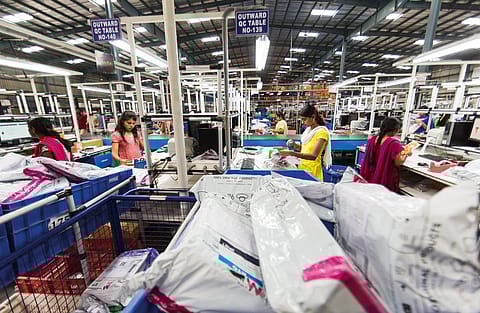
Behind the scenes at a Myntra-Jabong warehouse; Photo by Narendra Bisht
Tier II and III cities drive nearly half of Myntra’s international brand demand
Myntra reports a significant shift in demand for international fashion brands, with nearly 45% now coming from Tier II and III cities in India. This trend highlights the growing influence of non-metro consumers in the premium fashion market, driven by rising disposable incomes, urbanization, and internet penetration, reshaping global brands' strategies in India.
This summary is AI-generated, and Fortune India is not responsible for its content or any associated copyright issues.
Rising affluence, Gen Z-led awareness and faster delivery are pushing global fashion beyond metros, reshaping how international brands approach the India market.
Behind the scenes at a Myntra-Jabong warehouse; Photo by Narendra Bisht
Global fashion brands have moved beyond metro cities in India. Nearly 45% of demand for international brands on online fashion retail platform Myntra now originates from Tier II and III cities, signalling a structural shift in where premium fashion consumption is emerging in India, according to data from Myntra. What was once a metro-led market for global labels is increasingly being driven by non-metro consumers, reshaping how international brands view India as a growth geography.
India’s lifestyle market, valued at approximately $130 billion in 2024, is projected to grow at a rate of 10–12% annually to reach $210 billion by 2028, according to a report by Myntra and Bain from August 2024. While metros continue to account for a large share of premium spending, the next phase of growth is coming from cities such as Jaipur, Lucknow, Surat, Indore, and Guwahati—markets that were earlier seen as secondary to global fashion strategies.
“India represents one of the most compelling opportunities for international fashion and beauty brands today, and what is particularly striking is the premium demand emerging beyond metros,” says Venu Nair, Chief of Strategic Partnerships and Omnichannel at Myntra.
Rising disposable incomes in non-metro India are a key driver, says Nair. A large proportion of the young population, rising urbanisation, growing affluence, and deeper penetration of the internet have expanded discretionary spending power beyond large cities, he adds. As a result, premiumisation—long associated with metros—has begun to travel inland.
The parallel shift from unorganised to organised retail has further accelerated this trend. E-commerce platforms have reduced the traditional disadvantages of geography, giving consumers in smaller cities access to the same international brands, assortments, and pricing as metro shoppers.
Demographics reinforce the shift. India has one of the youngest populations globally, with Gen Z forming a large and increasingly influential consumer cohort. These consumers are exposed to global fashion trends through social media, streaming platforms, and creator-led content, narrowing the awareness gap between metros and non-metros.
“We are one of the youngest countries in the world, with a very large Gen Z population that is highly aware of global brands,” says Nair. “That awareness is no longer confined to metros.”
Discovery has moved decisively online. Influencers, micro-creators, and customer-generated content now shape brand discovery, particularly in Tier II and III markets where physical access to international brands remains limited.
Myntra’s creator-led formats and customer reviews have helped international brands build trust faster in these markets, especially in beauty and skincare as well beyond apparel. International beauty has emerged as one of the fastest-growing segments on the platform, growing at 2.5 times the pace of the broader online luxe beauty market. Within this, K-beauty has recorded nearly 200% year-on-year growth, driven largely by Gen Z and millennial consumers, says the platform.
“Customers increasingly trust people who have actually used the product,” says Nair. “That credibility matters far more than traditional advertising in premium categories.”
Fashion has traditionally been a planned purchase category, but faster delivery is beginning to change buying behaviour. Myntra’s M-Now service, which enables deliveries starting in 30 minutes in select cities, has expanded quick commerce into fashion and beauty—particularly for essentials, gifting, and occasion-led purchases.
{{#most-powerful-women-snapshot-individual.slug}} {{/most-powerful-women-snapshot-individual.slug}} {{^most-powerful-women-snapshot-individual.slug}} {{/most-powerful-women-snapshot-individual.slug}} {{#showRanking}} {{current-rank}} {{/showRanking}} {{#photo.0.url}}
{{name}}
Nearly half of international brand orders on Myntra are now delivered within 48 hours through its M-Express service, while over 50 international fashion and beauty brands are currently available on M-Now, the brand says. “Speed and access play a critical role in accelerating premium consumption,” says Nair. “It shortens the decision cycle and increases repeat behaviour.”
For international brands, such delivery timelines remain uncommon in most global markets, positioning India as an outlier in combining scale with speed.
Quick commerce for premium fashion can be margin-intensive, especially in non-metro markets. Myntra offsets this through a hybrid fulfilment model that combines dark stores with an omnichannel network of over 5,600 partner stores across 350 brands in over 170 cities.
Orders are fulfilled from the nearest available store or node, improving inventory efficiency while reducing logistics costs. Demand forecasting and data-led curation allow assortments to be tailored city by city rather than relying on uniform national trends.
“The advantage we have is data,” says Nair. “We can see what customers in each market are responding to and curate accordingly.”
In non-metro markets, top-performing international brand categories include sweatshirts, T-shirts, dresses, denim, and shirts—suggesting a move beyond functional purchases to style-led consumption, says Myntra.
For international labels such as NEXT and MANGO, Myntra functions as more than a distribution platform. The company manages brand entry end-to-end, including assortment planning, pricing, marketing, content creation, and, in some cases, offline expansion.
Technology underpins this approach. AI-driven personalisation, computer vision-based recommendations, and size-and-fit tools help reduce friction—particularly important for international brands whose sizing standards differ from Indian norms.
“Helping customers get the right fit the first time is critical to building confidence in global brands,” says Nair.
For global fashion companies, India is increasingly shifting from a secondary expansion market to a core growth market. Even among the country’s top 250–300 million consumers, per capita fashion consumption remains significantly below that of Southeast Asian peers, leaving considerable room for growth.
As consumption moves from need-based to occasion-led purchasing across fashion, footwear, accessories, and beauty, India’s scale, digital penetration, and improving logistics are becoming central to global brand strategies.
“India is probably the last large frontier for global fashion brands,” says Nair. “Consumption levels are rising, but the headroom for growth is still substantial.”
What was once a metro-led narrative is now decisively pan-India. Tier II and III cities are no longer catching up—they are shaping the next phase of global fashion growth in India.
NEXT STORY