Transforming a wasteland into the world’s largest renewable energy city in Khavda
/ 6 min read
How sunlight, wind and vision are turning one of India’s most remote frontiers into a global energy landmark.
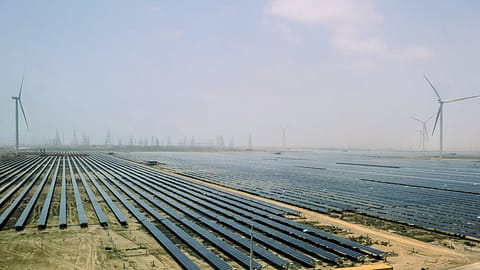
Credits: Sanjay Rawat
Khavda is one of the most remote and little-known villages in Gujarat’s vast Kutch district—a windswept landscape of barren earth with brown mud and useless bush vegetation, endless horizons, and scattered small hamlets that have learnt to coexist with one of the country’s harshest environments.
Distance defines life in Khavda. The district headquarters of Bhuj lies 115 km away, while Kutch’s other major centres, including Mundra, are nearly 190 km distant. National Highway 341 provides the lone arterial connection to Bhuj, cutting through an unforgiving terrain where nature dictates the rhythm of life.
Yet beyond its stark geography lies a region of extraordinary contrasts. A short drive along State Highway 45 leads to one of India’s most mesmerising natural seasonal spectacles—the White Rann of Kutch. Spanning nearly 7,500 sq. km, this vast salt marsh undergoes a dramatic transformation each winter, turning into a shimmering expanse of white desert, which glitters in the moonlight.
Every year, thousands of visitors converge on this surreal landscape for the celebrated Rann Utsav. Luxury tent cities emerge from the wilderness, while the desert comes alive with folk music, cultural performances and vibrant displays of local craftsmanship. The festival showcases Kutch’s rich artistic heritage, including the intricate beauty of Bandhani tie-dye textiles and Kalamkari art, traditions that have survived centuries and continue to define the region’s cultural identity.
Fighting a harsh life
Away from the festival grounds, however, life remains a daily contest against nature. Agriculture is sparse, limited to scattered patches of bajra and jowar that struggle to take root in saline soil. Vast stretches of barren mudflats dominate the landscape, offering little vegetation and even less respite from the extremes of climate. Summers are blistering, winters can be severe, and a small amount of rain turns the desert into a swamp. Cyclones and storms during the monsoon and extreme winter are also a part of the lives of the people in Kutch.
In these challenging conditions, small village communities depend largely on livestock for survival. Generations of pastoral families have adapted to the harsh terrain, developing a resilience as enduring as the desert itself. Dressed in brightly coloured kurtas and sherwanis that stand out against the muted earth tones of the landscape, the people of Kutch embody a rugged spirit forged by adversity.
Yet the region’s significance extends far beyond its rugged present. It occupies a remarkable place in India’s historical evolution. Over the centuries, the region has witnessed the rise and fall of powerful dynasties—from the Mauryas and Guptas to the Chavdas, Solankis, and the Samma Rajputs, better known as the Jadejas, and then the British rule and independent India. Each left its imprint on a land that has long served as a crossroads of trade, culture, and civilisation.
Perhaps the most striking reminder of this legacy lies just 30 km from Khavda. There stands Dholavira, one of the most important archaeological sites of the ancient Indus Valley Civilisation and now a UNESCO World Heritage Site. Dating back to around 2650 BCE, this fortified city is celebrated for its sophisticated urban planning, elaborate water conservation systems, and remarkable hydraulic engineering.
Battery Energy Storage Systems | Credits: Sanjay Rawat
From the past to the future—the world’s largest renewable energy city in the making
For centuries, Khavda stood at the edge of civilisation—a remote settlement surrounded by salt deserts, barren mudflats, and unforgiving climatic extremes. The scorching sun, fierce winds and arid landscape dictated the fortunes of the few communities that called this frontier region home.
Today, those very forces of nature are rewriting Khavda’s destiny. What was once considered an inhospitable wasteland is rapidly transforming into the world’s largest renewable energy city in a single location, turning one of India’s most isolated regions into a global symbol of the clean-energy transition.
The transformation is rooted in a simple reality: Khavda possesses some of the finest renewable energy resources anywhere in India. The region receives solar irradiation of around 2,060 kilowatt-hours per sq. m annually, while strong winds averaging eight metres per second sweep across its vast open plains. For generations, these natural elements were merely part of the harsh environment. Today, they have become valuable assets powering one of the most ambitious energy projects ever undertaken.
{{#most-powerful-women-snapshot-individual.slug}} {{/most-powerful-women-snapshot-individual.slug}} {{^most-powerful-women-snapshot-individual.slug}} {{/most-powerful-women-snapshot-individual.slug}} {{#showRanking}} {{current-rank}} {{/showRanking}} {{#photo.0.url}}
{{name}}
The journey began six years ago when the Gujarat government unveiled plans for the Gujarat Hybrid Renewable Energy Park, widely known as the Khavda Renewable Energy Park. It earmarked 72,600 hectares of largely barren land for solar and wind energy development. The vision was to generate between 30-42 gigawatts of renewable energy—enough electricity to power nearly 18 million Indian homes.
To realise this ambition, the state allocated land to some of the country’s largest energy developers, including Adani Green Energy (AGEL), NTPC, Gujarat Industries Power Company (GIPCL) and Gujarat State Electricity Corporation (GSECL). The Power Grid Corporation of India was entrusted with integrating the power generated at Khavda into the national transmission network.
Estimates projected investments of around ₹1.5 lakh crore and the creation of nearly 100,000 jobs. On December 15, 2020, Prime Minister Narendra Modi laid the foundation stone, formally launching a project that would soon attract global attention.
Construction and commissioning have gathered pace across the park. GIPCL is developing 2,375 MW of renewable capacity and has been allotted 4,750 hectares for hybrid energy projects. More than 600 MW has already been commissioned, say sources. NTPC Green Energy Limited recently declared the commercial operation of the final 105 MW tranche of its 1,200 MW Khavda-II Solar Project. Other developers, including NHPC, NTPC Renewable Energy and JSW Neo Energy, are also steadily expanding their presence.
Adani’s ambitions
Yet one developer towers over the rest in both ambition and scale.
Adani Green Energy is executing a mammoth 30 GW renewable energy project at Khavda—26 GW from solar power and 4 GW from wind energy. By 2029, the project aims to transform Khavda into the world’s largest power plant across all energy sources.
Spread across 538 sq. km—roughly five times the size of Paris and almost as large as Mumbai city—the project will deploy nearly 60 million solar modules and 770 advanced wind turbines. Once fully operational, it is expected to generate 87.4 billion units of clean electricity annually, enough to power around 17.4 million homes across India, from Kashmir to Tamil Nadu and from Gujarat to the country’s eastern frontier states like Tripura. The project is also expected to create more than 15,200 green jobs, contributing to regional economic development.
Work began in April 2023, and progress since then has been rapid. The first 551 MW of solar capacity was operationalised by February 2024. Today, nearly 10 GW of solar, wind, and hybrid energy capacity has already been commissioned at Khavda. During FY26 alone, AGEL added 2,974 MW of solar capacity and 683 MW of wind capacity.
A major milestone came in May when Adani Green Energy commissioned a cumulative 3.37 gigawatt-hour Battery Energy Storage System (BESS) at Khavda, which can store power and release it to the grid during peak hours. The facility is the world’s largest single-location battery storage deployment outside China and ranks among the fastest utility-scale battery storage projects ever executed globally. The entire project was completed within just 10 months of on-site construction beginning. The latest commissioning included an additional 1.37 GWh capacity added in March 2026.
Behind the scenes, multiple companies from across the Adani portfolio are contributing to what has become one of India’s most complex infrastructure undertakings.
Adani Energy Solutions has developed the transmission backbone required to evacuate power from the desert. Jash Energy supplies solar trackers that help maximise solar generation with bifacial 580 MW peak solar PV modules and horizontal single-axis trackers (HSAT). Waterless module cleaning robots counter dust accumulation on modules, saving 1716 million litres of precious water, required to clean the panels.
Adani New Industries manufactures advanced 5.2 MW specially designed wind turbines using German technology, among the largest onshore wind turbines deployed in India. The wind turbine foundations are specially designed with underground stone columns to overcome soil liquefaction challenges. Logistics support comes from Adani Ports & SEZ, while ACC and Ambuja Cement provide the enormous quantities of cement and concrete required for the project.
Operations are highly digital, with Virtual Reality (VR) powered safety kiosks, aerial imagery analytics, customised geo-tagging solutions and a digital twin to predict failures and detect equipment breakdown. Adani Infrastructure Management Services and the Adani Energy Network Operation Centre oversee data-driven monitoring and management, creating a sophisticated command-and-control ecosystem in the middle of the desert.
Equally remarkable is the emergence of entirely new infrastructure around the project. To support the energy city, Adani Infra is developing more than 200 km of optical fibre connectivity, 1,050 km of roads and 300 km of drainage infrastructure. Cellular towers have been erected, and a small airport is operational.
Around 12,000 engineers, technicians, workers, and support staff already live and work in the emerging settlement, which now offers essential amenities and services. In a region where habitation was once sparse and opportunities limited, a new ecosystem is taking root. What was once a desolate landscape is steadily becoming a fully functional industrial township, like how Adani transformed a barren Mundra into one of India’s finest port cities in less than two decades.
Khavda’s story is of a rare transformation—of how sunlight, wind and vision are turning one of India’s most remote frontiers into a global energy landmark. From the ancient ingenuity of nearby Dholavira to the futuristic solar arrays and wind turbines now rising across the desert, the region continues to make history. The winds that once swept silently across the salt plains are now powering homes, industries, and ambitions across a nation.
(The author was in Khavda at the invitation of the Adani Group.)
Follow Fortune India
NEXT STORY