Vice President stresses inclusive growth, policy flexibility amid global uncertainty
/ 3 min read
Vice President calls for inclusive growth and flexible policies to navigate global challenges.
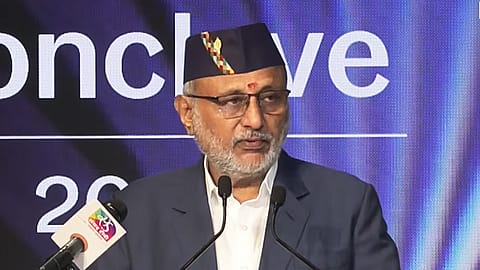
Vice President C.P. Radhakrishnan | Credits: Screengrab Sansad TV
Vice President C.P. Radhakrishnan on October 3 said India’s transition towards a developed economy can be meaningful only if economic growth is inclusive and its benefits reach every section of society and every region of the country.
Speaking at the inauguration of the fifth Kautilya Economic Conclave in New Delhi, Radhakrishnan said India was moving from a developing economy towards a developed one, but development could not be measured by economic growth alone.
“The mark of our development is how benefits reach all the sections of the society and every region of the country,” he said, adding that economic resilience could not be separated from social resilience.
India recorded real GDP growth of 7.8% in the first quarter of FY27, according to data cited in the speech. Radhakrishnan said India was going through a period of rapid change, with geopolitical tensions, shifts in global trade, technological advances and intensifying climate challenges making resilience increasingly important.
The theme of this year’s Kautilya Economic Conclave is ‘Resilience in an Age of Flux’.
Inclusion, formalisation central to India's resilience
Radhakrishnan pointed to financial inclusion, direct benefit transfers and formalisation as examples of how economic resilience could be strengthened from the ground up.
He cited the Jan Dhan-Aadhaar-Mobile (JAM) framework and said more than 590 million Jan Dhan accounts had been opened by August 2026. Cumulative direct benefit transfers had crossed ₹53.4 trillion, he said, arguing that the system had helped government benefits reach beneficiaries directly while improving transparency and reducing dependence on intermediaries.
“Inclusion can become an instrument of resilience,” he said, adding that resilience should not be viewed only through financial markets or large infrastructure projects.
“A resilient economy is not built only in the boardrooms, financial markets, and large infrastructure projects alone,” Radhakrishnan said. “It is also built when a woman in a village has a bank account, when a benefit reaches her directly, when a small enterprise enters the formal economy, when a self-help group becomes an enterprise, and when an enterprise generates a sustainable income.”
He also highlighted the Goods and Services Tax as a major step towards formalising the economy. GST, he said, replaced fragmented indirect taxation with a common national framework and digital compliance architecture. The number of registered GST taxpayers has risen from more than 6 million in 2017 to over 16 million by May 2026, he said.
Radhakrishnan also pointed to the role of self-help groups in expanding economic participation. Under the National Rural Livelihoods Mission, more than 9 million self-help groups cover over 100 million rural women, he said, adding that these groups were moving beyond savings and credit towards skills, entrepreneurship and market access.
{{#most-powerful-women-snapshot-individual.slug}} {{/most-powerful-women-snapshot-individual.slug}} {{^most-powerful-women-snapshot-individual.slug}} {{/most-powerful-women-snapshot-individual.slug}} {{#showRanking}} {{current-rank}} {{/showRanking}} {{#photo.0.url}}
{{name}}
He also highlighted the increasing role of women in India’s economic development, linking education and economic participation to women-led development.
“We want to empower the woman, give them the right education and they will empower themselves,” he said.
Radhakrishnan said more than 250 million Indians had moved out of extreme poverty over the past decade, calling it a significant achievement. He said India’s development journey showed that inclusion and economic growth could reinforce each other.
Policymaking must reflect ground realities
Radhakrishnan called for greater attention to ground realities while framing economic policy, particularly as the pace of global change accelerates.
“For making any policy, we always should understand the ground realities,” he said, adding that policymakers needed to remain flexible so that policies could adapt to changing circumstances.
He also argued that India’s democratic framework had supported the implementation and durability of economic reforms. While consensus-building could make the reform process gradual, it also helped build acceptance and made reforms more sustainable, he said.
“The process may sometimes be gradual, and sometimes we may lose our patience also inside, but we should never show it outside,” Radhakrishnan said.
He said India had demonstrated that democracy and economic growth could progress together and that consensus was important for taking reforms forward.
Looking ahead, Radhakrishnan said India’s resilience would also depend on strengthening its research ecosystem, human capital and collaboration with global institutions. He cited ongoing efforts to build academic partnerships between Indian and international institutions as part of this process.
He said the objective of India’s development journey should be to ensure that every state, district and village becomes both a participant and beneficiary of growth.
“In an age of flux, India’s resilience will come not from resisting change, but from embracing it with confidence, inclusion, and a free collective endeavour,” he said.
Follow Fortune India
NEXT STORY