WWDC 2026: Apple rebuilds Siri around AI as it seeks to close gap with rivals
/ 4 min read
With a privacy-first AI architecture and Visual Intelligence expanding beyond iPhone, Siri AI adds writing tools, cross-device conversation history and richer voice capabilities in Apple’s biggest assistant overhaul yet
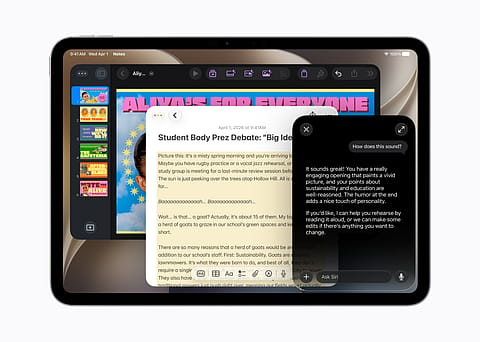
All new Siri
Apple has unveiled Siri AI, an entirely new version of its digital assistant powered by Apple Intelligence, in what marks the company's most ambitious artificial intelligence announcement to date and a critical step in its effort to catch up with rivals that have surged ahead in the AI race.
Announced at the company's Worldwide Developers Conference (WWDC) 2026, Siri AI represents a ground-up rebuild of Siri. Apple says the assistant combines personal context understanding, web knowledge, onscreen awareness, visual intelligence and system-wide app actions, transforming Siri from a voice assistant into a more capable AI agent.
"We're excited to introduce Siri AI, a dramatically more capable and conversational assistant designed to help users find information and get things done throughout the day," said Craig Federighi, Apple's senior vice president of Software Engineering.
"With access to broad world knowledge for up-to-date answers on virtually any topic, along with onscreen awareness and personal context understanding, Siri AI can help users take action across apps more naturally than ever."
The announcement comes nearly two years after Apple first previewed a more personalised Siri experience. Since then, the company has faced growing scrutiny over delays in rolling out advanced AI capabilities while competitors including OpenAI, Google and Anthropic accelerated development of conversational assistants.
Siri gets personal context and app actions
At the centre of the update is Siri's ability to understand a user's personal context. Apple says Siri AI can retrieve information from messages, emails, photos and files to answer questions or complete tasks. Users can ask Siri to find a restaurant recommendation shared by a friend in a message thread, retrieve a hotel confirmation number from an old email, or locate photos from a recent trip.
The capability will extend beyond Apple's own applications. Through integrations with Spotlight, developers will be able to make information from third-party applications accessible to Siri's personal context engine.
Apple is also expanding Siri's ability to take action across apps. Users can ask the assistant to draft emails, edit and share photos, organise information across applications and perform multi-step tasks without switching manually between apps.
A major addition is Siri's ability to access broad world knowledge from the web. Unlike previous versions of Siri that largely relied on directing users to search results, Siri AI can retrieve up-to-date information and generate detailed responses. Apple says users can ask questions on virtually any topic and continue the interaction through follow-up conversations.
Dedicated Siri app and conversation history
The company has also introduced a dedicated Siri app that stores conversation history and allows users to revisit previous interactions. Conversations will sync privately through iCloud, enabling users to move between iPhone, iPad, Mac, Apple Watch and Apple Vision Pro without losing context.
Users will also be able to access Siri AI from across Apple's ecosystem. On iPhone, Siri can be invoked through the side button or Dynamic Island. On Mac and iPad, the assistant is integrated into Spotlight, while on Apple Vision Pro it appears as a spatial interface that users can place anywhere in their surroundings.
{{#most-powerful-women-snapshot-individual.slug}} {{/most-powerful-women-snapshot-individual.slug}} {{^most-powerful-women-snapshot-individual.slug}} {{/most-powerful-women-snapshot-individual.slug}} {{#showRanking}} {{current-rank}} {{/showRanking}} {{#photo.0.url}}
{{name}}
Visual Intelligence expands beyond the iPhone
Apple is further broadening the role of Visual Intelligence, one of the flagship features introduced under Apple Intelligence. On iPhone, a new Siri mode inside the Camera app allows users to point the camera at objects, documents or surroundings and ask questions about what they see. Siri can then provide information or take actions based on the visual input.
For the first time, Visual Intelligence is also coming to iPad, Mac and Apple Vision Pro. On Mac, users can invoke the feature through a dedicated keyboard shortcut and ask questions about content displayed on their screens. On Vision Pro, users can simply look at objects or app windows and ask Siri for information.
Apple showcased use cases ranging from identifying objects and obtaining nutritional information about food to splitting bills with friends and interacting with content visible on a device screen.
AI-powered writing tools built into Siri
The company is also integrating AI-powered Writing Tools directly into Siri. Users can generate drafts, rewrite text, make edits and receive proofreading suggestions across the system. In Mail and Messages, Siri can adapt generated content to reflect a user's typical writing style, tone and formatting preferences for specific recipients.
Apple says Siri will also automatically proofread content while users type, including within many third-party applications.
Privacy-first AI architecture
Underpinning the experience is a new Apple Intelligence architecture that combines on-device AI processing with Private Cloud Compute. Apple says requests requiring additional computing power can be handled in Apple's cloud infrastructure without storing user data or making it accessible to the company.
The new architecture also introduces Apple's next-generation foundation models, which operate both on-device and through Private Cloud Compute. Siri AI additionally uses Apple's system orchestrator to access capabilities such as Spotlight indexing and app actions while keeping sensitive user information on-device.
Apple also announced improvements to speech capabilities through its most advanced on-device AI model. Siri AI will offer more expressive voices, improved speech recognition and enhanced dictation that can automatically handle punctuation, formatting and capitalisation while users speak.
Availability
The new features are available for developer testing beginning today across iOS 27, iPadOS 27, macOS 27 and visionOS 27. Apple plans to release Siri AI as a beta later this year for users with supported devices configured in English, with additional languages expected to follow shortly after launch.
Follow Fortune India
NEXT STORY