72% of rural women can identify digital fraud; UPI adoption hits 77% among HNW women: DBS-Deloitte study
/ 2 min read
Survey of 1,342 women highlights rising digital financial adoption, with female entrepreneurs leading the shift
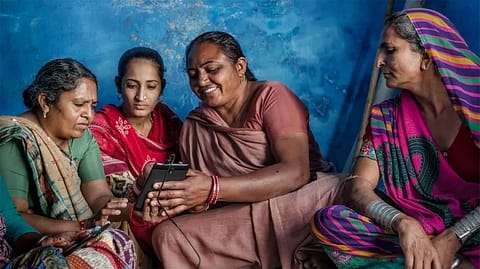
Younger SEWA members train older members using cellphones to expand their microbusinesses using digital payments. | Credits: Self Employed Women's Association (SEWA)
Women across India are becoming more confident participants in the digital financial ecosystem, with 72% of rural women earners surveyed saying they are confident of identifying digital fraud, according to the second edition of DBS Bank India's Women and Finance study, conducted in partnership with Deloitte Touche Tohmatsu India LLP. The findings also point to rising adoption of digital payments, banking and investment platforms across income groups.
The study, based on responses from 1,342 women across North, South, East and West India, found female entrepreneurs to be the most active users of digital financial tools, while high-net-worth (HNW) women and rural women earners are also increasingly embracing digital channels for payments, savings and investments.
Female entrepreneurs drive digital financial adoption
Digital payment tools were the most widely adopted financial solution among female entrepreneurs, with 84% of respondents using them. UPI usage stood at 72% among female entrepreneurs, 77% among HNW women and 54% among rural women earners, underlining the growing penetration of India's digital payments infrastructure.
The study also found that 38% of female entrepreneurs use digital loan and credit platforms, while 29% access brokerage platforms. Among HNW women, 28% actively use online brokerage platforms for investments.
" Among female entrepreneurs, digital tools are becoming increasingly integral to business management, supporting everything from payments, credit and payroll to customer acquisition and future planning. The study also underscores the importance of trust, convenience and accessibility in driving digital adoption," said Divyesh Dalal, Managing Director and Country Head, Global Transaction Services, Corporate Banking, Financial Institutions and SMEs, DBS Bank India.
Financial literacy boosts confidence against fraud
The report found a strong correlation between financial awareness and confidence in recognising digital fraud. Among female entrepreneurs who regularly consume financial content through newsletters, blogs, books and magazines, 61% said they were confident of identifying digital fraud.
Among HNW women, confidence rose to 73% for those who regularly consumed financial content, while 59% of those consulting financial advisors and 58% attending financial workshops also reported high confidence.
Dalal said sustaining the momentum in digital adoption would require financial institutions to build solutions beyond conventional banking. "As digital adoption deepens, entrepreneurs are increasingly seeking solutions that enhance operational efficiency and support their growth ambitions.
Sustaining this momentum requires going beyond traditional banking to create connected ecosystems that help entrepreneurs at every stage of their business journey. By deepening our understanding of this segment and continuing to innovate in response to evolving needs, we aim to help female entrepreneurs build and scale their businesses," he said.
The study also highlighted changing spending and payment preferences among women. Half of the female entrepreneurs surveyed use personal credit cards frequently, while 53% of HNW women identified credit cards as their second-most-used payment method after UPI.
Travel-related rewards, including hotel offers, air miles, lounge access and travel insurance, emerged as the most preferred credit card benefit, chosen by 65% of respondents. Business spending among female entrepreneurs was largely directed towards salaries (65%), marketing (53%) and technology investments (37%), while rural women primarily spent on raw materials (82%), rent (47%) and transportation (35%).
NEXT STORY