Academic centres of excellence are key to India’s growth story, say Pramath Raj Sinha, Ashish Dhawan of Ashoka University
/ 9 min read
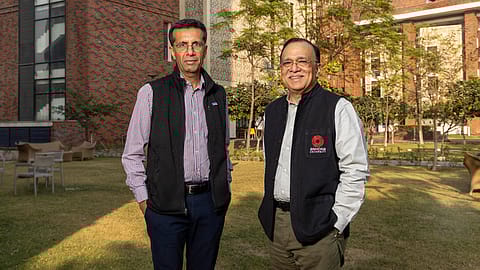
Ashish Dhawan (left), Founding Chairperson, Board of Trustees, Ashoka University; and Pramath Raj Sinha, Chairperson, Board of Trustees, Ashoka University. | Credits: Sanjay Rawat
Academic centres of excellence are key to India’s growth story, say Pramath Raj Sinha, Ashish Dhawan of Ashoka University
Pramath Raj Sinha and Ashish Dhawan of Ashoka University emphasize the need for India to focus on quality education and research to achieve Viksit Bharat by 2047. They advocate for interdisciplinary learning, equitable funding for private and public institutions, and a shift towards holistic education to prepare students for a rapidly changing world.
This summary is AI-generated, and Fortune India is not responsible for its content or any associated copyright issues.
How private institutions can play a role in strengthening the country’s academic core.
Ashish Dhawan (left), Founding Chairperson, Board of Trustees, Ashoka University; and Pramath Raj Sinha, Chairperson, Board of Trustees, Ashoka University. | Credits: Sanjay Rawat
India is firmly on the path to Viksit Bharat by 2047. With of one of the world’s youngest working populations, education and skilling are of utmost importance, especially higher education. In an exclusive interaction with Fortune India, Pramath Raj Sinha, Chairperson, Board of Trustees, Ashoka University and Ashish Dhawan, Founding Chairperson, Board of Trustees, Ashoka University, discuss what India needs to do on this journey, what needs to change, and preparing students for a VUCA world, among other things. Edited excerpts:
As India marches towards Viksit Bharat, what are the kind of changes you would like to see in the country’s education ecosystem?
Ashish Dhawan: In higher education, we’ve done a good job as a country in terms of increasing gross enrolment ratio quite a bit… to almost 28% now… 45-odd million students are in colleges and universities today, institutions, and we’ll probably go to 60 million in the next 10-15, years. That incremental growth… we went from 10 million to 45 million… was massification. Going from 45 to 55 or 60 is not the same rate of growth.
The focus now has to be on improving quality. [Many graduates]… don’t get a job or are unemployable…. How do we address that issue? The bottom half [of higher education institutes] needs to either get taken out through market forces and more and better institutions need to come up... it’s growth, but quality becomes more important. Two is, recognising the that the 21st century is different from the 20th century… and having 21st century skill sets [is important]. You’re going to be able to get that through AI or some tutor. But understanding how to think for yourself, being able to communicate well, being able to understand yourself, being able to connect the dots between different areas, I think that is really, really important. And so this idea of an interdisciplinary, holistic education [like at Ashoka], becomes even more important in the age of AI, in the 21st century… I think all of Indian higher education needs to move in that direction.
The third one is… If we’re going to have institutions that are more holistic, that are no longer siloed, this idea of having a separate regulator for technical institutes may not be necessary if we expect those technical institutes even to broaden, to become something bigger… we need a uniform sort of regulator as well, and I think a level playing field between private and public institutions.
Can you share some global instances from where policymakers can borrow?
If you look at the Carnegie classification of universities, there’s the research universities. In India, our minister has said, we want 20 universities in the Top 200 by 47. Now I will almost take a guess that out of those 20,10 are likely to be government and 10 are likely to be private. The government ones are the obvious ones—top IITs, Indian Institute of Science, etc, etc. The private ones are relatively new, so you don’t see the impact as yet, but the better private ones that have come up, that are not as commercial, that are also focussed on research... like in Ashoka… I think if we can create the right level playing field, so that research money goes equally… [to government and private institutes]… in the US, if you look at NSF (National Science Foundation) or NIH (National Institutes of Health), they don’t discriminate between a government institute and a private one... I think recognising that even our top institutions will have both private and public in the mix, so the government may invest money in in the public ones, but in terms of allocation of research money, it needs to be much more, I would say, equitable between private and public. And I think we need the right incentives, which is greater transparency of data, because most of the education will be in private institutions, already almost 65% plus of our students, two-thirds of our students in higher ed go to private. I think by 2047 it will be 75-80%. So the governance or regulatory mechanism needs to look at [offering incentives]… My solution for that would be greater autonomy, but in return, you have greater transparency and accountability.
What more needs to be done from the institutions themselves towards those particular goals?
Pramath Raj Sinha: One of the things is the whole area of research, and how that translates into the real world. You look at the great economies of the world. In different eras, the rise of universities coincided with the rise of those economies... Universities did great research. Some of that research got used very productively to give that country an edge. You see that happening in the US. All of the innovation around AI has come out of the US and out of the universities. Now you can see some of that happening in China, with the universities contributing to lithium batteries and EVs and collaborating with the Huaweis and the BYDs of the world. That, to me, is the linkage that you got to create.
But it’s a chicken and egg problem. I think today, industry doesn’t see universities in India as really contributing to what they are doing. They think that we are not capable of bringing about that quality of innovation. Nor is the university able to do that cutting-edge work.
If you look at this idea of the Top 20 universities, whether it is 10 public, 10 private, people over-invest in these few universities, disproportionately and at the expense of not being equitable. They say, let others not get the resources, but I will give all the possible resources to these 20 places and in fact, not be democratic and egalitarian. Now, that’s a tough call, which we have not taken.
{{#most-powerful-women-snapshot-individual.slug}} {{/most-powerful-women-snapshot-individual.slug}} {{^most-powerful-women-snapshot-individual.slug}} {{/most-powerful-women-snapshot-individual.slug}} {{#showRanking}} {{current-rank}} {{/showRanking}} {{#photo.0.url}}
{{name}}
What is the reason behind it?
Pramath Raj Sinha: I think it is our mindset… that we can’t give a disproportionate level of advantage to some people... It is seen as depriving the rest of the system and being unfair. It’s a very socialist mentality. But I don’t think in the current world it works that way, because you’re spreading your already meagre resources too thin.
Ashish Dhawan: I think the timing now may be right for this... the focus for the last 15 years was to spread IITs to every state... expand the number of IIMs... now is the right time to say, that let’s over invest in these 10-20 and really take them to the next level.
Pramath Raj Sinha: The second thing is what we call accreditation. In our country, accreditation is done entirely by this organisation called NAC... NAC was broken, now they have resolved to fix NAC, but it has not yet been fixed. If you look around the world, the accreditation system determines quality. There is a third-party accreditation that decides whether you are good or not… The regulator says that you need to have this quality… but the accreditor independently does an evaluation that then calls a spade a spade. Then true quality gets measured...
In the UK, and the US funding is tied to accreditation... so you are allowed to move up... They have an incentive, because the government says, ‘Look, if you can prove to the independent accreditor that you have become a four-star now, then I will give you more funding.’
Ashoka University | Credits: Sanjay Rawat
What are the focus areas at Ashoka University?
Ashish Dhawan: What people don’t know is that we have a fairly large scholarship programme... this year, it’s Rs 100-plus crore scholarship programme at the undergraduate level. I’m not counting masters PhD, just at the undergraduate level. And this coming year, for the next academic year, we’ve announced 500 scholarships—200 merit scholarships and 300 merit-cum-means scholarship. Everybody has to have a certain merit to anyway get in, but, and we were always merit-cum-means that you needed to have [merit to] get in but also demonstrate financial aid. For the first time, we’re doing both—we’ll have the merit-cum-means, but also pure merit scholarship.
Another big push has been [into sciences]... Ashoka was better known in humanities, social sciences... A lot of people don’t realise that we’re very, very strong in computer science, the sciences, mathematics, etc. Some of the top people from across the country have joined. In computer science, we handpicked some of the best people from across the country and hired a number of young scholars as well... PhDs from the US. And now we have a very exciting... CS plus X programme. So not only can you study computer science, but you can do computer science and mathematics, computer science and biology, computer science and philosophy, computer science and entrepreneur, many combinations...
Have we lost out on science graduates with so many people getting into engineering? And what are its ramifications?
Pramath Raj Sinha: Yes, I think so... the ramifications are that there are not enough people to do research... people who were passionate about science. When I was at IIT Kanpur in 1982-86, we used to get five physicists through JEE every year. They used to be the best rankers. Those physicists are now at TIFR... [The] point I’m making is that they were passionate, driven, science-loving [people]… I think we’ve lost that edge. There are still people who are interested. In fact, we are now getting some of those students here in our astrophysics, biology departments... we have to provide the opportunity for them to succeed. But for them to succeed, they also need to see cutting-edge stuff happening. I think there are enough people interested in science… So again, goes back to the point that you have to have excellence to attract people.
I'll give you an example. When I did my PhD in the US many years ago, I did robotics, but Canada had become very well known for building the robotic arm that used to sit on the space shuttle. And because of that, so many scientists, including me, went there because we were all excited about the opportunity to do something on the space arm.
I’m sure that because of ISRO’s success, a lot of people have become scientists. Or that women scientists are being so successful at ISRO, I’m sure, has gotten a lot of women into space... I think you have to show some of these successes. And it goes back to the point that in today’s day and age, things are so competitive that to be successful, you have to put disproportionate effort in one area and push it to become world leading, which then drives people to go into that sector.
How do you prepare your students for the VUCA world?
Pramath Raj Sinha: You can’t prepare in the same way that you were preparing before. Our mentality today is that this is what the future looks like. The future needs coders. So, to create coders, you create a computer science programme. Or tomorrow, India needs to send satellites into space, so I need to create electronics engineers. You know. Of engineers who will work on Mechanical Engineering, electronics, space, and they will be able to work in ISRO, and then I will launch a satellite. That whole logic is getting broken because, I don’t know what will happen tomorrow... and if you don’t, the definition of what will happen tomorrow, how will you extrapolate and decide on today? So, logic breaks down here.
Does that mean that you don’t know what to teach? I don’t think so. The larger logic is that we are going back to the time when, even in a Takshashila or Nalanda, people didn’t know what to educate for. When universities were first set up, they were not meant for skilling. Skilling was done in school. Universities are meant for people who can go beyond the immediate needs of the day, and they are equipped with those skills that allow you to deal with that VUCA of the future.
What were those skills? You ask the right questions, you understand what a problem is. What is the problem? Because new problems will come up. I don’t know what problem will come up. So, the ability to analyse and understand a problem, even if you have not seen it ever before, even if you have never been trained in it.
At Ashoka, we use a certain method to do that, which is called a liberal education, that teaches you the skill of learning to look at a problem with multiple lenses… You are able to do that because you have exposure to all these disciplines. The first thing you do in a liberal education is you expose students to multiple fields. The second thing you do is force them to choose what they want to study. Because then, you are forced to think...
So that teaches you to take responsibility for your actions, how to make choices, how to think about trade-offs, how to think about prioritisation. All that then comes through this education system, which we have here. And then on top of that, you teach them that try to make a difference to the world.
Follow Fortune India
NEXT STORY